GitHub hosts HunyuanVideo, Tencent's open-source framework for large-scale video generation models, enabling AI-driven video creation.

WatsonX.ai by IBM
$1Starting price
0Popularity
About WatsonX.ai by IBM
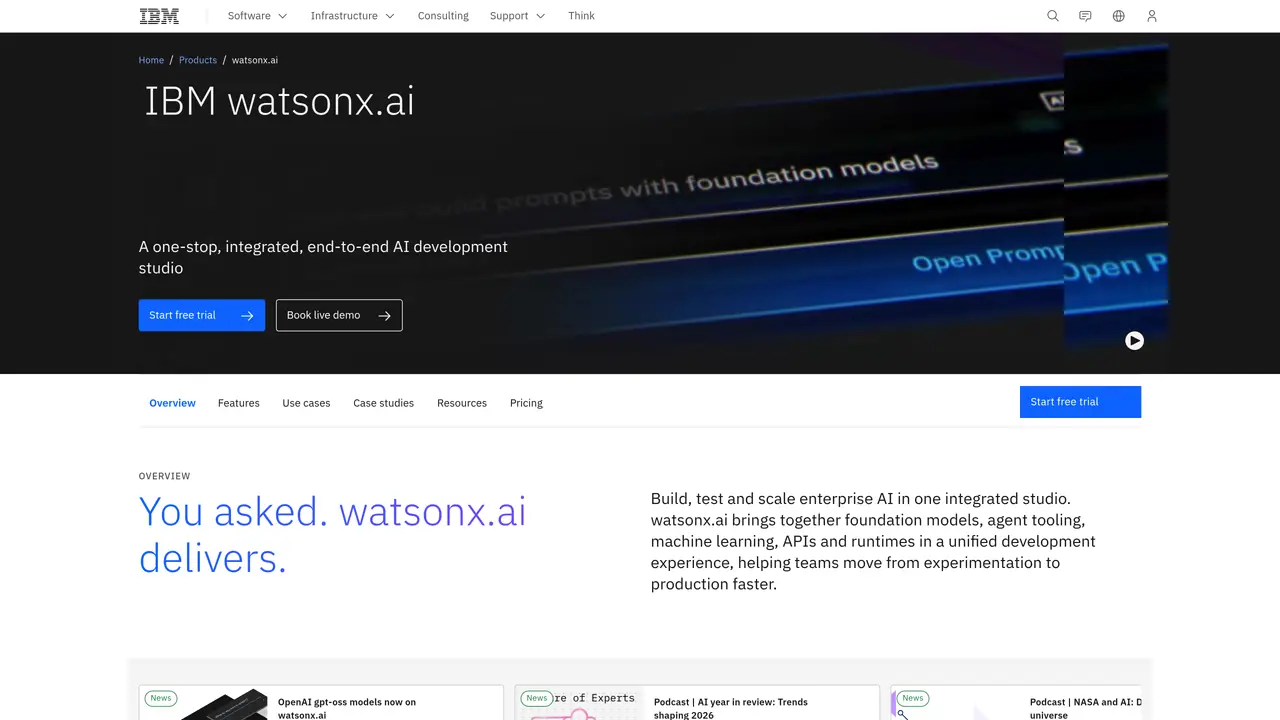
WatsonX.ai by IBM is a next-generation enterprise studio for AI builders that helps to bring together the best of generative AI capabilities and traditional machine learning into a powerful platform. It provides a comprehensive end-to-end solution to span the entire AI lifecycle from experimentation to deployment. With WatsonX, users can quickly create, train, and deploy AI models with ease. The platform also offers comprehensive tools to help AI builders gain real-time insights into their models and ensure that they are performing as expected.The intuitive interface of WatsonX makes it easy to use for anyone from data scientists to AI experts. With its built-in AI assistant, users can quickly access answers to frequently asked questions and tutorials to get started. Additionally, WatsonX offers the ability to integrate with other IBM AI-driven products such as Watson Studio, Watson Knowledge Studio, and Watson Discovery, as well as cloud-based storage and analytics solutions.
IBM
Armonk, United States · Founded 1911
- Founders
- Charles Ranlett Flint, Thomas John Watson, Sr.
- Founded
- 1911
- Headquarters
- Armonk, United States
- Legal status
- Public company
Key features
- Quickly create and deploy AI models
- Gain real-time insights into AI models
- Access answers to frequently asked questions and tutorials with AI assistant
- Integrate with other IBM AI-driven products
- Cloud-based storage and analytics solutions
Use cases
- Creating and deploying AI models for various applications
- Gaining real-time insights into AI model performance
- Accessing AI-related resources and support through the built-in assistant
Pros
- Unified end-to-end AI development studio spanning experimentation to production deployment
- Access to frontier foundation models, including OpenAI's open-source gpt-oss models
- Built-in tools for RAG development, model customization, and knowledge management
- Seamless integration with other IBM AI-driven products and cloud-based solutions
- Supports autonomous agent creation, conversational AI, and enterprise-grade automation
Cons
- May require technical expertise for advanced customization and deployment tasks
- Enterprise-focused features may introduce complexity for smaller teams or individual users
Frequently asked questions about WatsonX.ai by IBM
What is IBM watsonx.ai?
IBM watsonx.ai is an integrated enterprise AI development studio designed to help teams build, test, and scale AI solutions from experimentation to production. It combines foundation models, agent tooling, machine learning, APIs, and runtimes in a unified environment.
Who should use watsonx.ai?
The platform is intended for AI developers, machine learning engineers, data scientists, and business teams seeking to create, customize, and deploy AI models or agents using enterprise data. It supports users across technical and non-technical roles.
What types of AI models can I use or customize in watsonx.ai?
Users can access thousands of state-of-the-art foundation models, customize them for specific use cases, and fine-tune outputs through prompt engineering or retrieval augmented generation (RAG) pipelines grounded in enterprise knowledge.
Does watsonx.ai support integrations with other tools?
Yes, watsonx.ai integrates with other IBM AI-driven products such as Watson Studio, Watson Knowledge Studio, and Watson Discovery, as well as cloud-based storage and analytics solutions. It also supports seamless connections with technology partners for expanded capabilities.
How can I get started with watsonx.ai?
Users can start by exploring the platform through a free trial or booking a live demo. IBM provides resources, tutorials, and documentation to help users begin building and deploying AI models or agents in the integrated studio.
What are common use cases for watsonx.ai?
Common use cases include building autonomous agents, developing conversational AI and virtual assistants, creating content generation workflows, extracting and classifying text from documents, and training and deploying machine learning models for forecasting or analytics.