
OpenAI builds and deploys advanced AI models like GPT-4o for autonomous agents and workflows.
ccslot
0Popularity
About ccslot
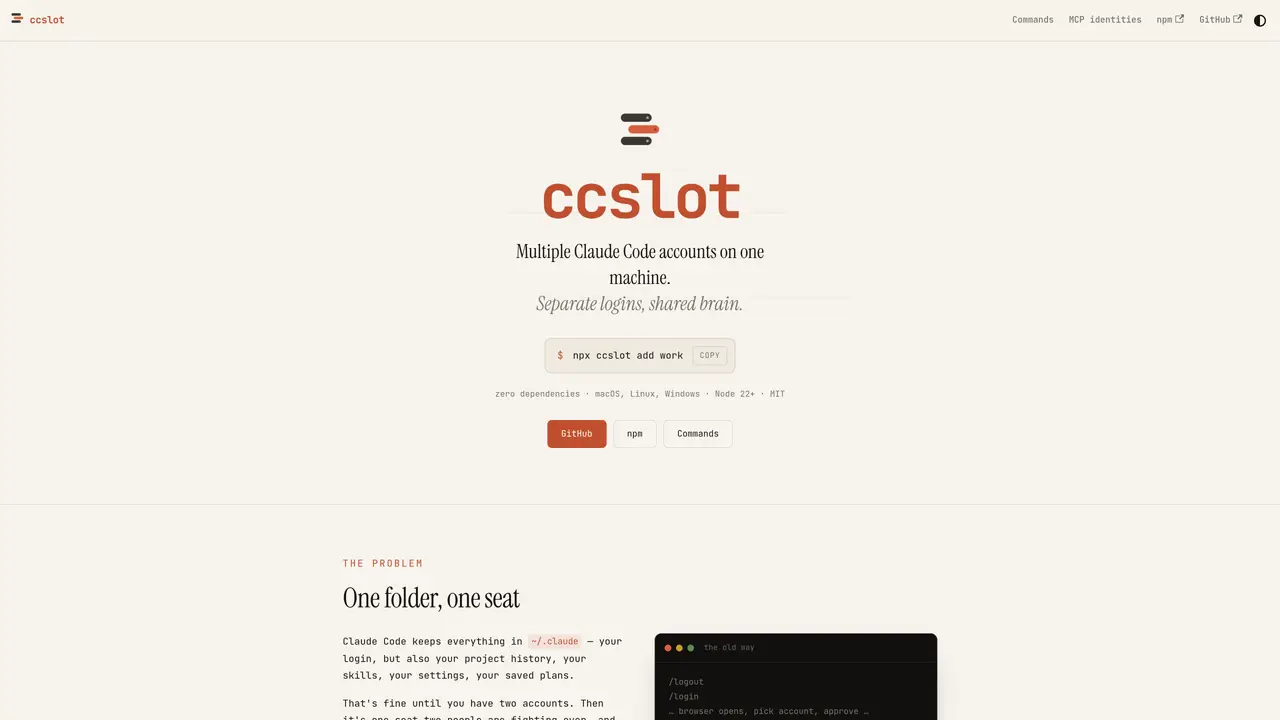
ccslot enables running multiple separate Claude Code accounts on a single machine by creating isolated configuration directories for each account while sharing project history, skills, plans, and settings. Each account maintains its own login credentials and MCP server authorizations, preventing conflicts when switching between identities. The tool works by setting the CLAUDE_CONFIG_DIR environment variable to a custom directory for each account, then symlinking shared resources back to the original location. This allows users to resume conversations started under one account from another, as the project history remains accessible across identities. ccslot provides commands to create, list, view, delete, and switch between these isolated accounts, with shell aliases generated for convenience. It does not bundle Claude Code itself but manages its configuration directories, requiring the official CLI to be installed separately.
Key features
- Create isolated config directories per account
- Share projects, skills, plans, and settings across accounts
- Resume conversations from one account in another
- Generate shell aliases for quick switching
- List and manage multiple accounts
- Support for MCP server identity isolation
- Cross-platform compatibility (macOS, Linux, Windows)
- View slot configuration details
Use cases
- Contractors managing separate client and personal accounts
- Developers working across multiple organizations
- Users maintaining distinct personal and work identities
Pros
- Isolates login credentials while sharing project data
- Supports multiple accounts with minimal setup
- Preserves conversation history across account switches
- Works across macOS, Linux, and Windows
- Zero dependencies beyond Node.js
Cons
- Requires Node.js 22+
- Does not include Claude Code itself
- Symlinks may not work with all backup tools
- Windows requires Developer Mode for full symlink support
Frequently asked questions about ccslot
What does ccslot do?
ccslot enables running multiple separate Claude Code accounts on a single machine by creating isolated configuration directories for each account while sharing project history, skills, plans, and settings. It manages login credentials and MCP server authorizations separately for each account.
Who is ccslot designed for?
ccslot is designed for users who need to manage multiple Claude Code accounts on one machine, such as contractors working with multiple organizations, individuals handling both personal and professional tasks, or anyone requiring separate identities for different projects.
Does ccslot include Claude Code itself?
No, ccslot does not bundle Claude Code. It only manages the configuration directories for Claude Code and requires the official CLI to be installed separately.
How do I install ccslot?
ccslot can be installed via npm using the command `npx ccslot` or globally with `npm install -g ccslot`. It requires Node.js 22+ and works on macOS, Linux, and Windows.
Can I switch between accounts without losing my progress?
Yes, ccslot allows you to resume conversations started under one account from another, as the project history remains shared across identities. The `/resume` command enables this functionality.
What happens to MCP server authorizations when switching accounts?
Each account maintains its own MCP server authorizations, so you do not need to re-authorize when switching between identities. This is useful for contractors or users managing multiple organizations.