AI-powered website builder that generates a professional site in under a minute and includes tools for content, SEO, and analytics.
52M visits/mo+0.7%#4 Coding & Development
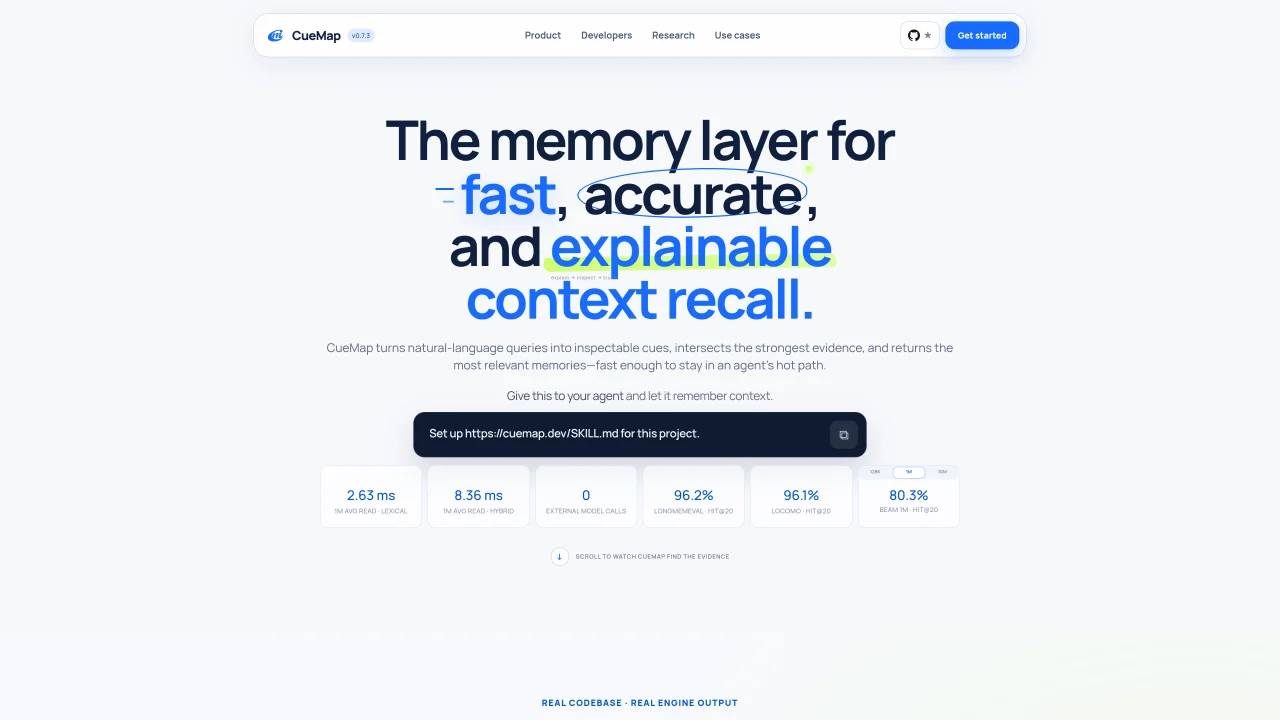
CueMap is a memory layer designed to enable fast, accurate, and explainable context recall for agents and applications. It ingests public source code and documentation, converting them into searchable memories tied to their original file paths. The system uses a lexical cue index for deterministic, high-speed retrieval and a local semantic reranker to improve ordering without external model calls. Retrieved memories include original evidence with attached file paths, allowing agents to inspect sources directly rather than relying on generated prose. Performance benchmarks show lexical recall averaging 2.63 ms and hybrid recall averaging 8.36 ms at 1 million memories, with retrieval scores such as 96.2% Hit@20 on LongMemEval. CueMap supports project isolation, automated directory ingestion, and configuration via TOML, and can be accessed through CLI, SDK, MCP, or HTTP API.
CueMap provides a memory layer for agents and applications to enable fast, accurate, and explainable context recall. It ingests public source code and documentation, converting them into searchable memories tied to their original file paths.
CueMap is designed for developers and applications that require reliable, traceable context retrieval, such as AI agents, coding assistants, or documentation systems.
CueMap uses a lexical cue index for deterministic, high-speed retrieval and a local semantic reranker to improve ordering without external model calls. Retrieved memories include original evidence with attached file paths.
Yes, CueMap can be accessed through CLI, SDK, MCP, or HTTP API, making it compatible with various workflows and systems.
Yes, CueMap supports project isolation, allowing users to manage memories separately for different projects or applications.
CueMap can be configured using TOML files, enabling users to customize ingestion and retrieval settings for their specific needs.
We use essential cookies to run aitoolnavio™, and optional cookies to analyze traffic and measure our marketing. You choose what we use — optional cookies stay off unless you turn them on. See our Privacy Policy.
One short email a week: fresh tools worth trying, honest takes and the updates that actually matter. No spam, unsubscribe any time.
AI-powered website builder that generates a professional site in under a minute and includes tools for content, SEO, and analytics.
AI-powered coding platform that uses agents to plan, write, and test software with real-time feedback and verifiable artifacts.
Automate code, research, and documents using agents.
AI-powered code assistant that generates, reviews, optimizes, and debugs code with natural language prompts and editor integrations.
AI assistant for safe, reliable productivity with code, collaboration, and integrations.
AI-powered IDE for autonomous coding tasks and agentic development workflows
Privacy-focused AI chatbot that generates uncensored text, code, images, and translations without storing conversations or requiring an account.
A free web-based AI chatbot and agent for writing, coding, research, and content creation with multilingual support.
Write & run code in 50+ languages, auto-complete with AI, and code faster with an intuitive interface.
An IDE that automates legacy-to-modern code migration using autonomous coding agents.
AI models that return typed decisions with calibrated confidence for software automation
Practice coding challenges, improve technical skills, get detailed explanations, compare performance with peers.
Matched on what this tool does — grouped by the job you would be replacing.
matches Lexical and hybrid retrieval modes · Local MiniLM-L3 reranking for hybrid mode · Zstd compression and encryption-ready storage
A memory layer and context engineering platform that provides long-term AI agent memory, retrieval, and connectors via a universal API.
Open-source memory layer for AI agents and IDEs with cloud sync
Adds persistent, queryable memory to AI agents so they can remember, reason, and personalize over time without custom state management.
Persistent memory API for AI agents with semantic search and namespace isolation
matches Exact passage retrieval from project files · Stateful understanding and memory for agents · Local-first persistent memory
matches Local MiniLM-L3 reranking for hybrid mode · Hybrid retrieval (vector + keyword) with sub-300ms recall · Vector search with approximate nearest neighbor
Stores coding assistants' project history locally.
Local evidence system that adds citations to agent answers by indexing project files
Open-source search engine that delivers fast, relevant results for websites and applications with minimal setup.
Vector and full-text search database built on object storage