
AI-powered website builder that generates a professional site in under a minute and includes tools for content, SEO, and analytics.
52M visits/mo+0.7%#4 Coding & Development
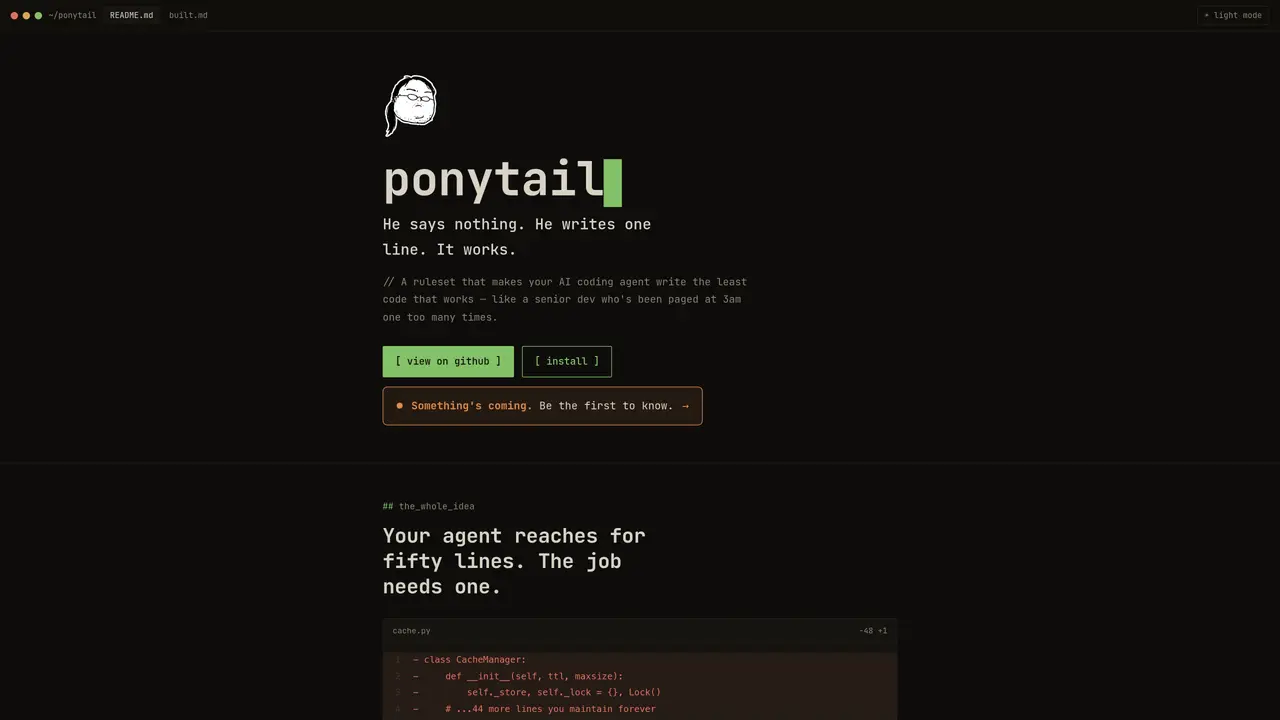
Ponytail is a ruleset and plugin that guides AI coding agents to write the minimal amount of code required to complete a task, functioning like a senior developer enforcing efficiency. It operates on a ladder of priorities: first checking if the requested feature already exists in the codebase, then whether it can be handled by standard libraries or native platform features, and finally whether it can be implemented in a single line before allowing additional complexity. The tool supports multiple intensity levels—lite, full, and ultra—to balance automation with developer oversight, and includes commands for reviewing, auditing, and managing code bloat. Ponytail is designed to reduce code size, lower token usage, and maintain safety without compromising functionality, making it suitable for developers using AI agents such as Claude Code, Cursor, or GitHub Copilot. It enforces principles like YAGNI (You Aren’t Gonna Need It) and prioritizes code reuse to minimize maintenance burden and potential bugs. Benchmarks indicate significant reductions in code volume and token usage while preserving validation, error handling, security, and accessibility standards. The tool is MIT licensed and integrates with over 14 AI coding agents, offering a practical approach to writing leaner, more maintainable code automatically.
Ponytail is a ruleset and plugin that guides AI coding agents to write the least amount of code necessary to complete a task by enforcing efficiency principles like YAGNI and prioritizing reuse of existing code, standard libraries, and native platform features.
Ponytail is designed for developers who use AI coding agents such as Claude Code, Cursor, or GitHub Copilot and want to reduce code bloat, lower token usage, and maintain safety without sacrificing functionality.
Ponytail integrates as a plugin or extension with over 14 AI coding agents, including Claude Code, Cursor, GitHub Copilot, and others, allowing it to enforce its ruleset during code generation.
Ponytail offers three intensity levels: lite, full, and ultra. Lite suggests lazier alternatives while building what was asked, full enforces the ladder of priorities strictly, and ultra takes a YAGNI extremist approach by shipping one-liners and challenging requirements.
Yes, Ponytail includes commands like /ponytail-review to find over-engineering in the current diff and /ponytail-audit to scan the entire repository for bloat, helping developers identify areas for improvement.
Yes, Ponytail is MIT licensed and available as an open-source project on GitHub.
ponytail.dev · third-party estimates from Similarweb
Last 4 months · grows by one month every month
Share of visits by channel
No measurable traffic from Paid Referrals.
Share of visits · estimated visits
Other countries: 23.2%
Coding & Development · Sep 2026
Traffic figures are third-party estimates, good for scale and trends; they can differ from a company's own numbers. Updated monthly.
We use essential cookies to run aitoolnavio™, and optional cookies to analyze traffic and measure our marketing. You choose what we use — optional cookies stay off unless you turn them on. See our Privacy Policy.
One short email a week: fresh tools worth trying, honest takes and the updates that actually matter. No spam, unsubscribe any time.
AI-powered website builder that generates a professional site in under a minute and includes tools for content, SEO, and analytics.
AI-powered coding platform that uses agents to plan, write, and test software with real-time feedback and verifiable artifacts.
Automate code, research, and documents using agents.
AI-powered code assistant that generates, reviews, optimizes, and debugs code with natural language prompts and editor integrations.
AI assistant for safe, reliable productivity with code, collaboration, and integrations.
AI-powered IDE for autonomous coding tasks and agentic development workflows
Privacy-focused AI chatbot that generates uncensored text, code, images, and translations without storing conversations or requiring an account.
A free web-based AI chatbot and agent for writing, coding, research, and content creation with multilingual support.
Write & run code in 50+ languages, auto-complete with AI, and code faster with an intuitive interface.
An IDE that automates legacy-to-modern code migration using autonomous coding agents.
AI models that return typed decisions with calibrated confidence for software automation
Practice coding challenges, improve technical skills, get detailed explanations, compare performance with peers.
Matched on what this tool does — grouped by the job you would be replacing.
matches Enforces YAGNI principle to avoid speculative code · Prioritizes standard library and native platform features · Reduces code and token usage while maintaining safety
AI coding agent for large-scale codebases with terminal-native workflows
A governance and orchestration platform for managing and governing AI agents in production environments.
Policy guardrails for AI coding sessions to control spend before it occurs
Lightweight spec framework that aligns humans and AI coding assistants before code is written, keeping plans auditable in Git.
matches Provides commands for reviewing and auditing codebases · Adapts to team-specific coding guidelines over time
AI-native code review platform that automates pull request reviews and enforces coding standards directly in GitHub workflows.
Enforces design system rules in AI-generated code and pull requests
AI-powered platform that automatically detects and fixes code vulnerabilities with one-click remediation via GitHub or GitLab pull requests.