
OpenAI builds and deploys advanced AI models like GPT-4o for autonomous agents and workflows.

OpenSpec
$0.07Starting price
0Popularity
About OpenSpec
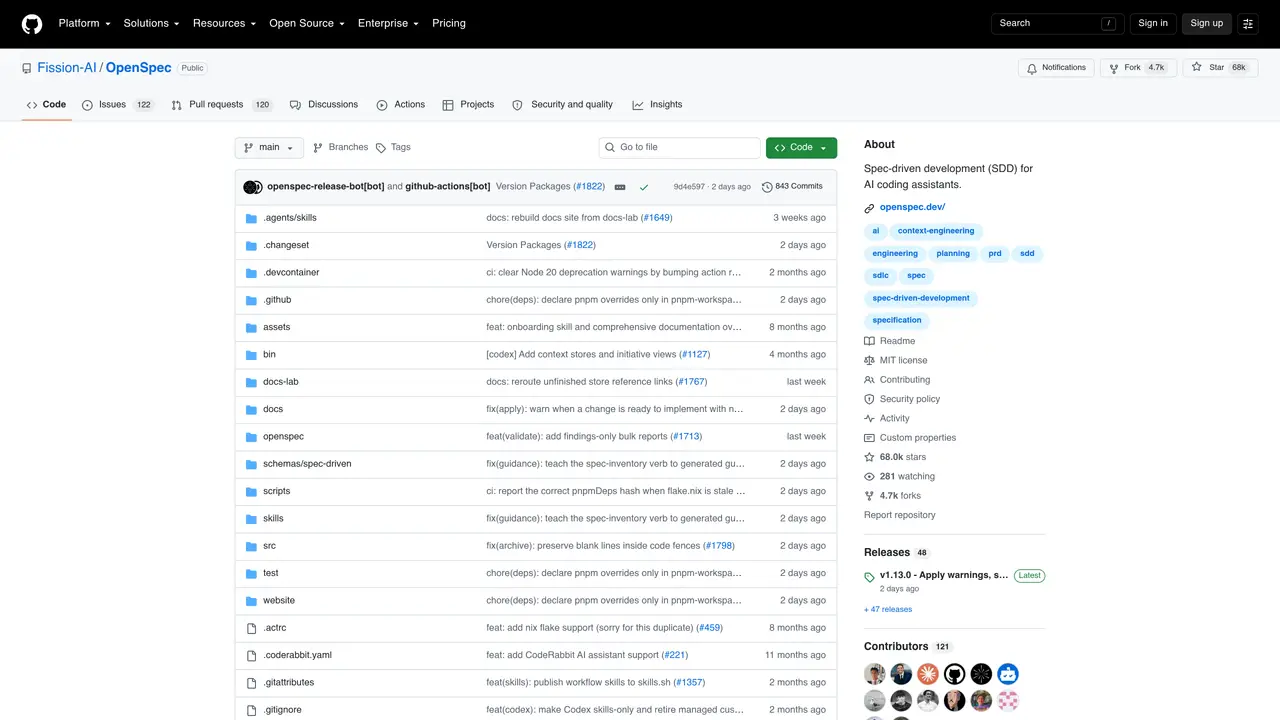
OpenSpec is a lightweight, artifact-guided spec framework and CLI that aligns humans and AI coding assistants before code is written. It creates structured change folders containing proposals, requirements, designs, and tasks directly in the repository. The tool integrates with over 30 assistants and IDEs using standardized commands, enabling consistent workflows across teams and tools. Plans can span multiple repositories via shared spec stores, decoupling planning from implementation while maintaining a single source of truth. Implementation tasks are applied automatically by the chosen coding agent, with verification steps and outcomes tracked for auditability. Changes are archived as dated folders, preserving a clean history of requirements, designs, and verifications in Git. This approach suits engineers, tech leads, platform teams, and AI-enabled organizations seeking predictable delivery from coding assistants, especially in complex or regulated environments.
GitHub, Inc.
San Francisco, California, US · Founded 2008
- Founders
- Tom Preston-Werner, Chris Wanstrath, PJ Hyett, Scott Chacon
- Founded
- 2008
- Headquarters
- San Francisco, California, US
- Legal status
- Subsidiary of Microsoft (NASDAQ: MSFT)
Key features
- Generates structured change folders with proposals, specs, designs, and tasks from a single slash command
- Applies implementation tasks automatically using supported coding agents or IDEs
- Supports cross-repo planning via shared spec stores for platform and multi-service changes
- Integrates with 30+ assistants through standardized command names and aliases
- Keeps all artifacts in Git for auditable plans, diffs, and archived changes
- Provides artifact-guided AI exploration to scope features quickly
- Offers governance with opt-out minimal telemetry for organizational compliance
- Enables refresh of agent instructions with a single CLI command
- Works with pnpm, yarn, bun, and nix package managers
- Maintains consistent commands across tools for unified team workflows
Use cases
- Aligning AI coding assistants and human engineers before code is written to ensure predictable delivery
- Planning and implementing cross-repo features with a shared spec store as a single source of truth
- Providing auditable trails of requirements, designs, and verification steps for regulated teams or OSS maintainers
Pros
- Enables structured, artifact-guided planning before code is written, reducing misalignment between humans and AI coding assistants.
- Integrates with over 30 AI assistants and IDEs using standardized commands, ensuring consistent workflows across tools.
- Supports multi-repository planning via shared spec stores, decoupling planning from implementation while maintaining a single source of truth.
- Tracks verification steps and outcomes for auditability, preserving a clean history of requirements, designs, and verifications in Git.
- Designed for scalability, from personal projects to enterprise environments, with a focus on fluid and iterative workflows.
Cons
- Requires adoption of a new workflow, which may involve a learning curve for teams accustomed to traditional development processes.
- Relies on AI coding assistants and standardized commands, which may limit flexibility for teams using less common or custom tools.
Frequently asked questions about OpenSpec
What is OpenSpec and what problem does it solve?
OpenSpec is a spec-driven development framework for AI coding assistants that aligns humans and AI before code is written. It creates structured change folders containing proposals, requirements, designs, and tasks directly in the repository, ensuring predictable and auditable delivery.
Who is OpenSpec designed for?
OpenSpec is designed for engineers, tech leads, platform teams, and AI-enabled organizations seeking structured and predictable workflows, especially in complex or regulated environments.
How does OpenSpec integrate with AI coding assistants and IDEs?
OpenSpec integrates with over 30 AI assistants and IDEs using standardized commands, enabling consistent workflows across teams and tools without requiring custom integrations.
Can OpenSpec be used for multi-repository projects?
Yes, OpenSpec supports planning across multiple repositories via shared spec stores, decoupling planning from implementation while maintaining a single source of truth.
What happens to the specifications and tasks after implementation?
After implementation, changes are archived as dated folders in Git, preserving a clean history of requirements, designs, and verifications for auditability.
How do I get started with OpenSpec?
To get started, run the command '/opsx:propose' followed by your idea to initiate the structured planning process. Detailed setup instructions are available in the repository's documentation.