
OpenAI builds and deploys advanced AI models like GPT-4o for autonomous agents and workflows.

Sequentialthinking MCP
$0.07Starting price
0Popularity
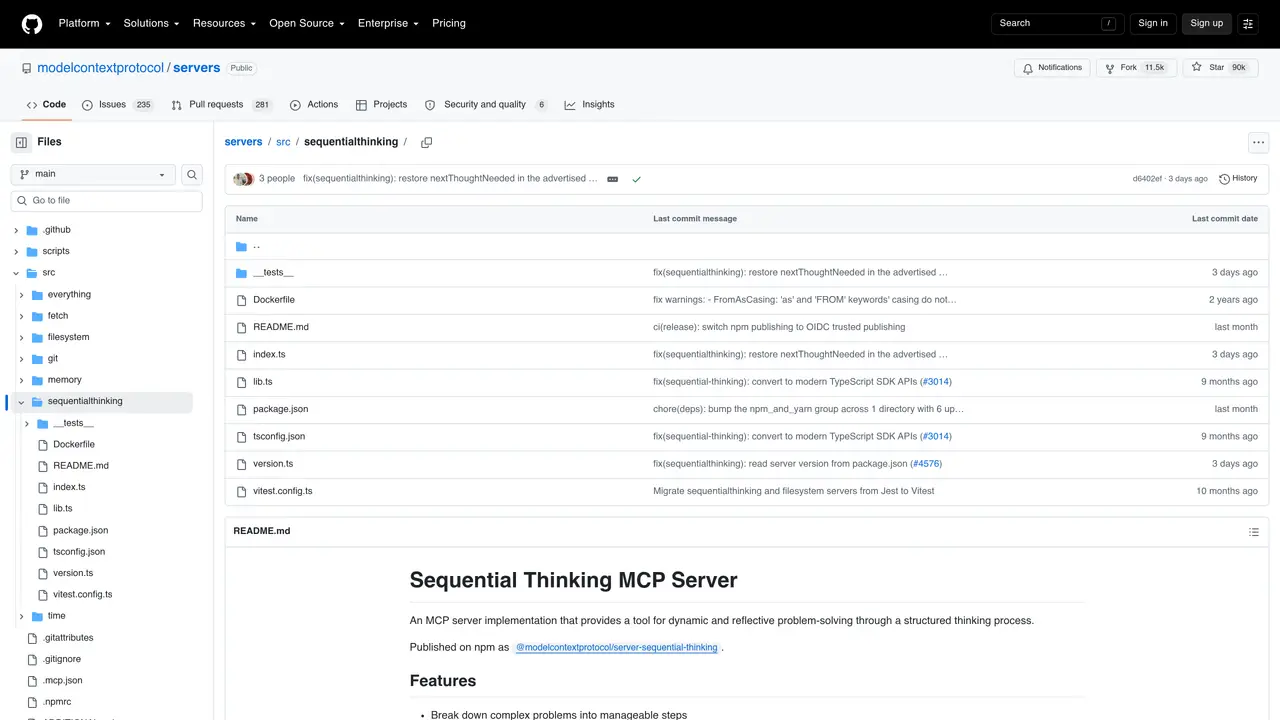
About Sequentialthinking MCP
The Sequentialthinking MCP server bridges Sequentialthinking with popular AI development environments like Cursor, Claude Desktop, and Windsurf. It enables structured, step-by-step reasoning workflows by integrating Sequentialthinking’s capabilities directly into these tools. Users can leverage Sequentialthinking’s reasoning processes within their preferred coding or development interface, streamlining workflows that require logical progression or multi-step problem solving. The server acts as a middleware, translating between Sequentialthinking’s reasoning engine and the MCP-compatible clients. It supports environments where sequential or hierarchical reasoning is beneficial, such as debugging, planning, or complex problem decomposition. By enabling this connection, it allows developers to apply Sequentialthinking’s methods without leaving their existing workflows.
GitHub, Inc.
San Francisco, California, US · Founded 2008
- Founders
- Tom Preston-Werner, Chris Wanstrath, PJ Hyett, Scott Chacon
- Founded
- 2008
- Headquarters
- San Francisco, California, US
- Legal status
- Subsidiary of Microsoft (NASDAQ: MSFT)
Key features
- Connects Sequentialthinking to Cursor, Claude Desktop, and Windsurf
- Enables structured, step-by-step reasoning workflows
- Acts as middleware between Sequentialthinking and MCP clients
- Supports environments requiring logical progression
- Integrates reasoning processes into existing development tools
- Facilitates multi-step problem decomposition
- Maintains compatibility with MCP-compatible clients
- Free and open-source implementation
Use cases
- Debugging complex code with step-by-step reasoning
- Planning and executing multi-stage development tasks
- Applying structured problem-solving in AI-assisted workflows
Pros
- Enables structured, step-by-step reasoning workflows within MCP-compatible AI development environments
- Supports dynamic problem-solving with the ability to revise, branch, and adjust reasoning paths
- Integrates seamlessly with popular AI coding tools like Cursor, Claude Desktop, and Windsurf
- Facilitates complex problem decomposition and multi-step analysis without leaving existing workflows
- Provides a reflective process for refining understanding as new insights emerge
Cons
- Requires familiarity with MCP-compatible hosts and tool integration workflows
- May introduce additional complexity for users unfamiliar with structured reasoning processes
- Dependent on the host environment's support for MCP tool calls and iterative reasoning
Frequently asked questions about Sequentialthinking MCP
What is the Sequentialthinking MCP server used for?
The server enables structured, step-by-step reasoning workflows within MCP-compatible AI development environments, allowing users to break down complex problems, plan, debug, or analyze with iterative refinement.
Who should use the Sequentialthinking MCP server?
Developers, data scientists, and technical planners who need to decompose complex problems, revise plans dynamically, or maintain context over multiple reasoning steps in their workflows.
How does the Sequentialthinking MCP server integrate with AI tools?
It acts as a middleware between Sequentialthinking’s reasoning engine and MCP-compatible clients like Cursor, Claude Desktop, or Windsurf, translating reasoning processes into tool calls within the host environment.
Can the server handle branching or revising reasoning paths?
Yes, the server supports branching into alternative reasoning paths and revising previous thoughts dynamically as understanding deepens or new information emerges.
What kind of problems benefit most from this tool?
Problems that require multi-step analysis, planning with room for revision, debugging with context retention, or filtering irrelevant information during reasoning.
How do I verify that the server is working correctly?
After installation, restart your MCP host, confirm the sequential_thinking tool appears in the host’s tool list, and test by asking the host to solve a non-trivial problem step-by-step.