
Frontier-grade Claude models with agentic workflows, strong coding, and enterprise guardrails delivered via developer console, web app, and cloud partners.

DataAnonymiser
€5/mStarting price
0Popularity
About DataAnonymiser
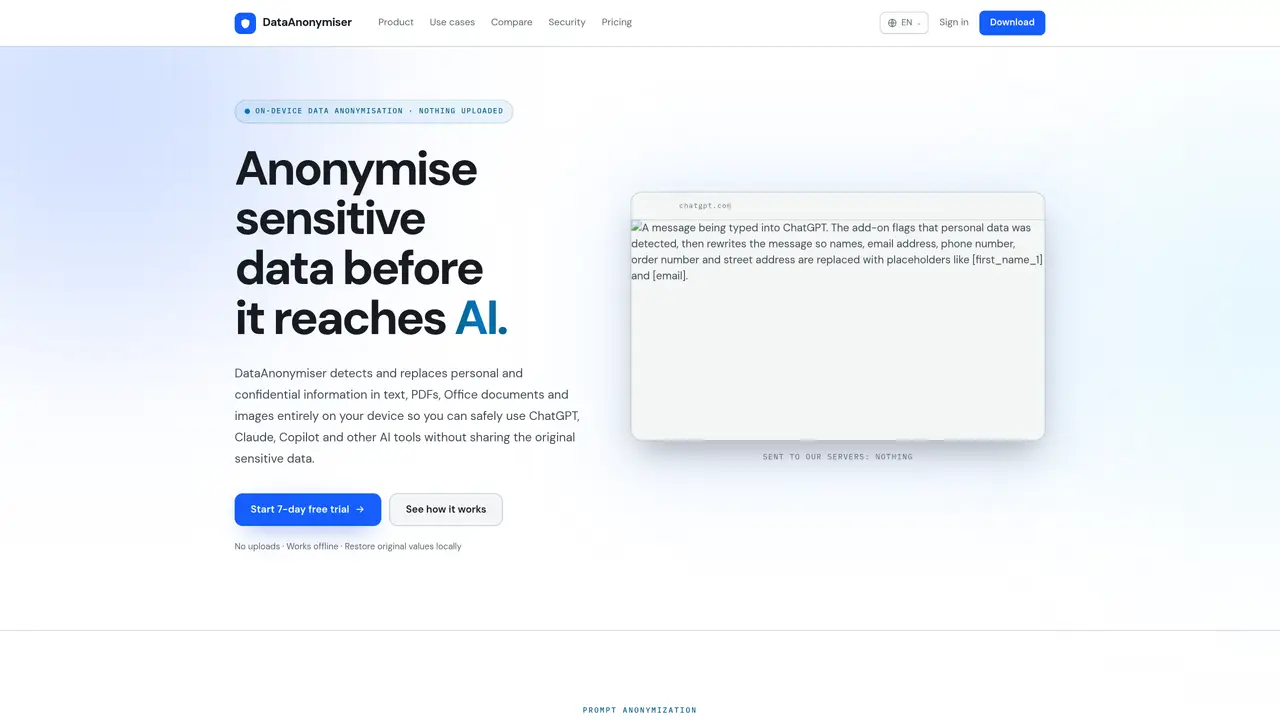
DataAnonymiser is a privacy-focused tool designed to detect and replace personal or confidential information in text, PDFs, Office documents, and images directly on the user’s device before it is shared with AI services like ChatGPT, Claude, or Copilot. The software operates entirely offline, ensuring that sensitive data such as names, phone numbers, financial details, and project names are anonymized using placeholders and later restored locally after receiving AI responses. This approach minimizes exposure to third parties and supports compliance with data protection requirements. DataAnonymiser offers both a desktop application and a browser add-on, enabling individuals and teams to anonymize prompts, documents, or screenshots seamlessly during their workflow. For organizations, an enterprise console allows centralized deployment of data loss prevention policies across multiple devices, ensuring consistent protection without relying on external servers. The tool is particularly useful for professionals handling sensitive information, compliance teams managing data exposure risks, and individuals seeking to use AI tools without compromising personal or confidential data. The browser add-on integrates with platforms like ChatGPT, Claude, and email services such as Gmail or Outlook, automatically flagging and anonymizing text before it is processed by AI. The desktop app supports direct anonymization of uploaded files, providing a straightforward way to clean documents before sharing them. By keeping all operations local, DataAnonymiser ensures that original data remains on the user’s device, reducing the risk of accidental data leaks. The tool also includes features for benchmarking performance against other privacy filters, with a focus on high detection rates and low false positives. Users can test the tool’s accuracy and report any missed cases for additional support time, reinforcing its commitment to reliability and user trust.
Key features
- Detects and replaces personal data in multiple file types
- Browser extension for real-time prompt anonymization
- Local restoration of original values after AI response
- Enterprise console for centralized DLP policy management
- Stable session placeholders for consistent anonymization
- Residual-risk reporting for compliance tracking
- Supports policy rollout across unlimited devices
- Connectors for integration with existing services
Use cases
- Anonymizing customer data before pasting into AI tools
- Redacting personal details from documents for compliance
- Cleaning up prompts for AI assistance without sharing sensitive information
Pros
- Processes text, PDFs, Office documents and images
- Works entirely offline with no uploads
- Supports restoration of original values locally
- Available as desktop app and browser extension
- Enterprise console for centralized policy management
Cons
- No free tier beyond a 7-day trial
- Requires installation on user devices
- PII detection is best-effort and may miss some details
- Enterprise plan requires custom pricing and setup
Frequently asked questions about DataAnonymiser
What does DataAnonymiser do?
DataAnonymiser identifies and replaces personal or confidential information in text, PDFs, Office documents, and images directly on the user’s device before sharing with AI tools like ChatGPT or Claude. It uses placeholders to mask sensitive data and restores the original values locally after receiving AI responses.
Who is DataAnonymiser for?
The tool is designed for individuals handling sensitive information, compliance teams managing data exposure risks, and organizations needing to minimize personal data sharing with third parties. It is also useful for anyone who wants to use AI tools without revealing personal details.
Does DataAnonymiser upload my documents to the cloud?
No. DataAnonymiser operates entirely on the user’s device, and no documents or sensitive data are uploaded to external servers. All anonymization and restoration processes occur locally.
How does the browser add-on work?
The browser add-on monitors text input in platforms like ChatGPT, Claude, or email services, and anonymizes selected text or prompts before they are sent to AI tools. The anonymization and restoration happen locally on the user’s computer.
Can DataAnonymiser be used in an enterprise setting?
Yes. The enterprise console allows organizations to deploy centralized data loss prevention policies across multiple devices, ensuring consistent protection without relying on external servers. IT teams can manage policies and view findings from a console hosted on their own infrastructure.
What happens if DataAnonymiser misses personal data?
If a user identifies a missed case, they can report it to DataAnonymiser. Upon confirmation, the user receives two weeks added to their subscription as a reward. This process helps improve the tool’s accuracy over time.