Frontier-grade Claude models with agentic workflows, strong coding, and enterprise guardrails delivered via developer console, web app, and cloud partners.

Gruvle Radar
$49/moStarting price
0Popularity
About Gruvle Radar
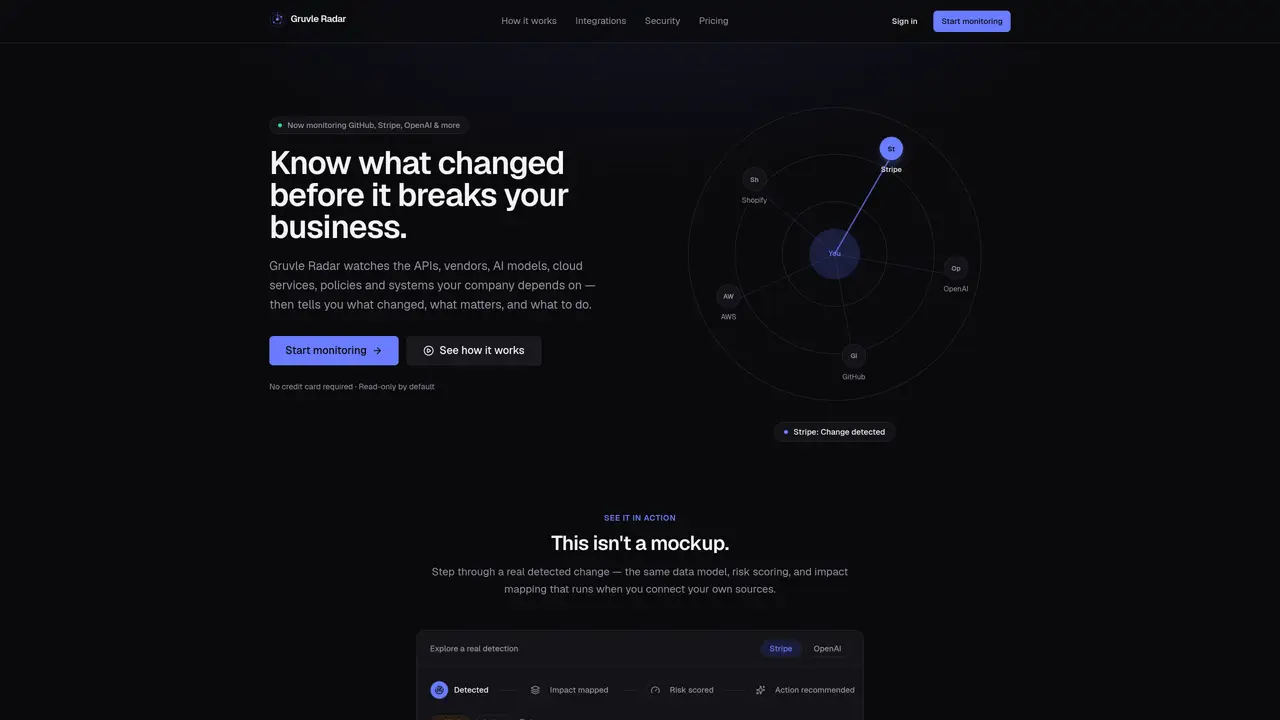
Gruvle Radar tracks changes across APIs, cloud services, AI models, vendor policies and regulatory requirements that businesses depend on. It ingests vendor changelogs, API specifications and policy updates, then maps each change to relevant repositories, services and teams within an organization. Changes are scored for risk using deterministic factors and presented with clear next steps rather than raw alerts. The system filters noise through a rules layer before any AI processing, collapsing related signals from multiple sources into single actionable changes. All integrations start with minimal permissions and operate in read-only mode by default, with users able to revoke access at any time. Encrypted credentials and customer-managed encryption options are available for security-sensitive environments.
Key features
- Real-time change detection across APIs and services
- Risk scoring based on deterministic factors
- Impact mapping to repositories and teams
- Read-only access by default
- Encrypted credential storage
- Integration marketplace with major services
- Customer-managed encryption option
- Revokable access permissions
Use cases
- Monitoring third-party API changes that could break integrations
- Tracking vendor policy updates affecting compliance
- Detecting AI model deprecations before they impact workflows
Pros
- Read-only access by default with minimal permissions required
- Deterministic risk scoring and explainable impact mapping
- Collapses related signals from multiple sources into single changes
- Encrypted credentials and customer-managed encryption options
- Integration ecosystem covering major APIs, cloud services and vendors
Cons
- No free tier beyond single-workspace offering
- Limited to integrations available in the marketplace
- No API access mentioned for custom integrations
Frequently asked questions about Gruvle Radar
What does Gruvle Radar do?
Gruvle Radar monitors APIs, cloud services, AI models, vendor policies, and regulatory requirements for changes that could impact a business. It maps detected changes to relevant repositories, services, and teams, scores them for risk, and provides clear next steps instead of raw alerts.
Who should use Gruvle Radar?
The tool is designed for teams and organizations that rely on multiple external services, APIs, or AI models and need to stay ahead of changes that could disrupt operations, compliance, or costs.
Does Gruvle Radar require write access to my systems?
No, Gruvle Radar operates in read-only mode by default and starts with minimal permissions. Write access is only enabled if explicitly configured by the user.
How does Gruvle Radar avoid alert fatigue?
It uses a deterministic rules layer to filter noise before any AI processing, collapsing related signals from multiple sources into single actionable changes and providing confidence levels for findings.
Can I connect services not listed in Gruvle Radar's integration marketplace?
Gruvle Radar supports a wide range of integrations, and users can request or configure additional sources as needed, though some may require manual setup.
Is Gruvle Radar secure?
Security is a default feature, with encrypted credentials, customer-managed encryption options, and the ability to revoke access at any time. All integrations start with minimal permissions and operate in read-only mode.