
Meta AI enhances machine learning, NLP, and computer vision capabilities.

Tonic Fabricate
$0.17Starting price
0Popularity
About Tonic Fabricate
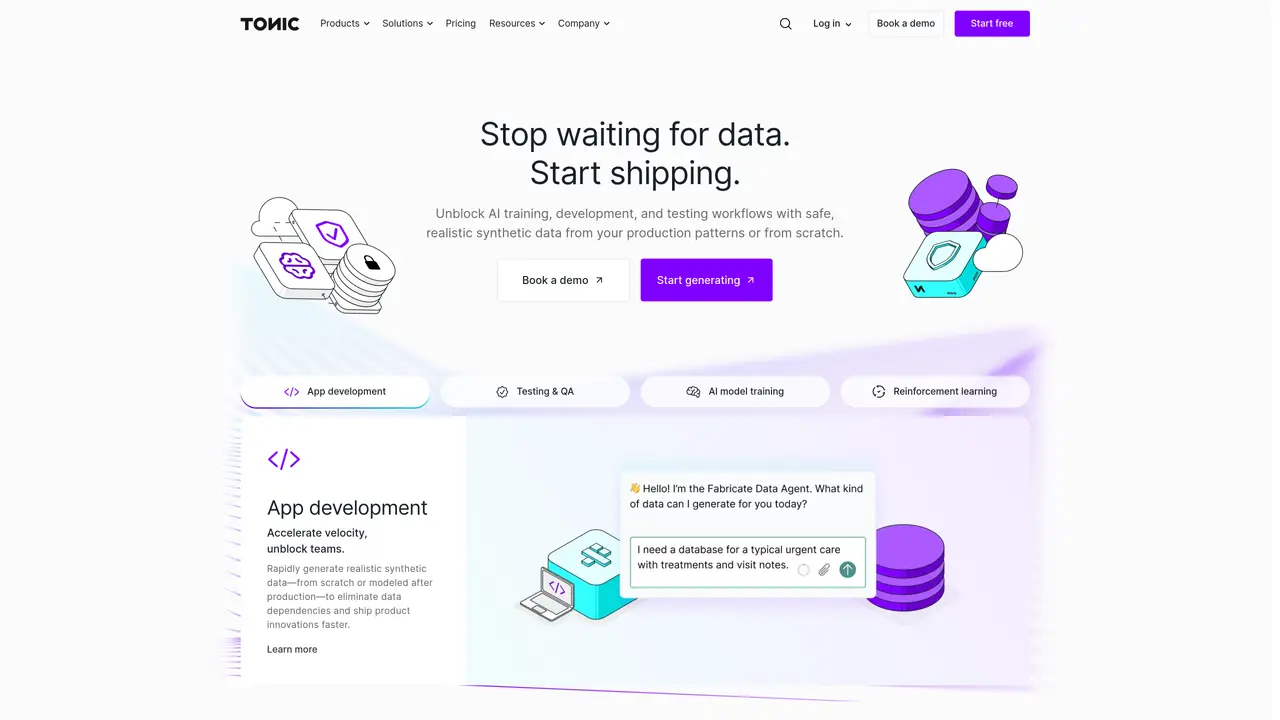
Tonic Fabricate helps teams generate secure, realistic synthetic data for AI model training and software testing. It enables developers and engineers to create private datasets that mimic real-world data without exposing sensitive information, reducing compliance risks and accelerating release cycles. The platform is designed for scenarios where real data is unavailable, restricted, or impractical to use, such as early-stage development, testing, or regulatory environments. By redacting sensitive details while preserving data realism, it supports faster bug identification and more reliable software validation. The tool is particularly useful for teams that need to iterate quickly without waiting for access to production data or dealing with privacy constraints. It integrates into existing workflows to provide fresh, de-identified datasets for AI model training and system testing.
Key features
- Generates secure synthetic data from real datasets
- Redacts sensitive unstructured data while maintaining realism
- Supports de-identified data for AI model training
- Enables local development with private datasets
- Creates compliant staging environments for testing
- Accelerates bug identification and software validation
- Maintains data consistency and usability
- Integrates into existing development and testing workflows
Use cases
- Generate synthetic test data for AI model training
- Create compliant staging environments without exposing real data
- Enable local development with fresh, de-identified datasets
Pros
- Generates fully relational synthetic databases, realistic unstructured data, and mock APIs from scratch or production patterns
- Supports structured, semi-structured, and unstructured data de-identification and synthesis
- Enables safe AI model training and fine-tuning by redacting sensitive data in unstructured datasets
- Accelerates testing and QA workflows with high-fidelity, referentially intact test data
- Provides open-source libraries, SDKs, and developer tools for streamlined implementation
Cons
- May require initial setup and configuration to integrate with existing workflows
- Dependence on synthetic data quality could impact downstream model performance if not properly validated
Frequently asked questions about Tonic Fabricate
What is Tonic Fabricate and what does it do?
Tonic Fabricate is a synthetic data platform that generates realistic, secure datasets for AI model training, software testing, and development workflows. It creates relational data, free-text, and mock APIs either from scratch or by modeling production patterns, enabling teams to bypass data access constraints while maintaining data realism.
Who should use Tonic Fabricate?
The tool is designed for engineering teams, developers, and data scientists who need high-fidelity test data or synthetic datasets for AI training without exposing sensitive information. It suits use cases in app development, testing and QA, model training, and reinforcement learning.
How does Tonic Fabricate generate synthetic data?
Tonic Fabricate synthesizes data by modeling production patterns or creating datasets from scratch, producing relational databases, unstructured text, and mock APIs. It preserves data realism while redacting or synthesizing sensitive details to ensure privacy and compliance.
What types of data can Tonic Fabricate handle?
The platform supports structured and semi-structured data (e.g., relational databases, NoSQL, flat files) as well as unstructured data (e.g., free-text, files, clinical notes). It also generates mock APIs and simulated environments for reinforcement learning.
Does Tonic Fabricate integrate with existing workflows?
Yes, Tonic Fabricate integrates with a variety of data sources and technologies, including relational databases, data lakes, SaaS applications, and flat files. It also provides open-source libraries, SDKs, and developer tools to streamline implementation.
How can I get started with Tonic Fabricate?
Prospective users can start by booking a demo or exploring the platform's capabilities through product documentation and tutorials. The tool is designed to unblock workflows by generating synthetic data on demand, reducing dependencies on production data.