
Meta AI enhances machine learning, NLP, and computer vision capabilities.

Unison
0Popularity
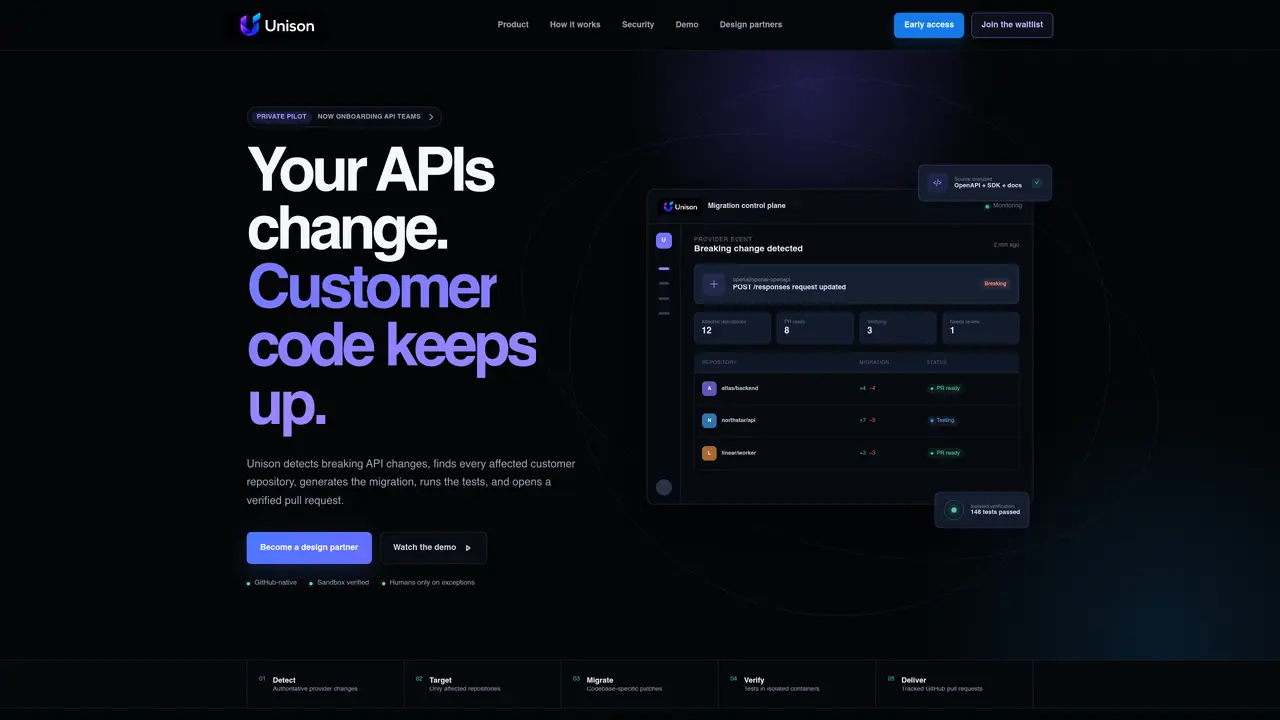
About Unison
Unison provides a continuous maintenance layer for API integrations by detecting breaking changes in provider APIs and automatically migrating affected customer repositories. It operates as a GitHub-native control plane that analyzes authoritative sources such as OpenAPI specifications, SDK releases, and documentation to identify meaningful changes. The system builds a dependency graph mapping providers to repositories, then generates scoped patches using AI grounded in exact provider evidence and the customer’s real code context. Each migration is verified in isolated containers before opening a draft pull request on GitHub, with human review reserved for exceptions. The tool tracks migration status across repositories and handles the entire lifecycle from detection to delivery, reducing manual coordination between API providers and customers. It is designed to fail closed, ensuring migrations are reproducible and reviewable before reaching customer code.
Key features
- Automatic detection of breaking API changes
- Provider-to-repository dependency mapping
- AI-generated scoped patches grounded in provider evidence
- Isolated verification in network-disabled containers
- Draft pull requests opened on GitHub
- Human review for exceptions only
- GitHub App with revocable access control
- Continuous migration lifecycle management
Use cases
- Keeping customer integrations current after API provider changes
- Reducing manual coordination between API providers and customers
- Automating repetitive migration work across multiple repositories
Pros
- Detects API changes automatically from specifications and documentation
- Maps impact across customer repositories using a provider-to-repository dependency graph
- Generates and verifies migrations in isolated containers before delivery
- Opens draft pull requests with human review only for exceptions
- GitHub-native with customer-controlled access and revocation
Cons
- Currently available only via waitlist and early access
- Limited to GitHub repositories and API teams
- Requires API providers to publish specifications or SDKs
Unison videos
Frequently asked questions about Unison
What does Unison do?
Unison detects breaking changes in provider APIs by analyzing authoritative sources such as OpenAPI specifications, SDK releases, and documentation. It maps the impact of these changes across customer repositories, generates codebase-specific patches, verifies migrations in isolated containers, and delivers tracked GitHub pull requests.
Who is Unison designed for?
Unison is designed for API teams that need to maintain continuous compatibility with their customers' integrations. It is particularly useful for organizations that want to automate the detection and migration of breaking API changes without manual coordination.
How does Unison verify migrations before applying them?
Unison runs baseline and patched tests in isolated, network-disabled containers to verify migrations. Each migration is reproducible and reviewable before it reaches customer repositories, with human review reserved for exceptions.
Can Unison integrate with GitHub?
Yes, Unison operates as a GitHub-native control plane. It opens verified pull requests on GitHub, tracks migration status across repositories, and allows customers to control repository access through a GitHub App.
How does Unison ensure the safety of migrations?
Unison is designed to fail closed, meaning every migration is scoped, reproducible, and reviewable before reaching customer code. It uses evidence-bound patches, isolated verification, and GitHub-controlled access to maintain safety.
How can I get started with Unison?
Prospective users can join the waitlist on the Unison website to receive product updates and an invitation when early access becomes available for more API teams.