Unleash creativity: edit photos, videos, and designs with AI-enhanced tools.
16M visits/mo-11.4%#6 Image & Design

AI-powered design team that turns written briefs into production-ready HTML and design systems
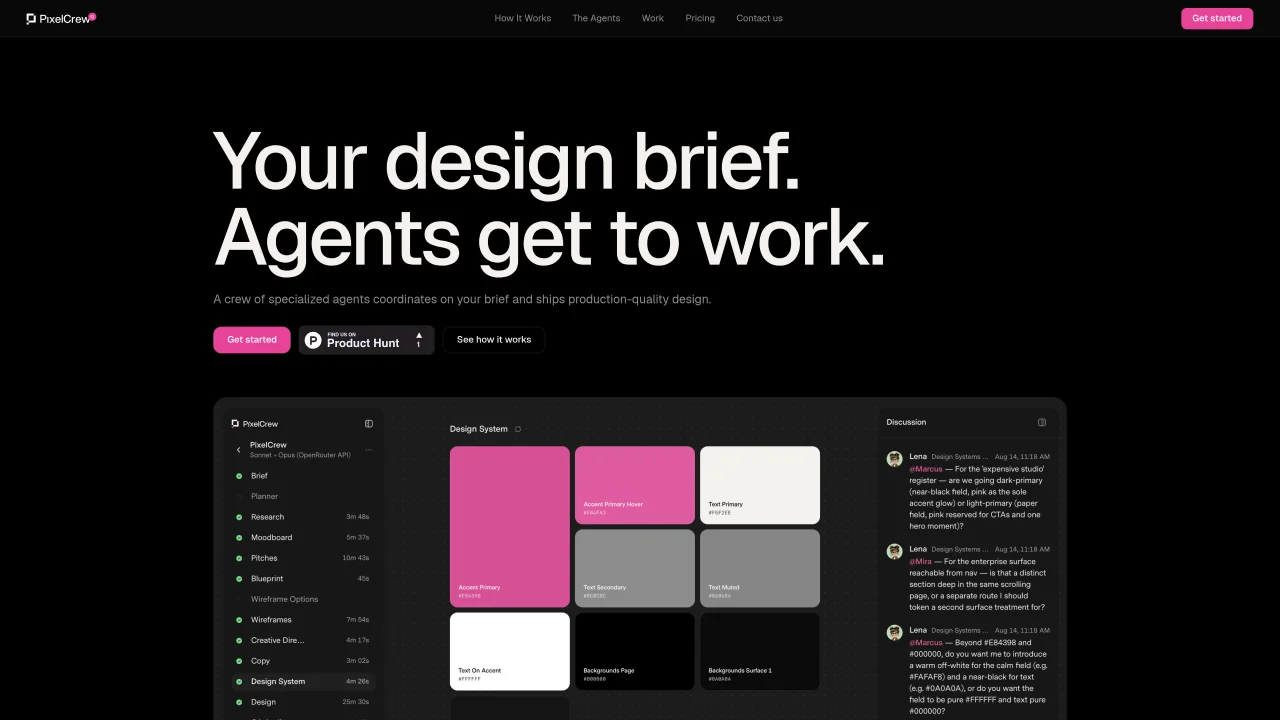
PixelCrew coordinates a sequence of specialized AI agents to transform a written design brief into production-quality output. The process begins with Elena, a researcher who conducts audience analysis, competitive audits, jobs-to-be-done mapping, and information architecture definition. Marcus, the art director, then sets the visual direction by creating three distinct pitches, selecting the strongest, and producing a full creative brief with palette, typography, and layout guidance. Mira, the designer, builds wireframes, user flows, and section-by-section specifications, which are converted into production-ready HTML and Tailwind code. The crew also generates copy, assembles a design system with tokens and components, and performs a QA audit before delivering a complete package including HTML, design system documentation, and design files. Typical deliverables include landing pages, dashboards, design systems, and pitch decks, all produced in 25–45 minutes on average.
PixelCrew is a platform that uses a coordinated team of specialized AI agents to transform a written design brief into production-quality output. The process involves sequential collaboration among agents, each with a defined role such as research, art direction, and UX design, to deliver deliverables like landing pages, dashboards, and design systems.
PixelCrew is designed for individuals or teams who need production-ready design outputs quickly, such as developers, designers, marketers, or small businesses without dedicated design resources. It is particularly useful for those who want to generate bespoke designs without starting from scratch.
PixelCrew operates on a bring-your-own-API-key model during its alpha phase, meaning users connect their own API key and pay model costs directly to the provider. There are no fees from PixelCrew, no subscription, and no markup. Users can choose providers like OpenRouter, Anthropic, or Google Gemini.
PixelCrew can produce a variety of deliverables, including landing pages, dashboards, design systems, pitch decks, and web applications. The output typically includes production-ready HTML, Tailwind code, design system documentation, and design files.
On average, PixelCrew delivers production-quality output in 25 to 45 minutes after submitting a brief. The timeline depends on the complexity of the request and the user's chosen AI model provider.
PixelCrew does not require integration with other tools for its core functionality, as it operates independently using the user's API key. However, the output (e.g., HTML, design systems) can be integrated into existing workflows or platforms by developers.
We use essential cookies to run aitoolnavio™, and optional cookies to analyze traffic and measure our marketing. You choose what we use — optional cookies stay off unless you turn them on. See our Privacy Policy.
One short email a week: fresh tools worth trying, honest takes and the updates that actually matter. No spam, unsubscribe any time.
Unleash creativity: edit photos, videos, and designs with AI-enhanced tools.
A drag-and-drop design platform for presentations and social graphics with AI photo tools and a large template library.
Create captivating, customizable presentations and easily share them across devices with a cloud-based platform.
Generate custom visuals for blogs, create unique social media images, and design eye-catching visuals for marketing campaigns.
Create stunning designs, edit photos, remove objects, make collages, and transform images with powerful AI tools and effects.
Create auto-resized campaign images and videos with DaVinci AI's generative media suite.
Create precise 3D models, collaborate on designs, and analyze simulations in real-time.
Cloudinary provides APIs and tools to integrate, manage, and optimize images and videos for AI-driven visual experiences.
Generate custom color palettes instantly with AI or from images for design projects.
Turn simple prompts into flyers, social posts, emails, event pages, and tickets using AI-powered design and marketing tools.
Generate high-quality images with flawless embedded text from text prompts, plus batch output and style control in a creative canvas.
Edit, transform, and enhance photos with text prompts using our free AI photo editor online.
Matched on what this tool does — grouped by the job you would be replacing.
matches Production HTML and Tailwind code generation · Design system with tokens, type scale, and components
AI-powered design canvas that accelerates UI workflows, visual iteration, and production-ready handoff with real CSS-based layouts.
Turns text prompts, screenshots, sketches or URLs into Figma wireframes, mockups and exportable HTML/React code.
Turns text prompts into ready-to-use React UI code with Shadcn UI and Tailwind CSS components.
Subframe is an AI-powered design tool for building software in the AI era.
matches Wireframes, user flows, and UX architecture · Visual direction with three distinct pitches
AI-powered platform that turns plain-language descriptions or screenshots into interactive app and website prototypes with multi-page workflows and UI components.
AI design agent that turns product ideas into production-ready prototypes
Turns plain-English briefs into product strategy, high-fidelity UI designs, copy, layouts, and developer notes in one pass.