
AI-powered medical search engine that delivers synthesized, cited answers from peer-reviewed research for clinicians.

Artera
$1Starting price
20KMonthly visits
22Popularity
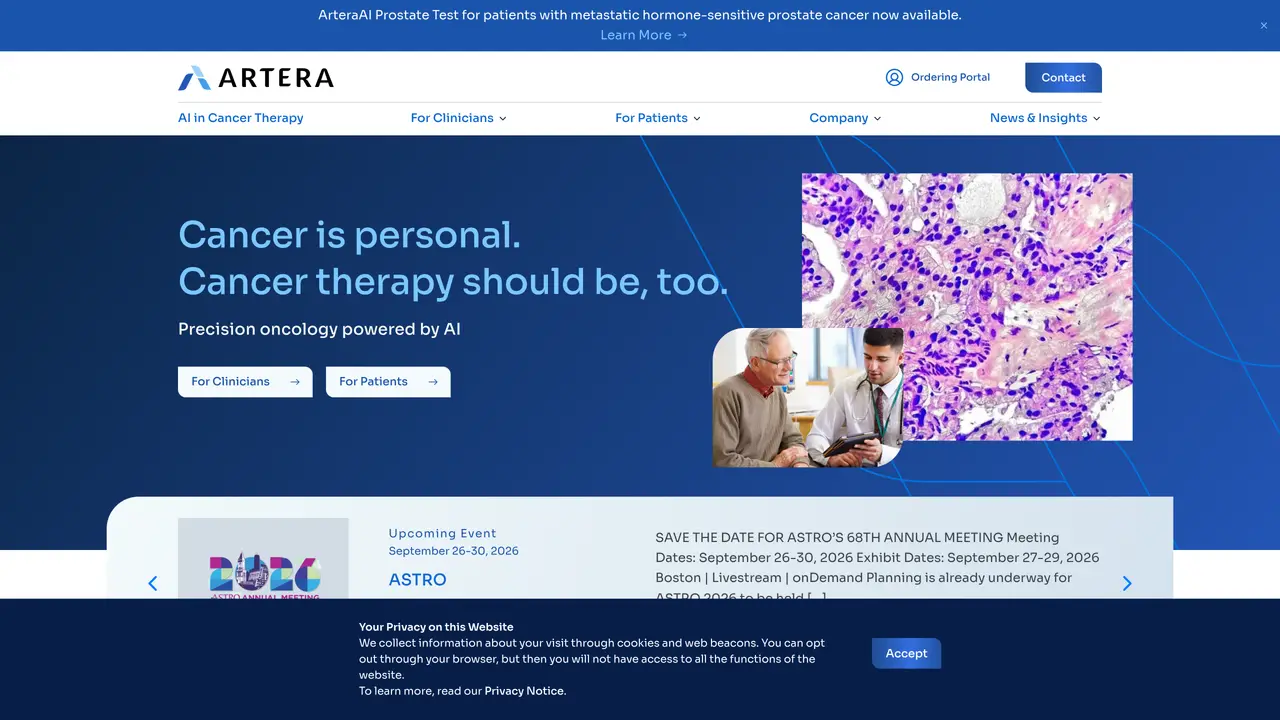
About Artera
Artera integrates multimodal AI to support oncology, specifically focusing on prostate cancer. The platform provides clinicians with predictive and prognostic assessments that guide personalized treatment decisions. By analyzing digital pathology images and clinical data, Artera delivers data-driven insights that simplify complex cancer care workflows. Designed for oncologists and healthcare providers, the tool enables faster, more accurate decision-making while preserving biological sample integrity. Results are typically available within 2-3 days, accelerating the initiation of tailored therapies. Its non-invasive approach eliminates the need for additional tissue consumption, relying instead on existing pathology slides. The platform is tailored for integration into clinical workflows and supports shared decision-making between clinicians and patients.
Key features
- AI-driven predictive models for cancer therapy guidance
- Prognostic assessments for personalized treatment planning
- Non-invasive analysis using existing pathology slides
- Rapid results delivered within 2-3 days
- Multimodal AI (MMAI) for enhanced precision
- Compatibility with digital pathology and clinical data systems
- Data-driven insights for shared decision-making
- Inclusion in NCCN Clinical Practice Guidelines for Prostate Cancer
Use cases
- Oncologists refining prostate cancer treatment strategies
- Research institutions studying cancer treatment outcomes
- Healthcare policy makers improving cancer care standards
Pros
- FDA-cleared as a Software as a Medical Device (SaMD) for prostate cancer risk stratification
- Analyzes existing H&E pathology slides without additional tissue consumption or staining
- Provides rapid turnaround with results available within 1-2 days after specimen receipt
- Validated in multiple large, randomized phase III clinical trials
- Included in the NCCN Clinical Practice Guidelines in Oncology for prostate cancer as a prognostic test
Cons
- Limited to specific cancer types (prostate and breast) with no broader oncology applications currently
- Dependent on availability and quality of digital pathology slides for analysis
- May require integration into existing clinical workflows for optimal adoption
Frequently asked questions about Artera
What is Artera and what does it do?
Artera is an AI-powered precision medicine platform that analyzes digital pathology images and clinical data to provide personalized prognostic and predictive insights for cancer care. It supports clinicians in making data-driven treatment decisions, particularly for prostate and breast cancer.
Who should use Artera?
Artera is designed for oncologists, healthcare providers, and clinicians involved in cancer treatment and decision-making. It is also relevant for patients seeking personalized cancer therapy options.
How does Artera integrate into clinical workflows?
Artera is tailored to integrate seamlessly into existing clinical workflows by providing rapid, actionable insights derived from standard pathology slides without requiring additional tissue or preparation. Results are typically available within 1-2 days.
What types of cancer does Artera support?
Artera currently offers validated tests for prostate cancer, including biopsy and post-radical prostatectomy scenarios, as well as a breast cancer test for early-stage patients. The platform is designed to expand to other cancer types.
Does Artera require additional tissue samples?
No, Artera does not consume additional tissue. It uses image data from existing H&E slides, eliminating the need for extra staining or preparation.
Is Artera covered by insurance?
Yes, Artera’s tests are covered by insurance, including Medicare for eligible patients, and many commercial health plans provide coverage. Coverage details may vary depending on the patient’s specific plan.
Artera Website Engagement
Last Update: 9 days ago
Total Monthly Visits
0
Bounce Rate
0%
Visit Duration (avg)
0.00s
Pages Per Visit
0
Country Rank
0
United States
Global Rank
0
Category Rank
#0
Health Conditions & Concerns
Monthly Traffic
Traffic Sources
Traffic Share By Country
- United States71.6%
- Canada14.2%
- United Kingdom5.2%
- Israel5.2%
- Germany3%