
AI-powered medical search engine that delivers synthesized, cited answers from peer-reviewed research for clinicians.

Lunit
42KMonthly visits
27Popularity
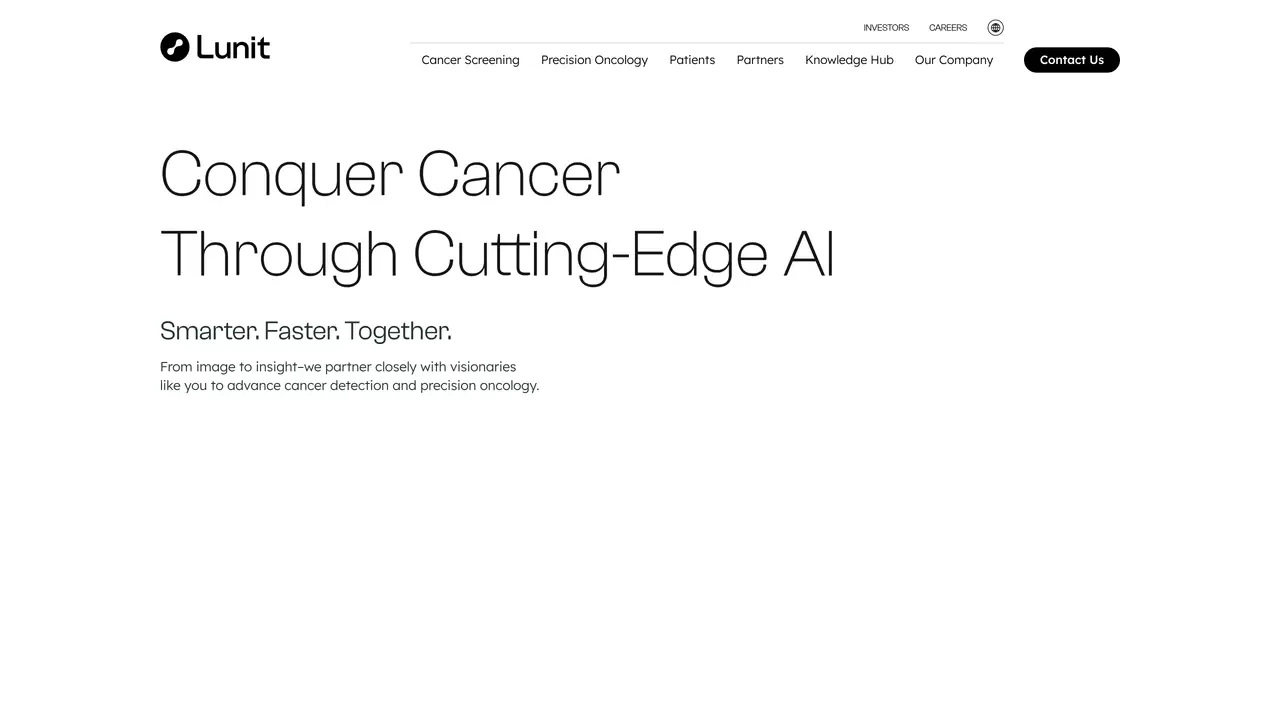
About Lunit
Lunit is a service that helps to reduce the risk of misdiagnosis and gives patients the best chance at survival. It has a proprietary AI platform that can accurately detect cancer in CT scans and mammograms. This service allows for faster and more accurate diagnoses, as well as for more personalized treatments. Overall, Lunit is an invaluable resource for medical professionals in the fight against cancer. By leveraging AI to detect and diagnose cancer earlier, Lunit helps increase patient survival rates and gives doctors the tools they need to give the best possible care. With Lunit, healthcare professionals have access to cutting-edge technologies that have the potential to revolutionize cancer treatment and save countless lives. Lunit’s AI platform can detect cancer in CT scans and mammograms more quickly and accurately than traditional methods. The service offers personalized treatments tailored to each patient’s needs, increasing the chances of successful outcomes. Lunit provides healthcare professionals with access to cutting-edge technologies, enabling them to stay ahead of the curve in cancer treatment.
Lunit
South Korea
- Headquarters
- South Korea
Key features
- Detects cancer in CT scans and mammograms
- Offers personalized treatments
- Provides access to cutting-edge technologies
- Reduces risk of misdiagnosis
- Increases patient survival rates
- Gives doctors tools for best possible care
Use cases
- Early detection of cancer in CT scans and mammograms
- Personalized treatment plans for patients
- Access to cutting-edge technologies for healthcare professionals
Pros
- Provides AI-driven cancer detection and precision oncology solutions for medical imaging
- Supports multiple imaging modalities including mammograms (2D/3D), CT scans, and chest X-rays
- Offers modular and interoperable AI tools for seamless integration into clinical workflows
- Developed with diverse global datasets for improved accuracy and scalability
- Includes tools for risk assessment, density scoring, and real-time analytics
Cons
- Limited public information on pricing and accessibility for individual practitioners
- Dependence on high-quality imaging data may introduce variability in performance
- Integration with existing systems may require technical support and training
Frequently asked questions about Lunit
What does Lunit do?
Lunit provides medical AI software for cancer detection and precision oncology, including AI-powered analysis of mammograms, CT scans, and chest X-rays to improve early cancer detection and support treatment decisions.
Who is Lunit designed for?
The platform is designed for radiologists, oncologists, and healthcare systems seeking to enhance cancer screening accuracy and precision oncology workflows through AI-driven insights.
How does Lunit integrate with existing healthcare systems?
Lunit offers modular, interoperable solutions that connect with radiology and oncology workflows, enabling seamless integration with imaging equipment and clinical data systems.
What are Lunit's main products?
Key products include Lunit INSIGHT for cancer detection in mammograms and chest X-rays, and Lunit SCOPE for precision oncology applications such as tumor microenvironment analysis and biomarker quantification.
Does Lunit support clinical trials?
Yes, Lunit partners with biopharma companies to provide AI-driven companion diagnostics and clinical trial solutions for oncology drug development and precision medicine.
How can I get started with Lunit?
Prospective users can contact Lunit directly through their website to request a consultation, demo, or partnership discussion tailored to their clinical or research needs.
Lunit Website Engagement
Last Update: 9 days ago
Total Monthly Visits
0
Bounce Rate
0%
Visit Duration (avg)
0.00s
Pages Per Visit
0
Country Rank
0
South Korea
Global Rank
0
Category Rank
#0
Math
Monthly Traffic
Traffic Sources
Traffic Share By Country
- South Korea36.3%
- United States22.9%
- Vietnam5.4%
- New Zealand4.4%
- Indonesia4.3%