AI assistant for safe, reliable productivity with code, collaboration, and integrations.

HDM — The Hesitation Diagnostic Model
0Popularity
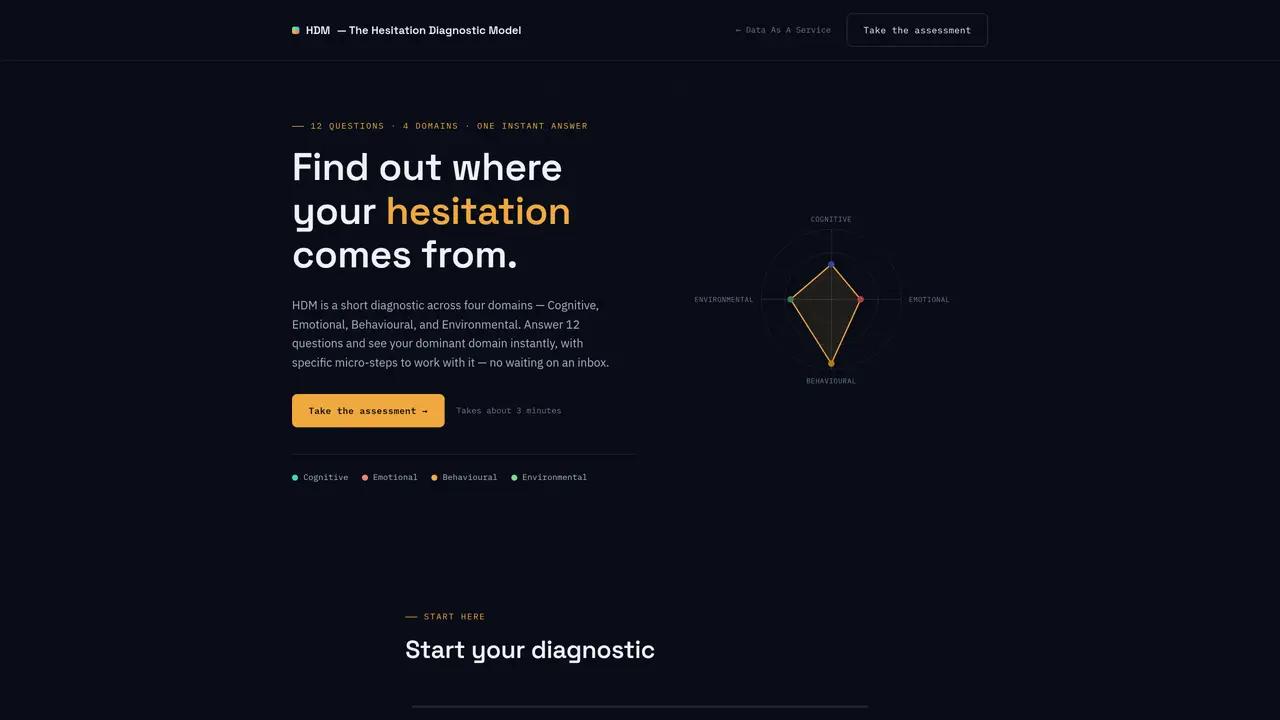
About HDM — The Hesitation Diagnostic Model
HDM is a brief online assessment designed to identify sources of hesitation through four domains: Cognitive, Emotional, Behavioural, and Environmental. Users answer 12 questions, rating statements from Strongly Disagree to Strongly Agree, with three questions per domain. The tool scores responses in real time and displays the dominant hesitation pattern immediately upon submission. Results include individual scores for all four domains, the highest-scoring domain, and tailored micro-steps for addressing the identified pattern. A copy of the results is also sent via email for reference. The model categorizes hesitation into distinct patterns, providing a clear starting point rather than a broad personality label. For teams, an optional feature aggregates results from multiple participants to reveal common hesitation patterns within an organization.
Key features
- 12-question diagnostic across four domains
- Real-time scoring and result display
- Email delivery of results
- Dominant domain identification
- Micro-steps for addressing hesitation
- Team diagnostic with aggregated results
- No personal account required to take assessment
- Results available immediately after submission
Use cases
- Individual self-assessment to understand personal hesitation patterns
- Team or organizational analysis to identify common hesitation trends
- Workplace coaching or development programs to address decision-making delays
Pros
- Instant scoring and results without waiting
- Four distinct domains covering cognitive, emotional, behavioral, and environmental hesitation
- Provides specific micro-steps for addressing identified patterns
- Aggregated team results available for organizational insights
- Email delivery of results for future reference
Cons
- No free tier or trial option mentioned
- Limited to online use via web browser
- No mobile app or cross-platform support specified
- Requires opt-in for team diagnostic feature
Frequently asked questions about HDM — The Hesitation Diagnostic Model
What does HDM measure?
HDM measures sources of hesitation across four domains: Cognitive, Emotional, Behavioural, and Environmental. Users answer 12 questions, with three questions per domain, to identify their dominant hesitation pattern.
Who is HDM designed for?
HDM is designed for individuals seeking to understand their hesitation patterns, as well as teams and organizations looking to identify common hesitation trends within their group.
How long does the assessment take?
The assessment takes approximately three minutes to complete. Users rate 12 short statements from Strongly Disagree to Strongly Agree, and results are provided instantly upon submission.
Can HDM be used for team assessments?
Yes, HDM offers an optional feature for teams where participants can take the diagnostic, and the results are aggregated to reveal common hesitation patterns within the organization.
What information is included in the results?
Results include scores for all four domains, the dominant hesitation domain, and tailored micro-steps for addressing the identified pattern. A copy of the results is also sent via email.
How are the hesitation patterns categorized?
Hesitation patterns are categorized into four distinct domains: Cognitive (overthinking), Emotional (feeling first), Behavioural (hesitation through motion), and Environmental (waiting for conditions).