
Generate content, correct spelling, suggest synonyms to enhance writing.
173M visits/mo+0.1%#1 Productivity & Office

AI-powered content curation tool that filters and merges news feeds based on personal preferences
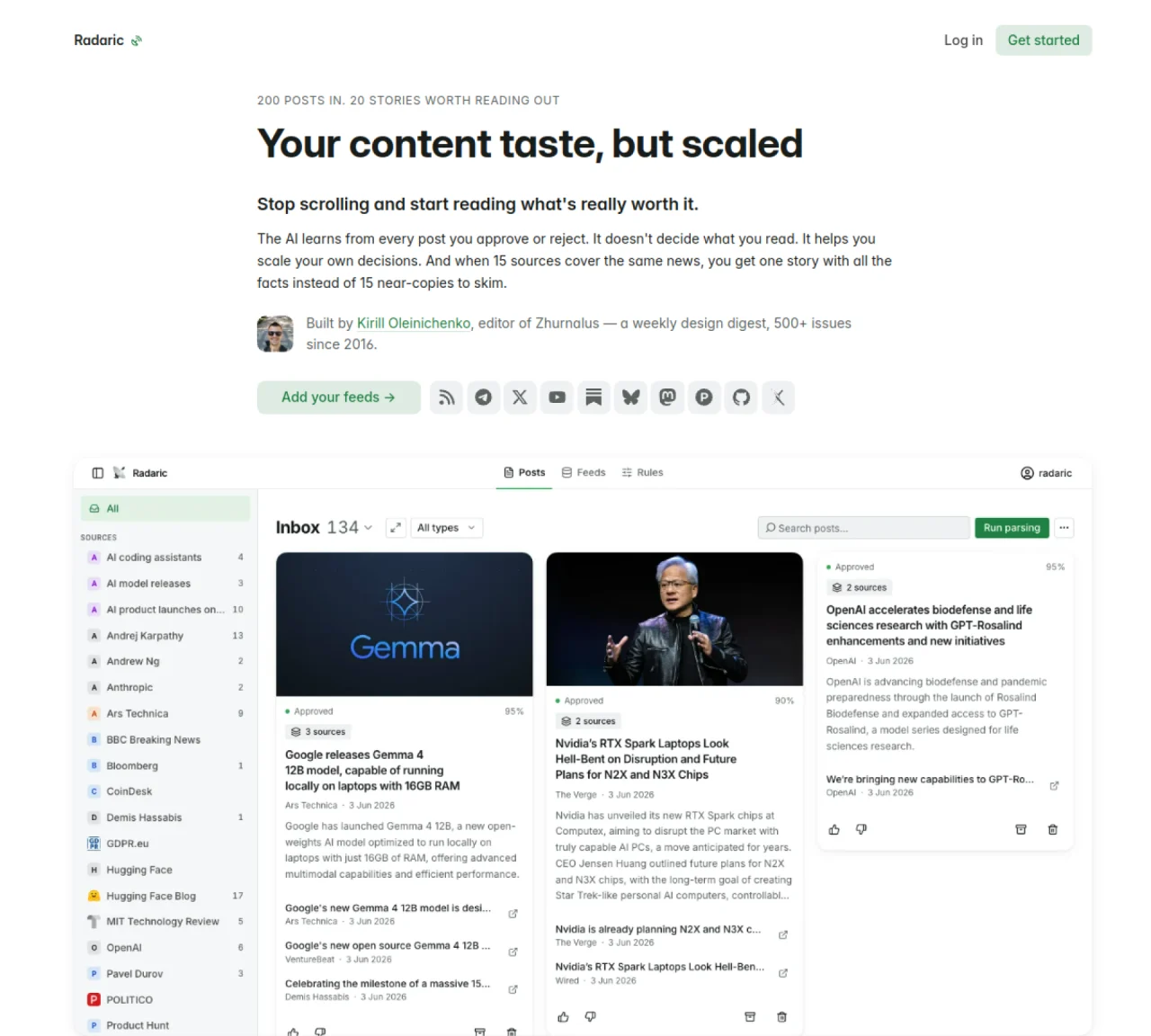
Radaric is an AI-driven content curation platform designed to help users scale their content consumption by filtering and organizing feeds according to personal taste. The tool connects to multiple sources including RSS, Telegram, Twitter/X, YouTube, Substack, Bluesky, Mastodon, Product Hunt, GitHub, and arXiv. It reads YouTube video transcripts directly and processes content from private Telegram channels. Users define their preferences in plain language, and the AI assigns confidence scores and reasons for each post’s inclusion or exclusion. The system learns from user feedback—approvals, rejections, and saved items—refining its filtering over time. Posts that match user preferences are compiled into a concise feed, reducing the time spent triaging content. When the same news appears across multiple sources, Radaric merges them into a single story while preserving links to all original sources. This aggregation works across different languages and source types, ensuring comprehensive coverage without redundancy.
Radaric supports multiple sources beyond RSS, including Telegram (including private channels), Twitter/X, YouTube, Substack, Bluesky, Mastodon, Product Hunt, GitHub, and arXiv. Unlike Feedly or Inoreader, its AI learns from individual user feedback—approvals, rejections, and saved items—tailoring the filtering to personal taste rather than applying a generic AI model.
Radaric connects to Telegram in a read-only mode, meaning it only accesses messages without sending, modifying, or deleting anything. User credentials are stored encrypted to ensure security.
Radaric was built by Kirill Oleinichenko, the editor of Zhurnalus—a weekly design digest with over 500 issues since 2016. He developed Radaric to address his own challenge of efficiently curating content from hundreds of feeds daily.
Yes, Radaric merges and aggregates content across different languages and source types, ensuring comprehensive coverage without redundancy when the same news appears in multiple sources.
Yes, Radaric can read and process YouTube video transcripts directly, allowing it to analyze video content alongside text-based sources.
Rejected posts are not deleted; they remain accessible with one click, allowing users to review the AI's reasoning and provide feedback to improve future filtering.
We use essential cookies to run aitoolnavio™, and optional cookies to analyze traffic and measure our marketing. You choose what we use — optional cookies stay off unless you turn them on. See our Privacy Policy.
One short email a week: fresh tools worth trying, honest takes and the updates that actually matter. No spam, unsubscribe any time.
Generate content, correct spelling, suggest synonyms to enhance writing.
Turn messy team ideas into actionable plans with Miro's visual workspace.
Leverage analytics, automate tasks, share documents, and coordinate projects.
Integrates AI into Airtable to analyze data, summarize insights, draft content, and automate workflows without prior AI experience.
Cloud accounting software that automates bookkeeping, invoicing, and financial reporting for small and growing businesses.
Streamline teamwork, manage projects, automate tasks efficiently.
Automate code, research, and documents using agents.
AI assistant for safe, reliable productivity with code, collaboration, and integrations.
Create customizable tables, databases, and spreadsheets, share data securely with team members.
Easy-to-use CRM platform that automates lead capturing, prioritizes tasks, and provides sales pipeline analytics for businesses of all sizes.
Transforms thoughts into actions, enhancing productivity and efficiency.
Write & run code in 50+ languages, auto-complete with AI, and code faster with an intuitive interface.
Matched on what this tool does — grouped by the job you would be replacing.
Paid placement · similar tools from listings that support aitoolnavio™
Instant lead response for home-service pros: your phone rings on every new lead, plus 14 days of follow-up
matches AI-powered content filtering with confidence scoring · Multi-source integration (RSS, Telegram, Twitter/X, YouTube, Substack, Bluesky, Mastodon, Product Hunt, GitHub, arXiv) · YouTube transcript reading and processing
matches YouTube transcript reading and processing · Story deduplication and merging
Digest aggregates content from multiple sources into a single personalized newsletter delivered to your inbox or accessible via a web app.
Daily podcasts generated from curated news sources and RSS feeds
AI-curated daily email digest of AI and tech news tailored to user preferences
Curate news, learn user preferences, and provide comprehensive news feed on iPhone and Android.
Instant summaries, key topics & chapter breakdowns, auto blog & social media posts, meaningful quotes, hooks & timestamps.
Automatically timestamp and summarize podcast transcripts, find information quickly, and gain valuable insights in seconds.
An AI repurposing platform that transcribes podcasts and videos, then generates summaries, blogs, social posts, and audiograms for creators and teams.
AI-generated summaries of Youtube transcripts with customizable length, manual editing, and input custom prompts.