
AI-powered medical search engine that delivers synthesized, cited answers from peer-reviewed research for clinicians.

Climate Policy Radar
$1Starting price
24KMonthly visits
23Popularity
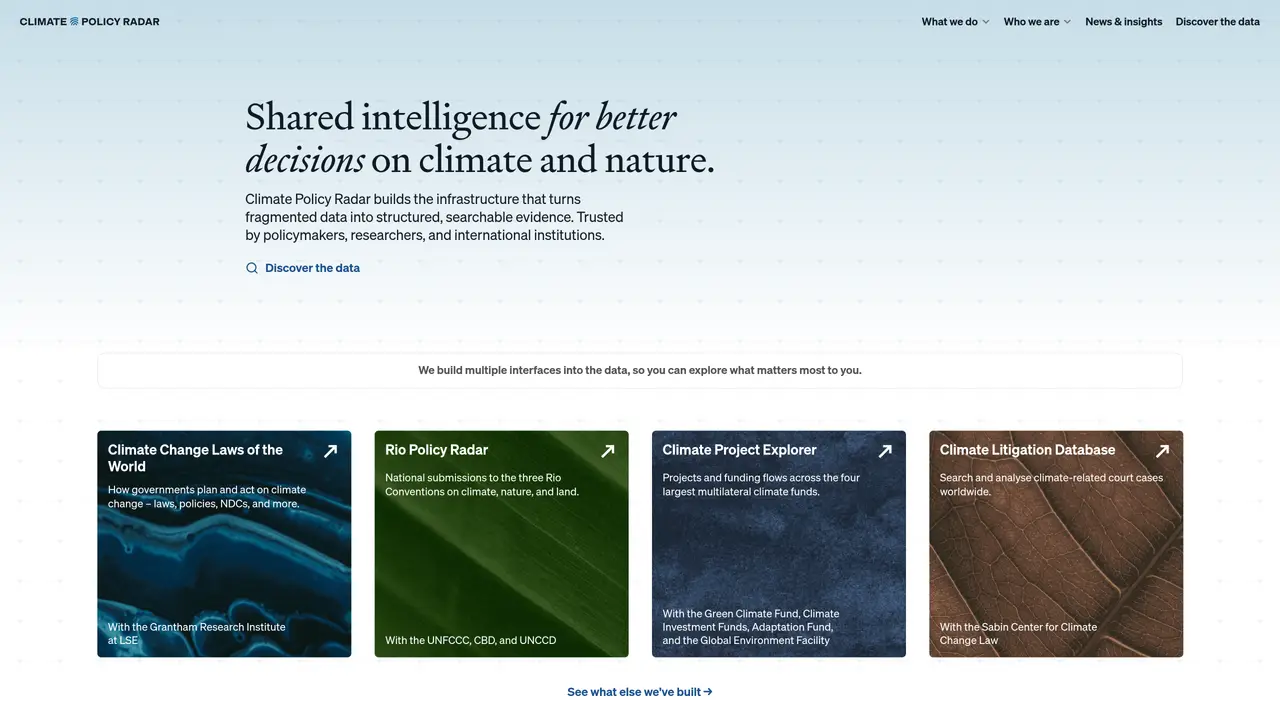
About Climate Policy Radar
Climate Policy Radar is an innovative AI tool designed to streamline the complex world of climate law and policy research. By leveraging advanced data science and artificial intelligence, this platform transforms the vast and scattered documents of climate policies and laws into searchable, accessible, and analyzable information. It is tailored for policymakers, researchers, and advocates dedicated to designing effective climate change strategies and ensuring informed decision-making. The tool provides a comprehensive database of climate policy and law documents from every country, advanced search capabilities, comparative analysis, open data access, and real-time updates. This allows users to significantly reduce the time required to find and analyze relevant policy documents, offering deep analytical capabilities to understand the effectiveness of various climate laws and policies. Climate Policy Radar is used by government agencies, academic researchers, environmental NGOs, legal professionals, and financial analysts to assess environmental risk in investments.
Key features
- Comprehensive database of climate policy and law documents
- Advanced search capabilities with AI-driven analysis
- Comparative analysis of climate action plans and policies
- Open data access for deep dives into policy assessments
- Real-time updates on global climate policy developments
- User-friendly interface for ease of use
Use cases
- Government agencies crafting and revising national climate policies
- Academic researchers conducting scholarly articles and advanced climate research
- Environmental NGOs advocating for stronger climate action and accountability
Pros
- Provides a comprehensive, structured database of global climate policies, laws, litigation records, finance documents, and UN submissions
- Offers advanced search, comparison, and tracing capabilities across tens of thousands of documents using expert-defined AI tools
- Enables real-time updates and open data access, ensuring users work with the most current and reliable information
- Supports integration into existing workflows or systems via API and MCP for seamless adoption
- Trusted by policymakers, researchers, international institutions, and local leaders worldwide
Cons
- May require familiarity with climate policy terminology to fully leverage advanced search and analysis features
- Dependence on institutional partnerships for data updates could introduce slight delays in coverage for some regions
- Access to certain specialized tools or datasets may require direct contact or early access requests
Frequently asked questions about Climate Policy Radar
What is Climate Policy Radar and what does it do?
Climate Policy Radar is an AI-powered platform that transforms fragmented climate policy and law documents into structured, searchable, and analyzable data. It provides comprehensive databases of climate policies, laws, litigation records, finance documents, and UN submissions from every country, enabling users to explore, compare, and trace relevant information efficiently.
Who should use Climate Policy Radar?
The tool is designed for policymakers, researchers, legal professionals, environmental NGOs, financial analysts, and academic institutions involved in climate change strategy, risk assessment, and policy analysis. It is also used by international institutions and local leaders to inform decision-making.
How does Climate Policy Radar organize and update its data?
Climate Policy Radar partners with institutions holding climate-related data to ensure its database is updated in real-time as new documents emerge. Expert-defined AI tools organize and map concepts across tens of thousands of documents, making it easier to surface relevant information.
Can Climate Policy Radar be integrated into existing workflows or systems?
Yes, users can access Climate Policy Radar’s data through its tools or connect it directly into their own systems via API and MCP. The platform is designed to be co-developed with users to ensure seamless integration into research, workflows, or products.
What types of documents and data does Climate Policy Radar cover?
The platform covers laws, policies, litigation records, finance documents, UN submissions, and more, spanning domains such as climate change, nature conservation, and land use. It includes data from initiatives like the Climate Change Laws of the World, Rio Policy Radar, Climate Project Explorer, and Climate Litigation Database.
How does Climate Policy Radar help reduce time-to-insight for users?
By providing structured, searchable, and expert-validated data, Climate Policy Radar significantly reduces the time required to find, compare, and analyze relevant climate policies and laws. Users report saving hundreds of thousands of hours by leveraging its AI-powered tools and databases.
Climate Policy Radar Website Engagement
Last Update: 9 days ago
Total Monthly Visits
0
Bounce Rate
0%
Visit Duration (avg)
0.00s
Pages Per Visit
0
Country Rank
0
United Kingdom
Global Rank
0
Category Rank
#0
Government
Monthly Traffic
Traffic Sources
Traffic Share By Country
- United States18.6%
- United Kingdom15.1%
- India12.7%
- Italy12.3%
- Philippines8.6%