
AI video generation tool that creates videos from text prompts, images, or reference clips with strong character consistency.

PicWav
$10/mStarting price
0Popularity
About PicWav
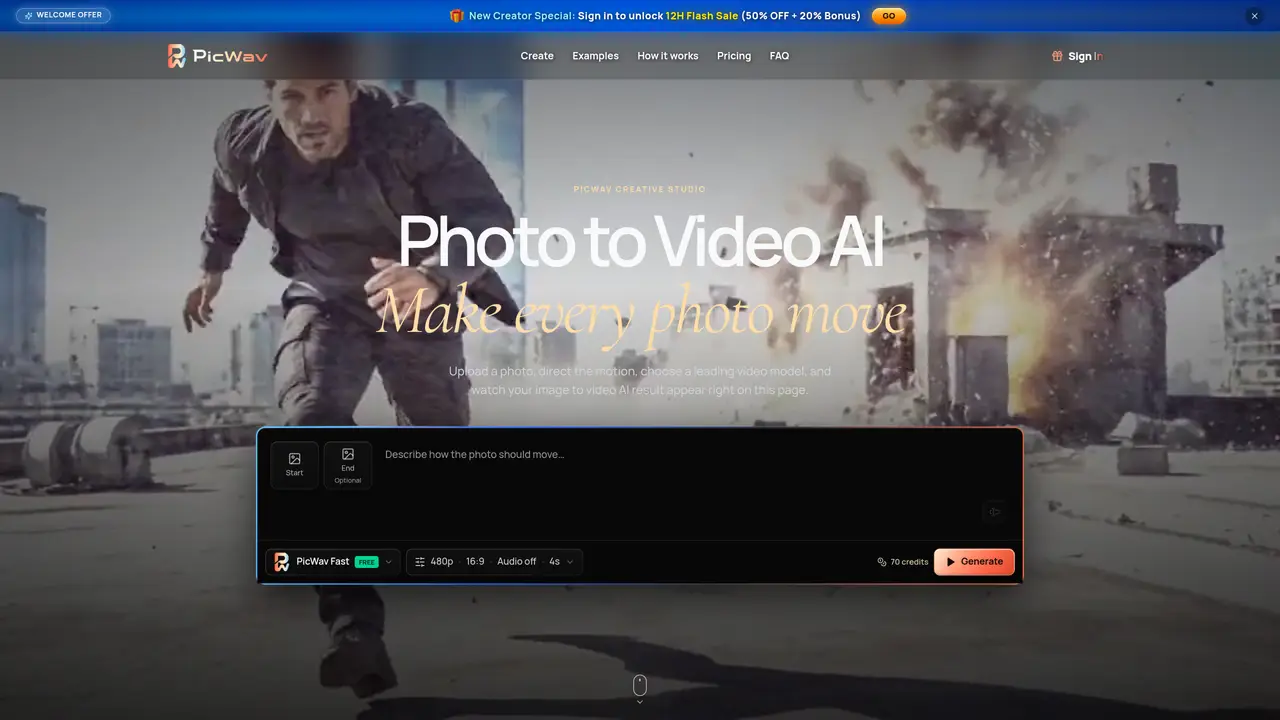
PicWav converts single images into short videos by applying AI-driven motion and camera movements. Users upload a photo and direct the motion through text prompts, selecting from preset motion directions or customizing camera behavior. The tool supports start and end frames for guided transitions, allowing precise control over the generated movement. Multiple video models are available, each offering different balances of speed, quality, resolution, and audio handling. Outputs can be tailored to various aspect ratios and durations, with settings adjusted for social media, product showcases, or cinematic styles. The process remains entirely browser-based, enabling upload, direction, generation, and review within a single workspace. PicWav emphasizes preserving the original image’s identity while adding natural-looking motion and atmosphere.
Key features
- Motion direction via text prompts
- Start and end frame guidance
- Multiple aspect ratio outputs
- Model selection for quality and speed
- Prompt enhancement for detailed motion
- Watermark-free video downloads
- Commercial rights for generated videos
- Cloud storage for generated videos
Use cases
- Transforming product photos into animated ads or social posts
- Adding cinematic motion to personal photos or memories
- Creating dynamic visuals for social media content
Pros
- Preserves original image identity and proportions during motion
- Supports start and end frames for guided transitions
- Multiple video models with adjustable quality and speed
- Browser-based workflow without external software
- Watermark-free exports for commercial use
Cons
- No free tier beyond limited trial credits
- Outputs stored for limited durations (30–180 days)
- Requires credits for generation beyond trial
- Single image input per project
Frequently asked questions about PicWav
What is PicWav and what does it do?
PicWav is an AI-powered tool that converts still images into short videos by applying motion and camera movements. Users upload a photo, direct the motion through text prompts, and select from various video models to generate a video while preserving the original image’s identity.
Who is PicWav designed for?
PicWav is designed for creators, marketers, and businesses who need to animate photos for social media, product showcases, or cinematic styles without additional shoots. It suits users who want precise control over motion and camera behavior.
How does PicWav guide the motion in generated videos?
PicWav allows users to direct motion using plain language prompts, such as specifying subtle smiles, drifting fabric, or camera orbits. The tool also supports start and end frames to guide transitions, ensuring the motion aligns with the user’s vision.
What video models are available in PicWav?
PicWav offers multiple video models, including PicWav Fast, Seedance 2.0 Mini, Hailuo 2.3, Kling 3.0 Pro, Veo 3.1, and Wan 2.7. Each model balances speed, quality, resolution, audio handling, and frame control differently to suit various project needs.
Can PicWav handle different aspect ratios and durations?
Yes, PicWav supports various aspect ratios (e.g., vertical 9:16, square 1:1, wide 16:9) and adjustable durations. Users can tailor outputs to specific platforms or styles, with unsupported options hidden to simplify the process for beginners.
How do I get started with PicWav?
To get started, upload a photo in JPG, PNG, or WebP format, direct the motion using text prompts, select a video model, and generate the video. The entire process—uploading, directing, generating, and reviewing—occurs within a single browser-based workspace.