OpenAI builds and deploys advanced AI models like GPT-4o for autonomous agents and workflows.

NeuralCleave
FreeStarting price
0Popularity
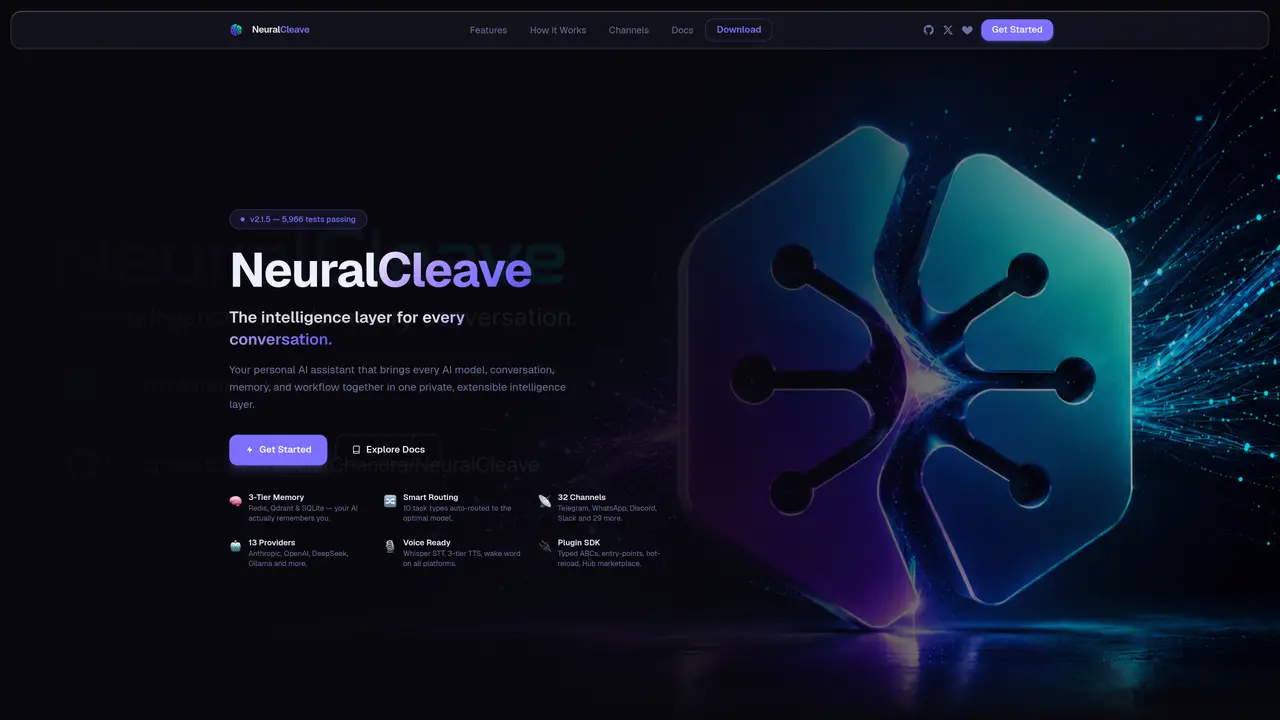
About NeuralCleave
NeuralCleave functions as a local-first intelligence layer that connects multiple AI models, conversation channels and memory systems into a single interface. It ingests messages from 32 supported platforms including Telegram, WhatsApp and Slack, then enriches each request with a three-tier memory system combining Redis hot cache, Qdrant vector search and SQLite long-term storage. A task-aware router automatically selects the optimal provider from 13 supported LLMs based on the request type, ranging from complex reasoning with Claude Opus to local inference with Ollama. Before delivering a response, the ReflectionEngine scores the output across relevance, completeness, accuracy and tone, regenerating low-scoring replies once. The system supports voice input via Whisper STT and three-tier text-to-speech, with wake-word detection available across all platforms. A plugin SDK allows typed Python extensions with hot-reload and a marketplace for verified packages, while a multi-agent orchestrator enables named nodes with model overrides and priority-based routing.
Key features
- 32 channel adapters for messaging platforms
- 13 supported LLM providers with automatic routing
- Three-tier memory system with Redis, Qdrant and SQLite
- ReflectionEngine quality scoring and auto-regeneration
- Voice pipeline with STT, TTS and wake-word detection
- Plugin SDK with typed Python ABCs and hot-reload
- Multi-agent orchestrator with named nodes and priority routing
- Prometheus observability with built-in metrics and Grafana dashboard
Use cases
- Daily briefing automation with calendar and email integration
- Developer assistance across Slack, voice and terminal commands
- Persistent research agent with cross-session memory and note export
Pros
- Unified interface for 32 messaging channels and 13 LLM providers
- Three-tier memory system combining hot, vector and long-term storage
- Task-aware model routing across 10 request types
- Local-first operation with optional privacy mode
- Plugin SDK with hot-reload and marketplace verification
Cons
- No explicit free tier or open-source availability mentioned
- Voice features require local device resources
- Plugin ecosystem depends on marketplace verification
Frequently asked questions about NeuralCleave
What is NeuralCleave and what does it do?
NeuralCleave is a local-first intelligence layer that unifies multiple AI models, conversation channels, and memory systems into a single interface. It processes messages from 32 supported platforms, enriches requests with a three-tier memory system, and routes tasks to the optimal LLM provider based on request type.
Who is NeuralCleave designed for?
NeuralCleave is designed for users who need a unified, private, and extensible AI assistant capable of handling complex workflows across multiple platforms and models. It suits developers, researchers, and individuals seeking persistent memory and multi-agent orchestration.
How does NeuralCleave handle memory and context?
NeuralCleave uses a three-tier memory system combining Redis for hot cache, Qdrant for vector semantic search, and SQLite for long-term storage. This allows the AI to remember past conversations, preferences, and facts across sessions while maintaining per-agent namespace isolation.
Does NeuralCleave support voice input and output?
Yes, NeuralCleave includes a voice pipeline with local Whisper STT for speech-to-text, three-tier TTS for text-to-speech, and wake-word detection across all platforms. Voice cloning is also supported, and everything runs on-device for privacy.
Can I extend NeuralCleave with custom functionality?
Yes, NeuralCleave provides a plugin SDK with typed Python ABCs, hot-reload support, and a marketplace for verified packages. The system also supports a multi-agent orchestrator with named nodes, model overrides, and priority-based routing.
How do I get started with NeuralCleave?
Users can get started by downloading the application from the official website, exploring the documentation, and configuring supported channels and models. The system offers a desktop app, PWA, and REST/CLI management for setup and customization.