An AI-driven experience management platform for enterprises to collect multi-channel feedback, analyze structured and unstructured data, and deliver actionable insights.

Data Analysis GPT
$20Starting price
0Popularity
About Data Analysis GPT
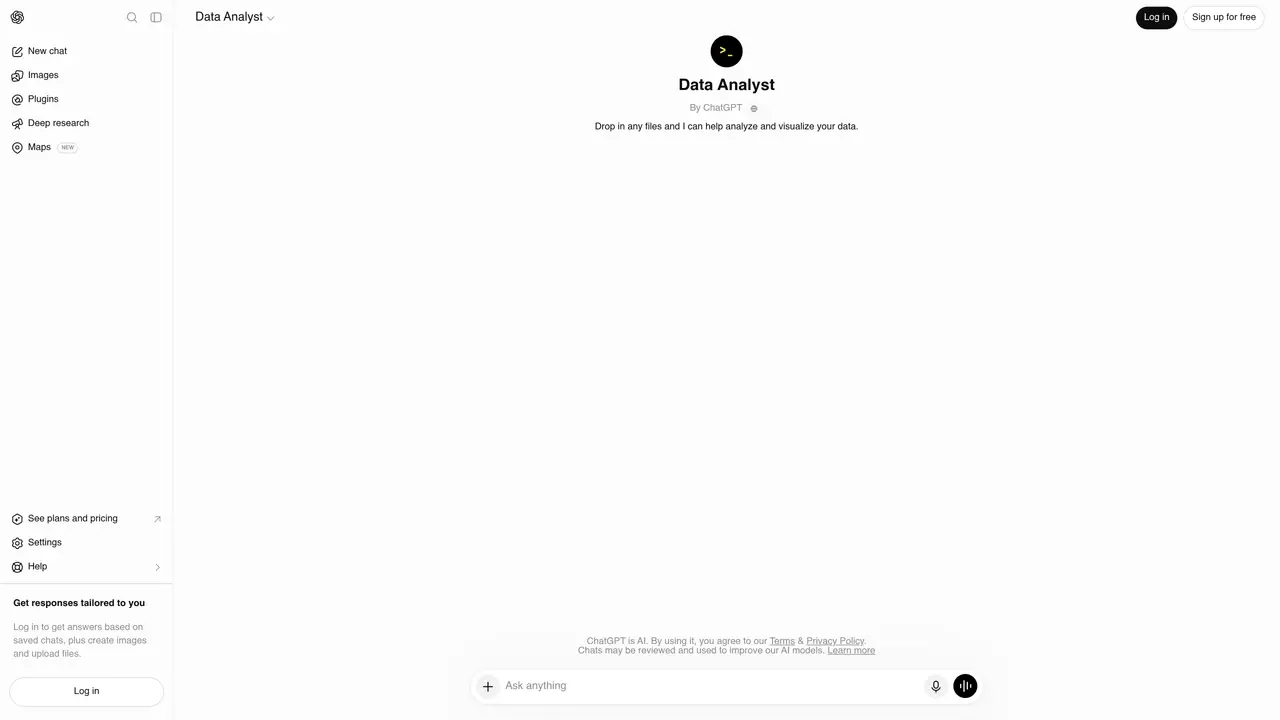
Developed by OpenAI, Data Analysis GPT is a chatbot designed to simplify data analysis for users without requiring advanced technical skills. It allows you to upload datasets in formats like spreadsheets or text documents and then pose questions or requests in plain language. The tool performs calculations on existing tables and fields, returning computed results directly. While it can generate graphs, users must explicitly request visualizations. Its conversational interface makes it accessible to professionals such as data analysts and researchers who need quick insights without writing code. The tool relies on a ChatGPT subscription, which is required to access its capabilities. It streamlines workflows by automating routine analysis tasks and providing immediate answers, reducing the time spent on manual calculations or data exploration.
OpenAI
San Francisco, California, US · Founded 2015
- Founders
- Sam Altman, Greg Brockman, Ilya Sutskever, Elon Musk, Wojciech Zaremba, John Schulman
- Founded
- 2015
- Headquarters
- San Francisco, California, US
- Legal status
- Private (capped-profit)
Key features
- Upload and analyze spreadsheets or text documents
- Answer questions about your data in natural language
- Perform calculations on existing tables and fields
- Generate graphs upon explicit request
- Provide quick, accurate results without coding
- Accessible via ChatGPT interface
- Supports data analysts and researchers
- Delivers computed results directly
Use cases
- Analyze Excel sheets for trends or summaries
- Extract insights from text documents
- Automate routine data calculations
Pros
- Enables data analysis without requiring advanced technical skills or coding knowledge
- Accepts datasets in common formats like spreadsheets or text documents for direct upload
- Allows users to pose questions or requests in plain language for intuitive interaction
- Performs calculations on existing tables and fields to return computed results automatically
- Provides immediate answers and reduces time spent on manual calculations or data exploration
Cons
- Requires a ChatGPT subscription to access its capabilities
- Visualizations must be explicitly requested by the user and are not generated automatically
- Dependent on the underlying ChatGPT model, which may have limitations in handling highly complex datasets
Frequently asked questions about Data Analysis GPT
What is Data Analysis GPT and how does it work?
Data Analysis GPT is a specialized version of ChatGPT designed to assist with data analysis tasks. Users can upload datasets in formats like spreadsheets or text documents and interact with the tool using plain language queries to perform calculations, generate insights, and request visualizations.
Who is Data Analysis GPT suitable for?
The tool is suitable for professionals such as data analysts, researchers, and business users who need to analyze data without requiring advanced technical skills like coding. It is particularly useful for those seeking quick insights and automated analysis.
Is a ChatGPT subscription required to use Data Analysis GPT?
Yes, access to Data Analysis GPT requires a ChatGPT subscription, as it operates within the ChatGPT platform. Users must log in to utilize its capabilities, including file uploads and tailored responses.
Can Data Analysis GPT generate visualizations like graphs and charts?
Yes, the tool can generate graphs and charts, but users must explicitly request visualizations as part of their queries. It does not automatically produce visual outputs without direct instruction.
What types of datasets can be uploaded to Data Analysis GPT?
Users can upload datasets in common formats such as spreadsheets (e.g., CSV, Excel) or text documents. The tool processes these files to perform calculations and provide insights based on the uploaded data.
How do I get started with Data Analysis GPT?
To get started, log in to ChatGPT, navigate to the Data Analysis GPT interface, and upload your dataset. You can then ask questions or provide instructions in plain language to begin analyzing the data and receiving computed results.