An AI-driven experience management platform for enterprises to collect multi-channel feedback, analyze structured and unstructured data, and deliver actionable insights.

Looker
0Popularity
About Looker
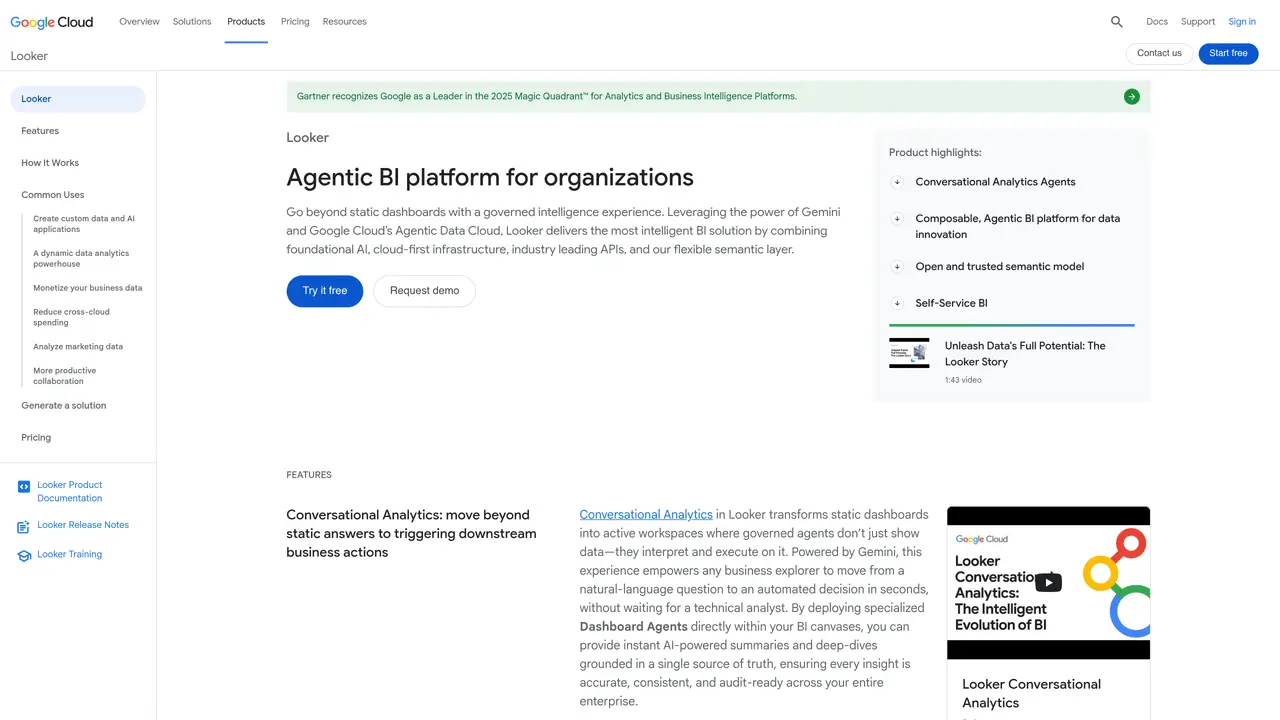
Looker is a web-based enterprise business intelligence (BI) and embedded analytics platform designed for organizations that require governed access to trusted, near-real-time data across teams. It provides a centralized semantic modeling layer called LookML, which allows teams to define business logic once with Git version control and generate efficient SQL queries for consistent metrics. The platform supports dashboards, reports, and self-service exploration with features like filtering, drill-down to row-level detail, scheduling, and export options. Looker also offers embedded analytics and APIs to integrate interactive dashboards into external products, including signed embedding, custom themes, and private labeling in the Embed edition. It integrates with Looker Studio for combining governed BI with ad hoc, drag-and-drop reporting. The platform is built for deep Google Cloud integration, including BigQuery for scalable, in-database processing, and supports data workflows and embedded analytics. Its model-first approach centralizes business definitions as a single source of truth, ensuring consistency and governance across the organization.
Key features
- LookML semantic modeling layer with Git version control
- Dashboards, reports, and self-service exploration
- Embedded analytics with APIs for external integration
- Signed embedding, custom themes, and private labeling
- Looker Studio integration for ad hoc reporting
- Governed access to trusted, near-real-time data
- BigQuery integration for scalable in-database processing
- Row-level detail drill-down and filtering
- Scheduling and export options for reports
- Advanced security and compliance features
Use cases
- Automating reports for business analysts and executives
- Embedding interactive dashboards into customer-facing applications
- Centralizing business definitions as a single source of truth for data governance
Pros
- Centralized semantic modeling with LookML for consistent, governed metrics across teams
- Deep integration with Google Cloud services like BigQuery for scalable, in-database processing
- Supports embedded analytics with APIs for integrating interactive dashboards into external products
- Git version control for collaborative development and management of business logic
- Combines governed BI with ad hoc reporting via integration with Looker Studio
Cons
- Model-first approach may require initial setup time for defining business logic
- Primarily optimized for Google Cloud ecosystems, limiting flexibility for non-Google data sources
- Advanced features like embedded analytics may require technical expertise to implement effectively
Frequently asked questions about Looker
What is Looker primarily used for?
Looker is a business intelligence and embedded analytics platform designed for organizations needing governed access to trusted, near-real-time data across teams.
Who is Looker best suited for?
It suits enterprises and teams requiring consistent, scalable analytics with deep integration into Google Cloud, particularly those using BigQuery.
How does Looker handle data governance?
Looker centralizes business definitions in a semantic modeling layer called LookML, ensuring a single source of truth and consistent metrics across the organization.
Can Looker integrate with non-Google data sources?
While optimized for Google Cloud, Looker can connect to other data sources, but advanced features like embedded analytics are best leveraged within Google’s ecosystem.
Does Looker support real-time data processing?
Yes, Looker supports near-real-time data processing, particularly when integrated with Google Cloud services like BigQuery.
What are the key features of Looker’s embedded analytics?
Looker’s embedded analytics includes signed embedding, custom themes, private labeling, and APIs to integrate interactive dashboards into external products.