GitHub hosts HunyuanVideo, Tencent's open-source framework for large-scale video generation models, enabling AI-driven video creation.

Microsoft Phi
0Popularity
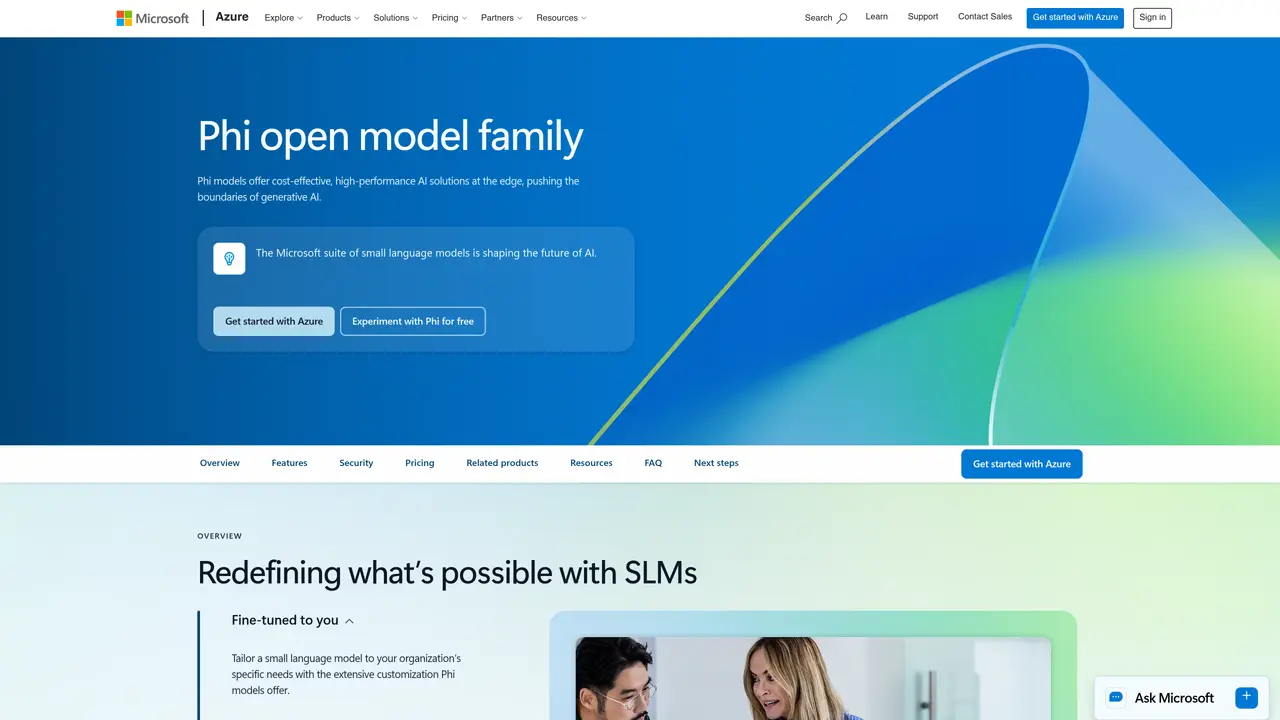
About Microsoft Phi
Microsoft Phi is a family of compact, instruction-tuned language models designed for practical accuracy where latency, privacy, and cost are critical. The models run through Azure-managed endpoints for cloud deployment or are exported as ONNX packages for local execution on devices, enabling consistent performance across cloud, client, and edge scenarios. Teams can prototype in Azure, then scale with cloud endpoints or deploy on-device for offline resilience and privacy-sensitive use cases. Phi supports chat, summarization, extraction, and lightweight reasoning, often paired with retrieval to ground answers in private enterprise data for improved factuality and compliance. Quantization via Olive reduces memory footprints without major quality loss, while ONNX Runtime accelerates inference across CPUs, GPUs, and NPUs to meet strict latency targets on commodity hardware. The same model family serves both cloud and edge, simplifying operations and reducing infrastructure overhead for developers and architects targeting Windows clients, kiosks, or edge gateways with limited bandwidth.
Microsoft
Redmond, United States · Founded 1975
- Founders
- Bill Gates, Paul Allen
- Founded
- 1975
- Headquarters
- Redmond, United States
- Legal status
- Public company
Key features
- Compact, instruction-tuned models optimized for quality per parameter
- Cloud deployment via Azure-managed endpoints with autoscaling and governance
- Local execution through ONNX Runtime on CPUs, GPUs, and NPUs
- Quantization support via Olive to reduce memory and improve tokens-per-second
- Retrieval-augmented generation (RAG) for grounding answers in private data
- Multimodal variants available alongside language models
- Single model family spanning cloud, client, and edge scenarios
- Hardware-accelerated inference for low-latency assistants
- Documentation and quickstarts for deployment and security controls
Use cases
- Embedding chat assistants in productivity applications with low latency
- On-device processing for privacy-sensitive or offline workflows
- Document summarization and extraction in enterprise workflows
Pros
- Supports both cloud and on-device deployment for flexibility in latency, privacy, and cost optimization
- Uses ONNX Runtime to accelerate inference across diverse hardware including CPUs, GPUs, and NPUs
- Quantization via Olive reduces memory footprint with minimal quality degradation
- Designed for practical accuracy in scenarios where latency and privacy are critical
- Enables offline resilience and privacy-sensitive use cases through local execution
Cons
- May require additional setup for local deployment compared to cloud-only solutions
- Quantization and ONNX conversion processes could introduce complexity for some users
- Performance on edge devices depends on hardware capabilities and model optimization
- Limited to the Phi model family, which may not cover all specialized use cases
Frequently asked questions about Microsoft Phi
What is Microsoft Phi?
Microsoft Phi is a family of compact, instruction-tuned language models optimized for practical accuracy in scenarios prioritizing latency, privacy, and cost efficiency.
Who should use Microsoft Phi?
Developers and architects targeting cloud, client, or edge scenarios with strict latency, privacy, or bandwidth constraints would benefit from using Microsoft Phi.
How does Microsoft Phi handle deployment?
Phi models can be deployed via Azure-managed endpoints for cloud use or exported as ONNX packages for local execution on devices, supporting both online and offline scenarios.
What hardware does Microsoft Phi support?
Phi models leverage ONNX Runtime to accelerate inference across CPUs, GPUs, and NPUs, ensuring consistent performance on commodity hardware.
Can Microsoft Phi integrate with private enterprise data?
Yes, Phi supports retrieval-augmented workflows to ground answers in private enterprise data, improving factuality and compliance for sensitive use cases.
How do I get started with Microsoft Phi?
Teams can begin prototyping in Azure and then scale with cloud endpoints or deploy on-device for offline use, with tools like Olive available for quantization and optimization.