GitHub hosts HunyuanVideo, Tencent's open-source framework for large-scale video generation models, enabling AI-driven video creation.

Reformer
$0.07Starting price
0Popularity
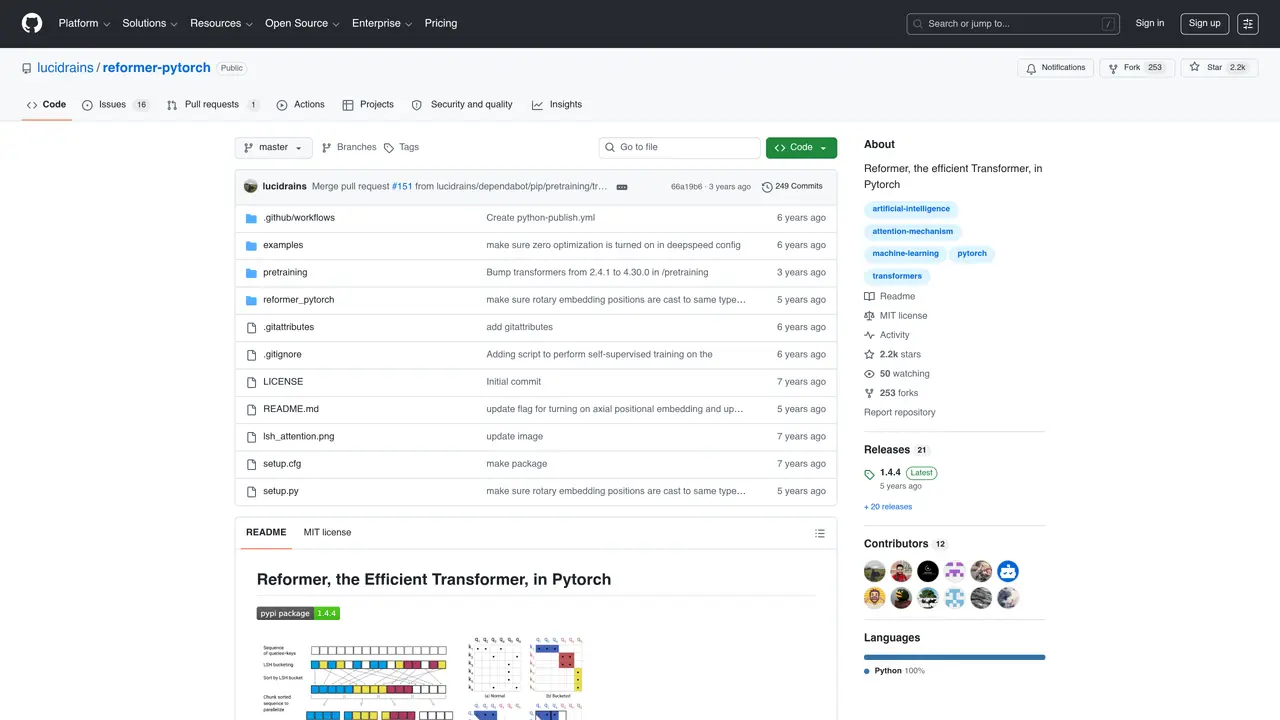
About Reformer
Reformer is an efficient and powerful deep learning library for Natural Language Processing (NLP). The library is designed for fast development and experimentation, allowing developers to quickly train models and deploy them in production. Reformer provides an array of features that make it an ideal choice for NLP applications. It has a flexible architecture that allows for quick adaptation to new tasks, a lightweight memory footprint, and a high-performance backend that enables faster model training. Additionally, Reformer features various tools and methods, such as Transformer and RNN architectures, that help developers build and deploy models quickly and easily. Reformer is easy to use and requires minimal coding, making it an excellent choice for both novice and experienced developers alike. With its robust features and capabilities, Reformer is the perfect tool for building and deploying powerful NLP models with optimal speed and accuracy.
GitHub, Inc.
San Francisco, California, US · Founded 2008
- Founders
- Tom Preston-Werner, Chris Wanstrath, PJ Hyett, Scott Chacon
- Founded
- 2008
- Headquarters
- San Francisco, California, US
- Legal status
- Subsidiary of Microsoft (NASDAQ: MSFT)
Key features
- Flexible architecture for quick adaptation to new tasks
- Lightweight memory footprint
- High-performance backend for faster model training
- Transformer and RNN architectures
- Easy to use with minimal coding
- Ideal choice for NLP applications
Use cases
- Quickly train models and deploy them in production
- Build and deploy powerful NLP models with optimal speed and accuracy
- Adapt to new tasks easily with Reformer's flexible architecture
Pros
- Implements LSH (Locality-Sensitive Hashing) attention for efficient long-sequence processing
- Includes reversible network architecture to reduce memory usage during training
- Supports chunking for processing sequences beyond typical memory limits
- Validated on auto-regressive tasks with sequences up to 81k tokens in half precision
- Provides flexible configuration options for attention mechanisms and memory optimizations
Cons
- Requires familiarity with PyTorch and deep learning concepts for effective use
- Memory savings depend heavily on configuration choices like chunking and bucket sizes
- Not all features may be compatible with standard Transformer workflows
- Performance gains are most noticeable with very long sequences
Frequently asked questions about Reformer
What is Reformer and what does it do?
Reformer is a PyTorch implementation of the efficient Transformer architecture designed to handle long sequences with reduced memory and computational overhead. It replaces standard self-attention with locality-sensitive hashing (LSH) attention, reversible layers, and chunking to enable processing of sequences up to 32k tokens or more.
Who should use Reformer?
Reformer is intended for researchers and developers working on natural language processing tasks that require handling long sequences, such as language modeling, document analysis, or time-series prediction. It is particularly useful for those needing scalable attention mechanisms without excessive memory usage.
How does Reformer improve upon traditional Transformers?
Reformer reduces memory and compute requirements by using LSH attention to approximate full self-attention, reversible network layers to reduce memory footprint during training, and chunking to process sequences in manageable segments. This allows it to scale to much longer sequences than standard Transformers.
What are the key components of Reformer?
The key components include LSH attention for efficient attention computation, reversible layers for memory-efficient training, chunking for processing long sequences, and optional features like product key memory (PKM) and local attention heads to enhance performance on specific tasks.
How do I get started with Reformer?
To get started, install the library via pip and import the Reformer or ReformerLM classes. Configure the model with parameters like sequence length, number of layers, and attention settings, then train or evaluate on your dataset. Example code is provided in the repository for quick setup.
Does Reformer support auto-regressive tasks?
Yes, Reformer supports auto-regressive tasks such as language modeling. The library includes a ReformerLM class specifically designed for causal (auto-regressive) modeling, with options to control dropout, attention mechanisms, and memory usage.