GitHub hosts HunyuanVideo, Tencent's open-source framework for large-scale video generation models, enabling AI-driven video creation.

Retrivora AI
FreeStarting price
0Popularity
About Retrivora AI
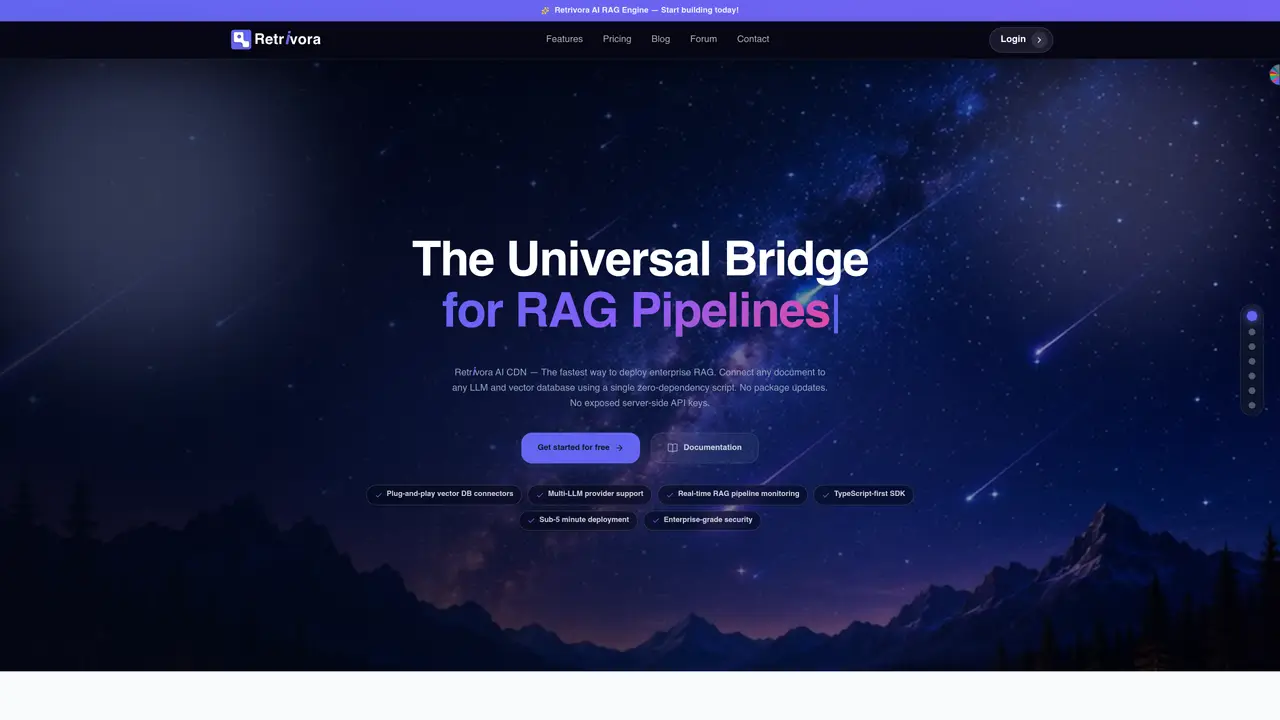
Retrivora AI provides a TypeScript-first SDK and CDN-based deployment for building Retrieval-Augmented Generation (RAG) pipelines. It ingests documents, splits them into context-aware chunks, and converts segments into embeddings using an LRU cache to avoid redundant API calls. The system supports parallel batch processing for embeddings and vector upserts, enabling fast document indexing across multiple vector databases. It integrates with major LLM providers such as OpenAI, Anthropic, and Google Gemini, as well as local models via Ollama and Qwen. Retrivora abstracts provider-specific APIs into a unified interface, allowing developers to switch models or databases without code changes. The platform includes real-time monitoring of RAG pipelines and exposes detailed logs for debugging, including sources, latency, and token usage. It is designed for teams building knowledge bases, document Q&A systems, or AI assistants requiring traceable, grounded responses.
Key features
- Zero-dependency CDN deployment
- Context-aware document chunking at natural boundaries
- LRU embedding cache with 500-entry limit
- Parallel batch processing for embeddings
- Multi-LLM provider support (OpenAI, Anthropic, Gemini, Groq, local models)
- Multi-vector database support (Pinecone, PostgreSQL, MongoDB, Milvus, Qdrant, etc.)
- Real-time RAG pipeline monitoring
- Project namespace isolation for multi-tenancy
Use cases
- Building enterprise knowledge base Q&A systems
- Document search with semantic retrieval
- Production-grade AI assistants with traceable responses
Pros
- Zero-dependency deployment via CDN script
- Supports multi-LLM providers and vector databases
- LRU embedding cache to reduce API costs
- Real-time pipeline monitoring and debugging
- TypeScript-first SDK with plug-and-play connectors
Cons
- Free tier limited to 25 documents and 500 request units
- No explicit support for Python or other non-TypeScript languages
- Enterprise features require paid plans
Frequently asked questions about Retrivora AI
What is Retrivora AI and what does it do?
Retrivora AI is a universal RAG engine that provides a TypeScript-first SDK and CDN-based deployment for building Retrieval-Augmented Generation pipelines. It ingests documents, splits them into context-aware chunks, converts segments into embeddings with an LRU cache, and supports parallel batch processing for fast indexing across multiple vector databases.
Who should use Retrivora AI?
Retrivora AI is designed for developers and teams building knowledge bases, document Q&A systems, or AI assistants that require traceable, grounded responses. It suits those who want to integrate RAG pipelines without managing multiple provider-specific APIs or infrastructure.
How does Retrivora AI integrate with existing tools and services?
Retrivora AI integrates with major LLM providers such as OpenAI, Anthropic, and Google Gemini, as well as local models via Ollama and Qwen. It also supports multiple vector databases, including Pinecone, PostgreSQL (pgvector), MongoDB Atlas, Milvus, and Qdrant, abstracting provider-specific APIs into a unified interface.
Can I use Retrivora AI with my own vector database or LLM?
Yes, Retrivora AI supports a wide range of vector databases and LLM providers, including both cloud-based and local models. It provides adapters to unify diverse SDKs into a single, standardized API layer, allowing you to switch providers without code changes.
How do I get started with Retrivora AI?
You can get started by adding the Retrivora AI SDK to your project via an HTML script tag or npm package. The platform offers a free tier and detailed documentation to help you integrate document ingestion, vector search, and grounded LLM citations into a single typed pipeline.
Does Retrivora AI provide real-time monitoring and debugging features?
Yes, Retrivora AI includes real-time monitoring of RAG pipelines and exposes detailed logs for debugging, including sources, latency, token usage, and retrieval data. This allows developers to inspect and optimize their pipelines as needed.