GitHub hosts HunyuanVideo, Tencent's open-source framework for large-scale video generation models, enabling AI-driven video creation.

TraceLogicAI
$29/mStarting price
0Popularity
About TraceLogicAI
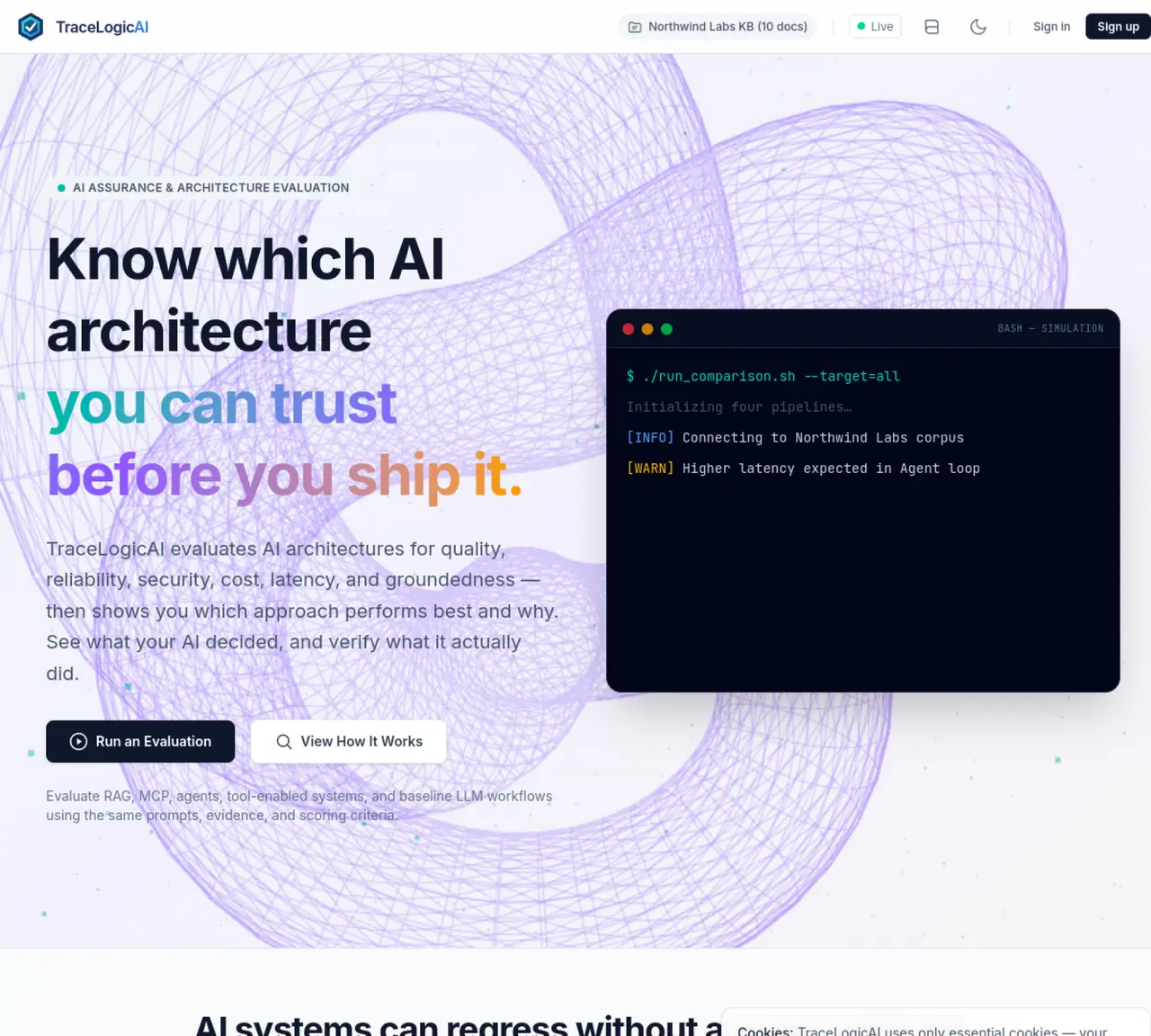
TraceLogicAI is a platform designed to systematically evaluate and compare AI system architectures by executing the same prompt across multiple approaches, including plain large language models, retrieval-augmented generation (RAG), model context protocol (MCP), agent workflows, and security-aware pipelines. Each architecture run produces a final output alongside detailed execution evidence, allowing teams to assess performance under consistent criteria. The tool measures key metrics such as quality, reliability, security, cost efficiency, latency, and groundedness, enabling organizations to determine which architectural configuration best suits a specific task before deployment. By providing a controlled environment for testing, TraceLogicAI helps identify improvements or regressions in system behavior, such as changes in model performance, prompt effectiveness, retrieval quality, tool integration, or workflow design. It addresses critical gaps in traditional software testing for AI systems, which often fail to detect subtle issues like increased hallucinations, elevated operational costs, or hidden security vulnerabilities. Additionally, TraceLogicAI offers runtime assurance by validating the actual behavior of AI systems during real user interactions, ensuring alignment between declared intent and executed actions. This helps uncover discrepancies such as unauthorized tool usage or undeclared activities, enhancing transparency and trust in AI deployments.
Key features
- Multi-architecture evaluation (RAG, MCP, agents, tool-enabled systems)
- Consistent scoring across quality, reliability, security, cost, latency, and groundedness
- Execution traces and step-by-step breakdowns for each run
- Runtime assurance with live trace-fidelity mismatch detection
- Governance checks for data access permissions and least-privilege enforcement
- Remediation engine with exportable control checklists
- Run history and dashboard analytics
- Decision profiles summarizing performance trade-offs
Use cases
- Comparing RAG, MCP, and agent workflows for a customer support chatbot
- Evaluating the impact of model or prompt changes before production deployment
- Validating security-aware pipelines against OWASP/CWE guidelines
Pros
- Compares multiple AI architectures under identical conditions
- Provides execution traces and evidence for every run
- Evaluates quality, reliability, security, cost, latency, and groundedness
- Offers runtime assurance to verify real AI behavior against declared intent
- Includes governance features such as permission checks and least-privilege enforcement
Cons
- Free tier limited to five-pipeline comparisons
- Real-time assurance requires a paid Pro subscription
- No public API access mentioned
Frequently asked questions about TraceLogicAI
What does TraceLogicAI do?
TraceLogicAI evaluates AI architectures by running the same prompt through multiple approaches—plain LLM, RAG, MCP, agent workflows, and security-aware pipelines—under consistent criteria. It assesses quality, reliability, security, cost, latency, and groundedness to help teams determine which architecture performs best for a given task.
Who should use TraceLogicAI?
Teams developing AI systems, including engineers, architects, and product managers, use TraceLogicAI to verify AI behavior before deployment. It is particularly useful for those concerned with silent regressions, such as increased hallucinations, higher costs, or security vulnerabilities.
How does TraceLogicAI help detect issues in AI systems?
TraceLogicAI detects silent regressions by comparing AI system behavior across different architectures and configurations. It provides execution evidence and scoring to identify changes that may degrade performance, such as reduced correctness, increased latency, or security vulnerabilities.
What types of AI architectures can TraceLogicAI evaluate?
TraceLogicAI can evaluate plain LLM workflows, RAG systems, MCP-based tool-enabled workflows, agent loops, and security-aware pipelines. Each architecture is tested using the same prompt and evaluation criteria for fair comparison.
Does TraceLogicAI provide runtime assurance?
Yes, TraceLogicAI offers runtime assurance by verifying what an AI system actually did during real user runs. It correlates declared intent with executed behavior to detect mismatches, such as rogue tools or undeclared activity.
How can I get started with TraceLogicAI?
To get started, sign up on the TraceLogicAI website and access the platform without requiring an API key. You can then run evaluations by providing prompts and comparing different AI architectures using the provided tools and documentation.