
Create cloud servers with ease, enjoy full control, automated backups, secure networking, and reliable support.
3.8M visits/mo-4.4%#44 Coding & Development

An open-source Node.js toolkit that provides pre-built components to simplify and accelerate API development.
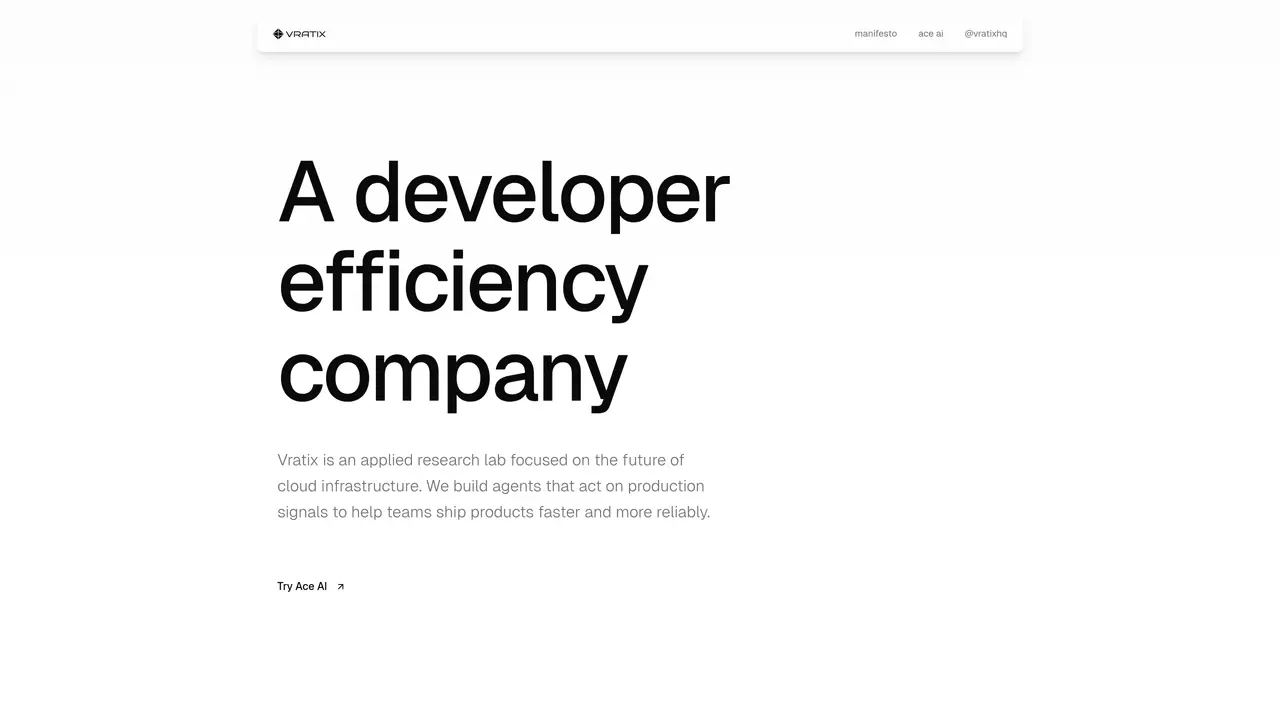
Vratix is an open-source collection of Node.js modules designed to simplify API development by providing pre-built components that handle common API logic. Instead of writing repetitive boilerplate code, developers can focus on core functionality, reducing development time and effort. The toolkit streamlines the process of building server-side applications, making it easier to create efficient, scalable, and maintainable REST APIs. By leveraging community-supported modules, Vratix offers a cost-effective solution for developers looking to accelerate their workflow without sacrificing performance. It is particularly useful for teams or individuals who want to avoid reinventing the wheel while maintaining flexibility in their API design. The open-source nature of Vratix also allows for customization and contributions from the developer community, ensuring continuous improvement and adaptation to evolving needs.
Vratix builds AI-driven agents that automate the detection of performance regressions and incidents, correlate telemetry and infrastructure signals, and provide actionable fixes to reduce operational overhead.
Vratix is designed for enterprise teams that want to focus on shipping products rather than managing on-call duties or firefighting incidents.
Vratix integrates telemetry, code repositories, CI/CD pipelines, and cloud infrastructure signals to provide a unified view of system health and automate incident response.
While Vratix is built for enterprise teams, smaller teams with similar needs for automation and observability may also benefit from its capabilities.
Vratix drafts root cause analyses, runbooks, and actionable fixes, which are delivered directly in Slack to streamline incident resolution.
Visit the Vratix website to try Ace AI, which provides a demonstration of how the tool automates incident detection and response.
vratix.com · third-party estimates from Similarweb
Last 4 months · grows by one month every month
Share of visits by channel
No measurable traffic from Paid Referrals.
Share of visits · estimated visits
Coding & Development · Sep 2026
Traffic figures are third-party estimates, good for scale and trends; they can differ from a company's own numbers. Updated monthly.
We use essential cookies to run aitoolnavio™, and optional cookies to analyze traffic and measure our marketing. You choose what we use — optional cookies stay off unless you turn them on. See our Privacy Policy.
One short email a week: fresh tools worth trying, honest takes and the updates that actually matter. No spam, unsubscribe any time.
Create cloud servers with ease, enjoy full control, automated backups, secure networking, and reliable support.
Backend platform providing Postgres databases, authentication, storage and compute for applications and agents
Rent GPU computing resources for running AI models at a low cost.
Heroku enables developers to deploy, manage, and scale applications quickly with minimal server management, supporting multiple languages and frameworks.
Unified cloud platform to run VMs, Kubernetes, and AI-era applications across on-prem, cloud, and edge with centralized governance and cost control.
AI backend platform that simplifies app development with a database, server functions, and real-time updates for developers.
Open-source backend platform for building and scaling applications
Vertically integrated AI chip manufacturing program delivering high-volume, co-packaged logic–memory assemblies for Earth and orbital deployments with standardized, scalable production lines.
Runtime platform for deploying AI workloads, databases and services across clouds or on-premises
Revolutionize AI with scalable, decentralized, cost-effective compute management.
Disaggregated inference platform combining SN50 RDUs, GPUs, and OpenAI-compatible APIs for fast, scalable agentic AI at scale.
OpenViking turns scattered agent memory into structured, queryable files so teams can store once, retrieve precisely, and collaborate reliably across models and tools.
Matched on what this tool does — grouped by the job you would be replacing.
matches Pre-built Node.js modules for common API logic · Simplifies repetitive boilerplate code · Accelerates API development workflow
Open-source backend platform providing Postgres, authentication, APIs, and real-time features to build scalable apps quickly.
AI backend platform that simplifies app development with a database, server functions, and real-time updates for developers.
Open-source low-code platform for rapidly building and self-hosting custom internal tools and dashboards with drag-and-drop components.
matches Simplifies repetitive boilerplate code · Supports scalable and maintainable server-side applications · Focuses on core functionality over infrastructure
Low-code platform accelerates enterprise app development with AI.
Access pre-built AI models, streamline development, and scale serverless architecture for any AI project.