
Automates software development tasks like coding, debugging, and project management to boost productivity and accelerate development cycles.

Keelen
$29Starting price
0Popularity
About Keelen
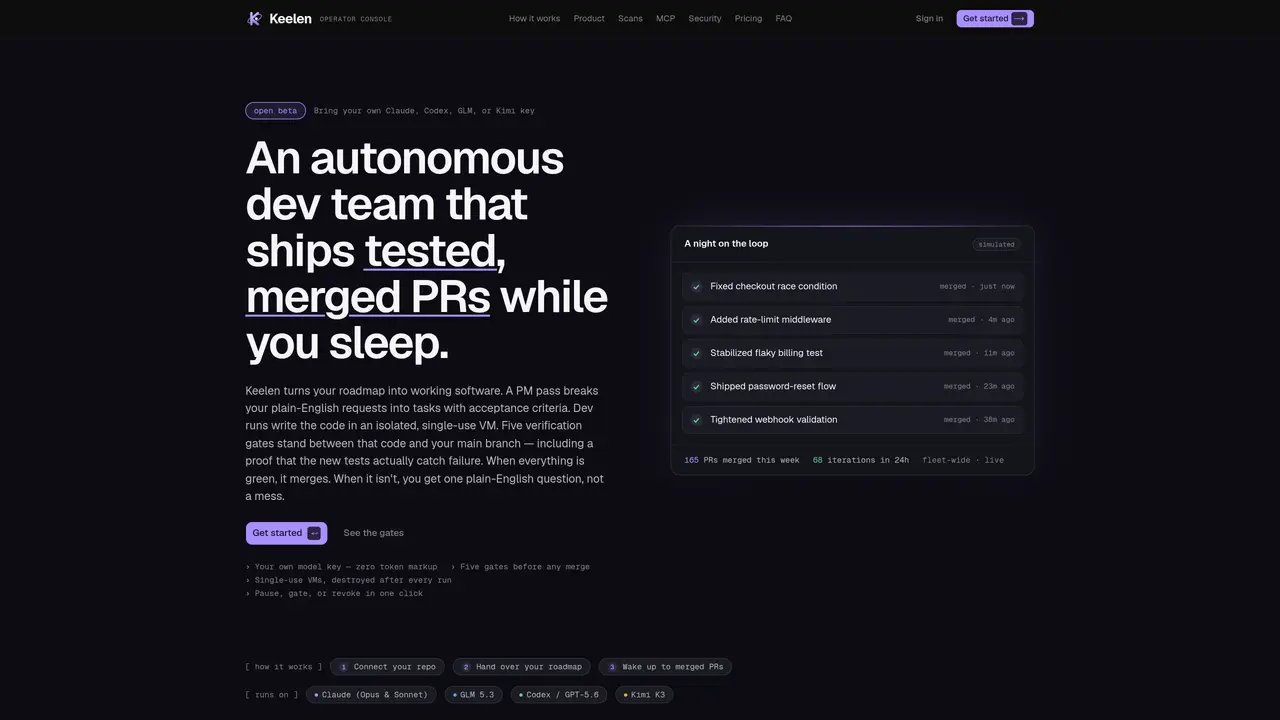
Keelen is an autonomous AI development loop that operates continuously against a GitHub repository. It accepts plain-English requests, converts them into a prioritized roadmap, and breaks each item into dev-ready tasks with acceptance criteria. Each task is implemented in an isolated, single-use virtual machine using the user’s own model credentials. The system enforces five verification gates before any code reaches the main branch: a red-first test proof, adversarial review by an independent model, execution of the project’s own test suite, CI gate enforcement, and a configurable review window. Only when all gates pass does Keelen merge the pull request. Failed runs are classified and handled with bounded retries, and the system avoids spamming the issue tracker by reopening original tickets rather than creating duplicates. It is designed to maintain existing quality gates and only interrupts users with plain-English questions when real decisions are required.
Key features
- Plain-English request intake and roadmap conversion
- Task breakdown with acceptance criteria and definitions
- Isolated single-use VM for each implementation run
- Red-first test proof to validate test effectiveness
- Adversarial review by an independent model
- Execution of project's own test suite in CI context
- CI gate enforcement before merge
- Configurable review window or manual merge control
Use cases
- Continuous delivery of small, reviewable code changes overnight
- Automated handling of flaky tests and infrastructure issues
- Maintenance of existing quality gates without weakening checks
Pros
- Autonomous 24/7 operation without manual prompting
- Five verification gates before any merge to maintain code quality
- Isolated single-use VMs for each task to prevent environment contamination
- Uses user-provided model keys to avoid token markup costs
- Classifies and handles failures deterministically with bounded retries
Cons
- Requires user-provided model API keys for operation
- No pricing or plan details publicly available
- Limited to GitHub repository integration
- Currently in open beta with no stated free tier
Keelen videos
Frequently asked questions about Keelen
What is Keelen and what does it do?
Keelen is an autonomous AI development loop that operates continuously against a GitHub repository. It converts plain-English requests into a prioritized roadmap, breaks tasks into dev-ready units with acceptance criteria, and implements them in isolated virtual machines using the user’s own model credentials.
Who is Keelen designed for?
Keelen is designed for teams or individuals who need a continuous, hands-off development process to reduce backlog growth during off-hours or busy periods. It suits users who want an autonomous team handling routine coding tasks while maintaining existing quality gates.
How does Keelen handle verification and quality control?
Keelen enforces five verification gates before merging any code: a red-first test proof, adversarial review by an independent model, execution of the project’s test suite, CI gate enforcement, and a configurable review window. Only when all gates pass does it merge the pull request.
Can Keelen work with my existing GitHub repository?
Yes, Keelen operates directly against a connected GitHub repository. Users can connect their repo, hand over a roadmap in plain English, and Keelen will autonomously work through tasks while respecting the repository’s existing structure and processes.
What happens if Keelen encounters a failure during execution?
Failed runs are classified into specific failure kinds, and the system handles them with bounded retries or pauses as needed. It avoids spamming the issue tracker by reopening original tickets rather than creating duplicates, and it provides plain-English explanations for failures.
Does Keelen require me to use specific AI models?
Keelen allows users to bring their own model credentials, including options like Claude, Codex, GLM, or Kimi. This ensures users retain control over the models used for their development tasks while avoiding token markup costs.