
OpenAI builds and deploys advanced AI models like GPT-4o for autonomous agents and workflows.

Annotate
416Monthly visits
0Popularity
About Annotate
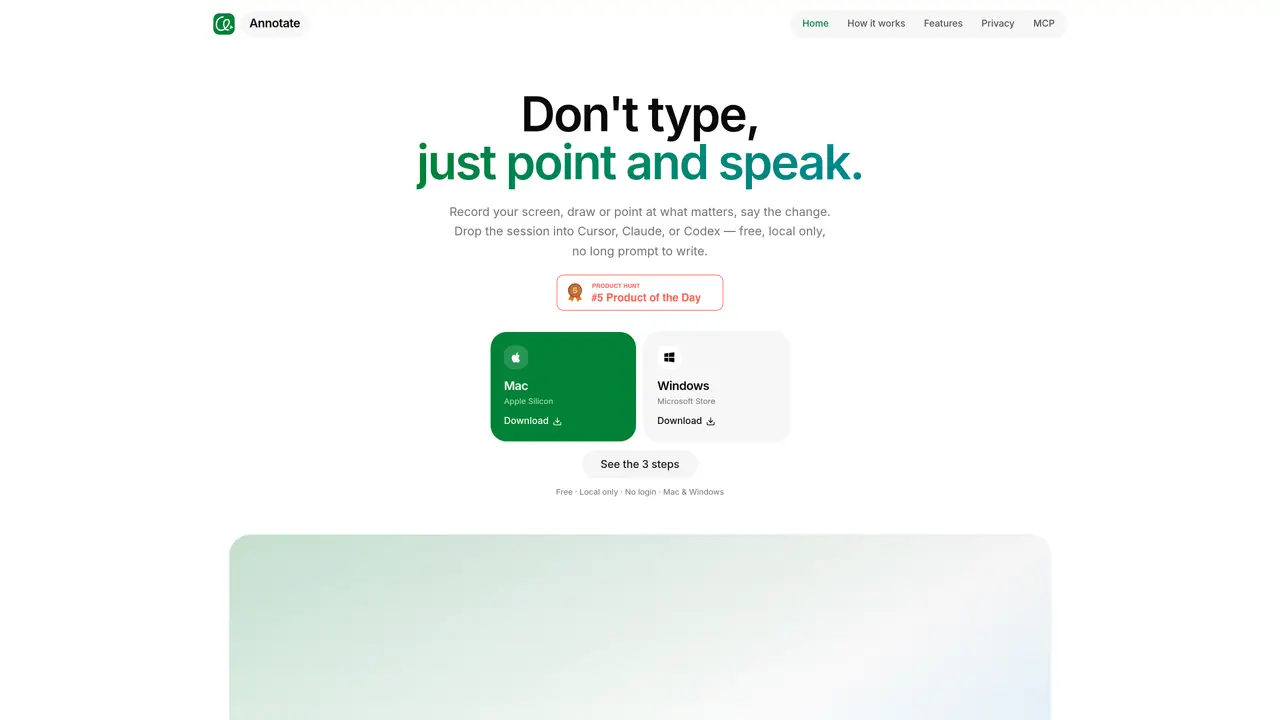
Annotate records on-screen activity and voice narration to create a structured brief for AI coding assistants. Users capture their screen, draw or point at specific UI elements, and speak their instructions aloud. The recording is saved locally and can be opened directly in Cursor, Claude Code, or Codex without manual prompt drafting. The tool emphasizes precision by marking exact UI elements with gestures and synchronizing speech with on-screen actions. It supports multi-monitor setups and avoids uploading data, keeping all content on the user’s device. The output is designed to reduce ambiguity for AI agents by preserving timing, clicks, and contextual details that static screenshots cannot convey.
Key features
- Screen recording with window or display selection
- On-screen drawing and pointing tools
- Voice narration transcription
- Local file storage without uploads
- Multi-monitor capture support
- Gesture and frame synchronization
- Direct integration with Cursor, Claude Code, and Codex
- No login or account creation required
Use cases
- Demonstrating UI changes to an AI coding assistant
- Explaining complex workflows to an agent
- Providing context-rich prompts for code generation
Pros
- Records screen activity and voice simultaneously
- Synchronizes gestures, frames, and speech for clarity
- Local processing with no data upload
- Direct integration with Cursor, Claude Code, and Codex
- Supports multi-monitor captures
Cons
- No cloud backup or cross-device sync
- Requires compatible AI coding tools for handoff
- Limited to macOS Apple Silicon and Windows
Frequently asked questions about Annotate
What is Annotate and how does it work?
Annotate is a screen recording tool that captures on-screen activity, gestures, and voice narration to create a structured prompt for AI coding assistants. Users record their screen, draw or point at specific UI elements, and speak their instructions aloud. The recording is saved locally and can be opened directly in supported AI agents like Cursor, Claude Code, or Codex.
Which AI coding assistants does Annotate work with?
Annotate integrates with Cursor, Claude Code, and Codex. The recorded sessions can be opened directly in these agents, allowing them to process the on-screen actions, gestures, and transcribed speech as a prompt.
Does Annotate require an internet connection or upload data?
No, Annotate operates locally and does not upload any data. All recordings, frames, and transcripts remain on the user's device, ensuring privacy and security.
Is Annotate free to use?
Yes, Annotate is free to use with no login required. It is available for both macOS (Apple Silicon) and Windows, with versions accessible via the Mac Apple Silicon download or Windows Microsoft Store.
Can Annotate capture multi-monitor setups?
Yes, Annotate supports multi-monitor setups. Users can capture one window or every display in a single session, making it suitable for workflows involving multiple screens.
How do I get started with Annotate?
To get started, download Annotate for your operating system (macOS Apple Silicon or Windows), install it, and begin recording your screen. After recording, open the session directly in your preferred AI coding assistant to hand off the task.
Annotate Website Engagement
Last Update: 9 days ago
Total Monthly Visits
0
Bounce Rate
0%
Visit Duration (avg)
0.00s
Pages Per Visit
0
Country Rank
—
Unknown
Global Rank
—