
OpenAI builds and deploys advanced AI models like GPT-4o for autonomous agents and workflows.

Bento Term
0Popularity
About Bento Term
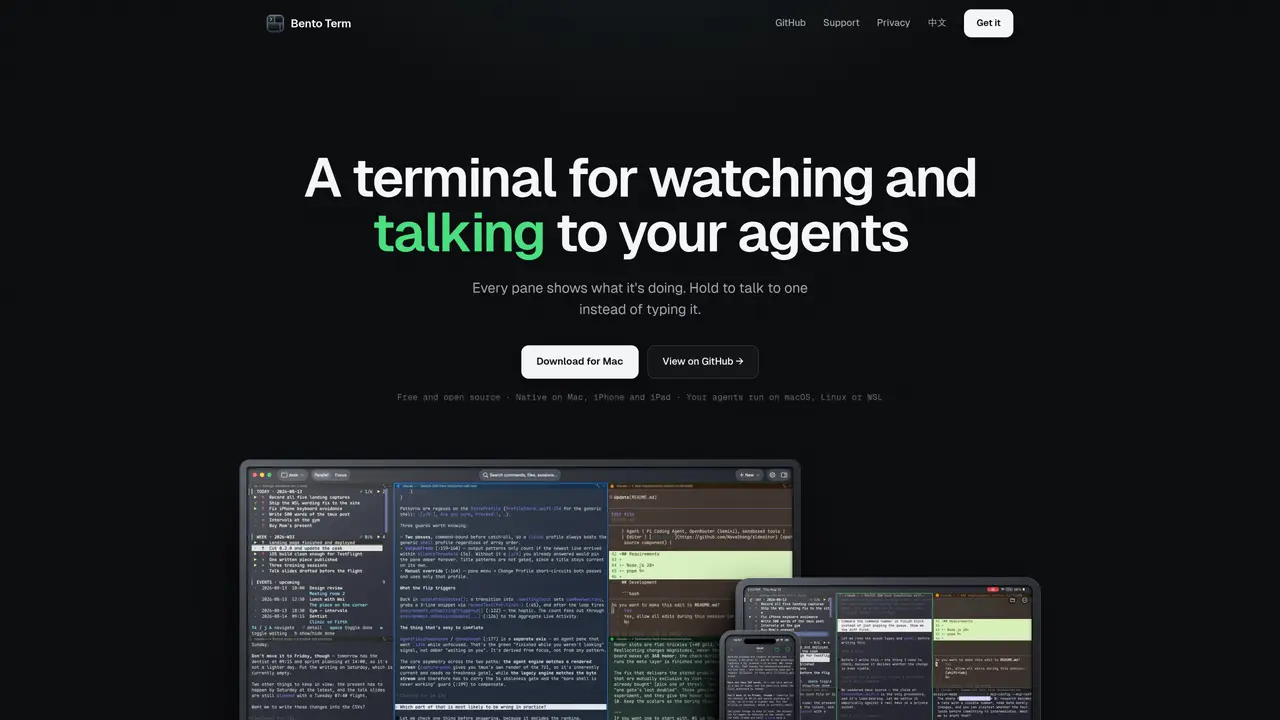
Bento Term is a terminal application designed to monitor and communicate with multiple AI agents simultaneously. Each agent runs in its own pane, tinted by status, allowing users to observe activity across an entire team in a single screen. The interface supports both parallel and focused layouts, with panes that can be resized or moved like windows. Voice input is integrated, enabling faster communication with agents by speaking instead of typing. The application runs natively on Mac, iPhone, and iPad, and connects to agents running on macOS, Linux, or WSL via plain SSH and tmux. It does not require accounts or additional software on remote machines beyond tmux. Bento Term supports multiple AI engines, including Apple on-device, Qwen, OpenAI, or custom API keys. Work sessions persist even when the app is closed or the device loses connectivity, as the state is managed by tmux on the remote machine. The terminal includes features like file browsing within panes, Quick Look previews for documents, and a command palette for managing sessions and panes.
Key features
- Parallel agent panes with status tinting
- Voice input via right-click hold
- File browsing and preview within panes
- GPU-accelerated rendering via libghostty
- Command palette for session and pane management
- Customizable state detection for agents
- Continuity across device disconnections
- Support for multiple AI engines
Use cases
- Monitoring multiple AI agents in parallel
- Remote development and debugging via SSH
- Voice-driven interaction with AI tools
Pros
- Supports parallel agent monitoring in a single screen
- Native applications for Mac, iPhone, and iPad
- Voice input for faster agent communication
- Persistent sessions via tmux integration
- Open source under Apache-2.0 license
Cons
- No native support for Windows desktop
- Requires tmux on remote machines
- Voice features rely on external APIs unless using Apple on-device
Frequently asked questions about Bento Term
What is Bento Term and what does it do?
Bento Term is a terminal application that allows users to monitor and communicate with multiple AI agents simultaneously. Each agent runs in its own pane, tinted by status, enabling users to observe activity across an entire team in a single screen.
Who is Bento Term designed for?
Bento Term is designed for users who work with multiple AI agents, such as developers, researchers, or teams managing parallel tasks. It suits those who need to observe, interact with, and manage agents efficiently in a unified interface.
Does Bento Term require accounts or additional software on remote machines?
No, Bento Term does not require accounts or additional software on remote machines beyond tmux. It connects to agents running on macOS, Linux, or WSL via plain SSH and tmux, and the state is managed by tmux on the remote machine.
How does voice input work in Bento Term?
Voice input in Bento Term allows users to communicate with agents by speaking instead of typing. Users can hold right-click on a pane and speak, with the input being processed and sent to the agent. Voice input is integrated to speed up communication.
Can Bento Term be used on mobile devices?
Yes, Bento Term is native on Mac, iPhone, and iPad. Users can attach to sessions and interact with panes from their iPhone or iPad, even mid-run, using the same SSH connection.
What AI engines does Bento Term support?
Bento Term supports multiple AI engines, including Apple on-device, Qwen, OpenAI, or custom API keys. Users can choose the engine they prefer or use their own API keys for flexibility.