
OpenAI builds and deploys advanced AI models like GPT-4o for autonomous agents and workflows.
relai
$9.99Starting price
0Popularity
About relai
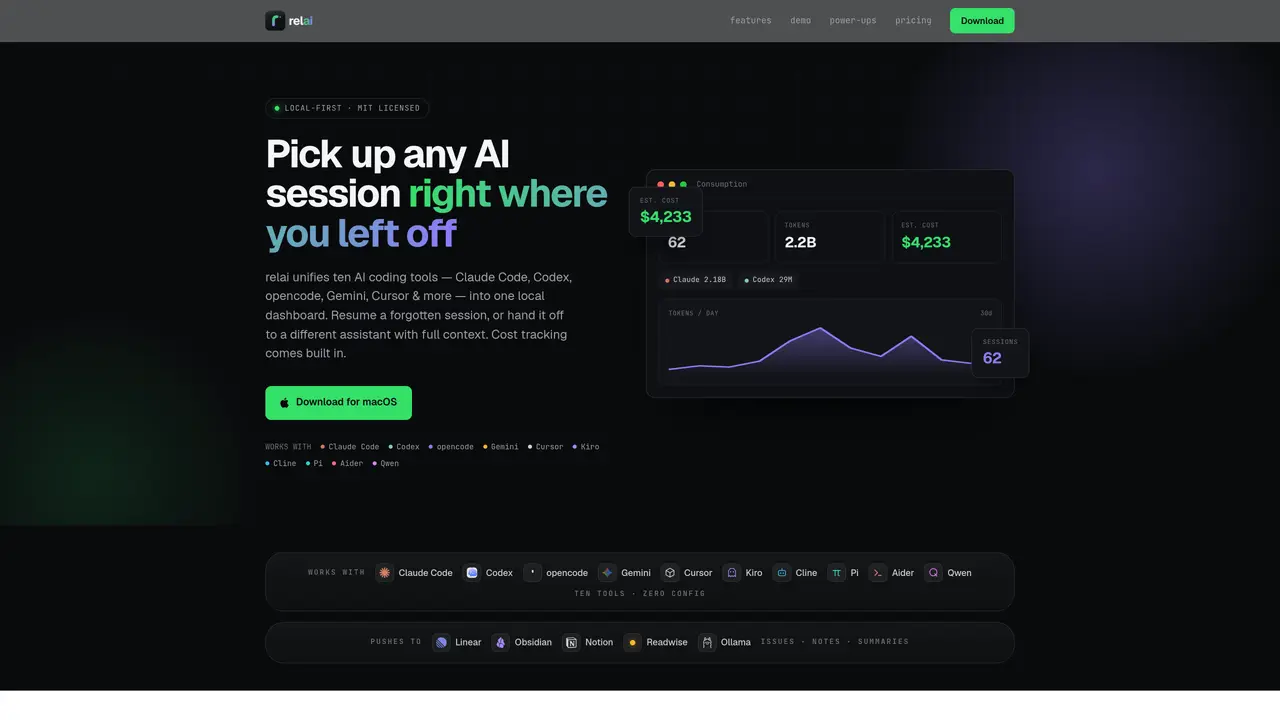
relai consolidates AI coding sessions from ten different tools—Claude Code, Codex, opencode, Gemini, Cursor, Kiro, Cline, Pi, Aider, and Qwen—into a single local dashboard. It parses the session files generated by these CLI-based assistants and transforms them into structured data, enabling users to resume or hand off sessions with full context. The tool tracks token usage and cost per session, providing real-time telemetry and historical reports. Users can search sessions by title, preview, or project path, and export data to platforms like Obsidian, Notion, Readwise, or Linear. relai also offers local processing for summaries and study plans via Ollama, with cloud fallback if needed. A live monitor shows active and idle terminals, while encrypted cross-device sync ensures sessions follow users between machines. The app operates locally-first, with no agents to install and no data leaving the user’s machine by default.
Key features
- Resume or hand off sessions between different AI tools
- Per-tool token and cost breakdowns with side-project exclusion
- Full-text search across session titles, previews, and project paths
- Export sessions to CSV, JSON, Obsidian, Notion, Readwise, or Linear
- Live monitoring of active and idle terminal sessions
- Local Ollama integration for free, private summaries and study plans
- Encrypted cross-machine session synchronization
- Context primer generation for seamless tool handoffs
Use cases
- Resume forgotten AI coding sessions weeks after they were started
- Hand off a session from one AI assistant to another while preserving context
- Track token usage and costs across multiple AI coding tools in one place
Pros
- Unifies sessions from ten AI coding tools into one dashboard
- Local-first architecture with no agents or cloud uploads required
- Built-in token usage and cost tracking per session
- Cross-device sync with end-to-end encryption
- Supports local processing for summaries and study plans
Cons
- macOS-only platform support
- No free tier after the 7-day trial period
- Requires CLI-based AI coding tools to generate session files
- Encrypted sync is opt-in and not enabled by default
Frequently asked questions about relai
Which AI coding tools does relai work with?
relai reads the local session files written by ten AI coding tools: Claude Code, Codex, opencode, Gemini CLI, Cursor, Kiro, Cline, Pi, Aider, and Qwen. No plugins or agents are required to install; it parses the transcripts your CLIs already generate and unifies them in one dashboard.
Does relai send my code or sessions to the cloud?
No. relai operates local-first, meaning session transcripts, token counts, cost data, and exports remain on your machine by default. Cross-device sync is end-to-end encrypted and opt-in, and session summaries can run on a local Ollama model to avoid cloud processing entirely.
How do I resume an old Claude Code session or move it to another tool?
Open relai, locate the session by searching titles, previews, or project paths, then choose Resume to reopen it in its original CLI or Hand off to fork it into a different assistant. relai generates a context primer from the transcript, CLAUDE.md, and memory to ensure the new tool continues with full context.
How does relai track token usage and cost?
relai parses real session data to provide per-tool token and cost breakdowns, reflecting actual work. Users can exclude side projects from reports with a single checkbox to maintain accurate telemetry.
Can I export my sessions to other platforms like Obsidian or Notion?
Yes. relai allows exporting sessions as CSV or JSON and pushing session notes and reports to platforms like Obsidian, Notion, Readwise, or Linear. Findings can be filed as Linear issues that close automatically when marked resolved.
Does relai offer local processing for summaries and study plans?
Yes. Users can enable local processing for session summaries, handoff primers, and study reports using Ollama at no cost. If the local model fails, relai automatically falls back to the cloud CLI to ensure continuity.