Frontier-grade Claude models with agentic workflows, strong coding, and enterprise guardrails delivered via developer console, web app, and cloud partners.

Shield
$49.99/moStarting price
0Popularity
About Shield
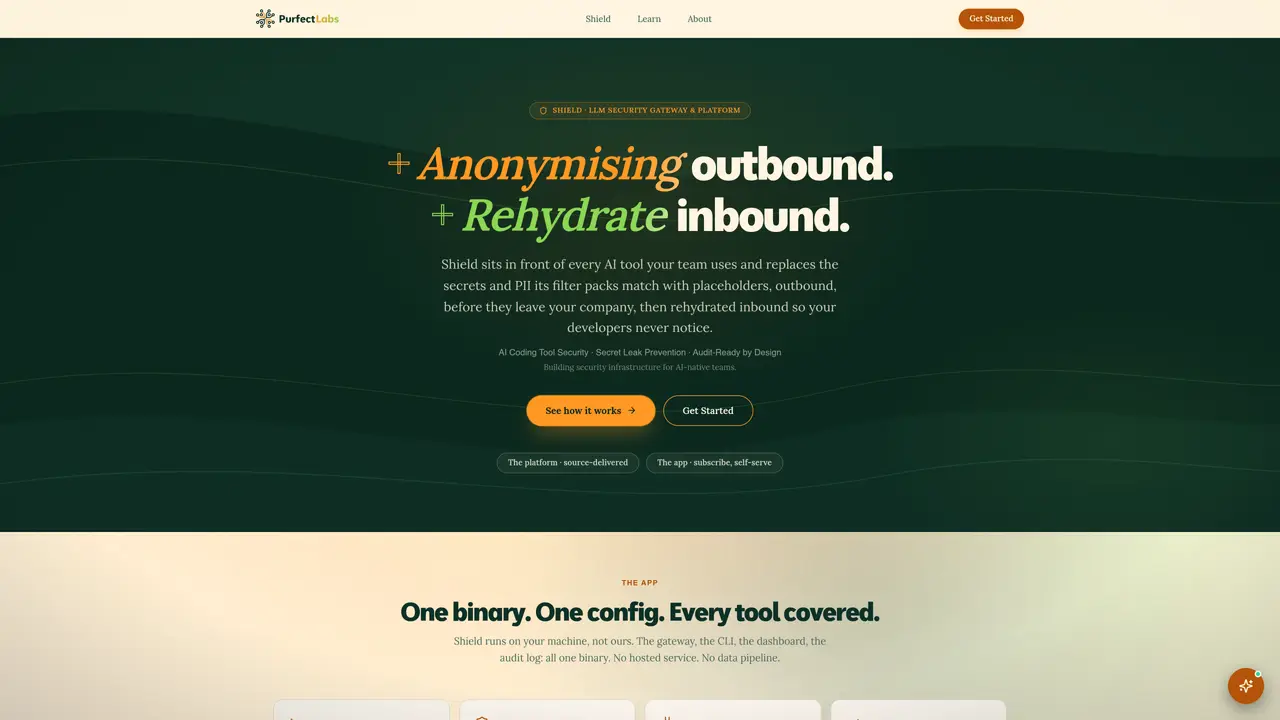
Shield is an LLM security gateway designed to prevent accidental leakage of secrets and personally identifiable information (PII) when developers use AI coding tools. It installs locally on a developer’s machine and operates as a transparent redaction layer between the developer’s tools and the AI provider. The tool replaces matched secrets and PII with placeholders before outbound requests are sent, then rehydrates the original values inbound so the developer’s workflow remains uninterrupted. Shield supports a range of AI coding tools, including Claude Code, Cursor, VS Code Copilot, and others, with plugins that auto-install for seamless integration. The platform emphasizes audit readiness by design, maintaining a local, tamper-evident audit trail of every redaction event. It is available in two deployment models: a subscription-based app or a source-delivered platform for self-hosting, with both options providing the same binary and functionality. Shield is built for teams prioritizing security and compliance, particularly those handling sensitive data such as API keys, database credentials, or protected health information.
Key features
- Local gateway with one binary install
- Auto-installing plugins for LLM tools (Claude Code, Cursor, Copilot, etc.)
- Pattern-based secret and PII detection with filter packs
- Tamper-evident, hash-chained audit logs
- Federated dashboard for org-wide visibility
- Semantic detection layer for advanced redaction
- GPU orchestration for defense models on cloud infrastructure
- Source-delivered or subscription-based deployment
Use cases
- Preventing accidental leakage of API keys or database credentials in AI prompts
- Ensuring compliance with SOC 2 or HIPAA by redacting PII before it leaves the network
- Protecting proprietary code or internal documents shared with AI tools
Pros
- Local deployment with no cloud service or data pipeline
- Transparent redaction and rehydration to preserve developer workflow
- Audit-ready logging with tamper-evident evidence
- Support for multiple AI coding tools via auto-installing plugins
- Two-layer fail-safe design (plugin and gateway) to catch leaks
Cons
- No free tier or open-source option
- Limited to desktop environments and specific AI tools
- Detection relies on pattern-based filter packs, not semantic guarantees
- Requires installation and configuration on each developer’s machine
Frequently asked questions about Shield
What does Shield do?
Shield is an LLM security gateway that anonymizes secrets and personally identifiable information (PII) before they leave a developer's machine, replacing them with placeholders outbound and rehydrating them inbound so the developer's workflow remains uninterrupted.
Who is Shield designed for?
Shield is built for AI-native teams prioritizing security and compliance, particularly those handling sensitive data such as API keys, database credentials, or protected health information.
How does Shield integrate with existing AI coding tools?
Shield integrates seamlessly with AI coding tools like Claude Code, Cursor, VS Code Copilot, and others through auto-installing plugins that route traffic through the local gateway.
What deployment models does Shield offer?
Shield is available as a subscription-based app or a source-delivered platform for self-hosting, with both options providing the same binary and functionality.
Does Shield require a hosted service or data pipeline?
No, Shield runs entirely on the user's machine with no hosted service or data pipeline, ensuring data remains local and under the user's control.
How does Shield handle audit requirements?
Shield maintains a local, tamper-evident audit trail of every redaction event, with evidence export capabilities for compliance programs like SOC 2 and HIPAA.