Meta AI enhances machine learning, NLP, and computer vision capabilities.

OmniParser
$0.03Starting price
0Popularity
About OmniParser
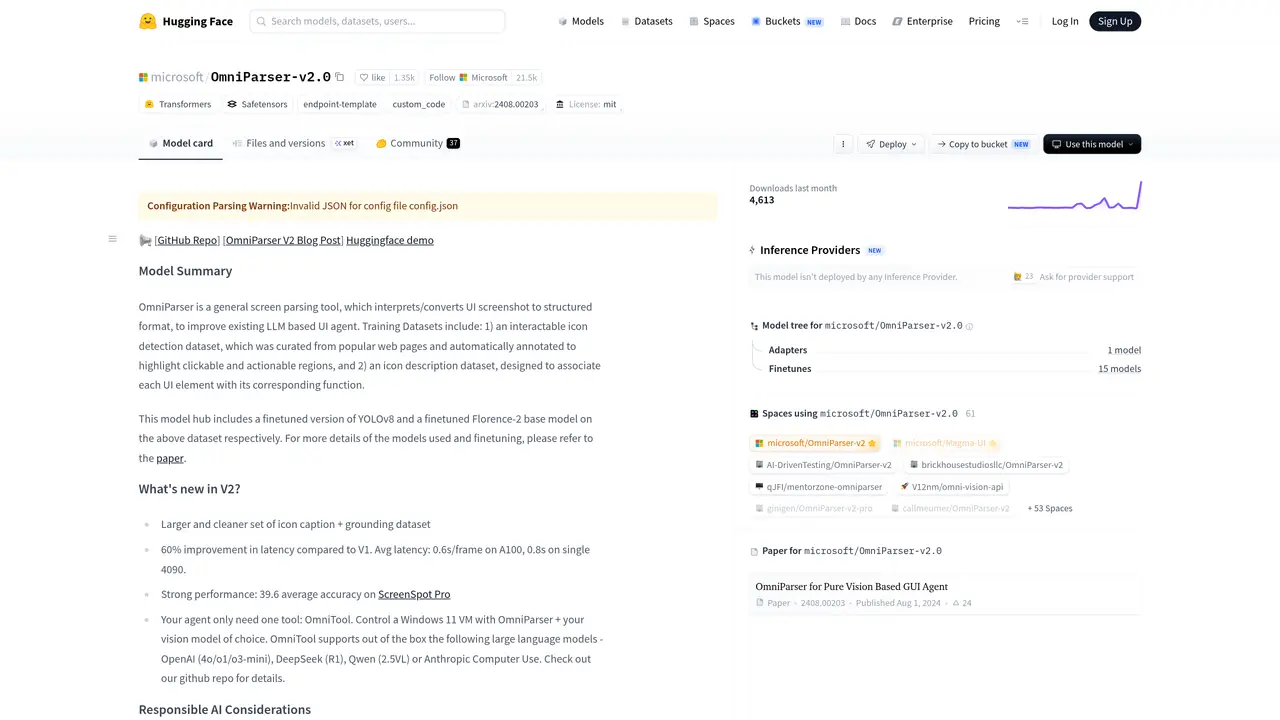
OmniParser converts screenshots into structured data that AI models can use to understand user interfaces. It addresses the challenge of identifying screen elements for automation by parsing interfaces and extracting element attributes. Developers use OmniParser to improve the accuracy and speed of GUI automation workflows, enabling AI agents to recognize buttons, text fields, and other UI components. The tool is designed to work alongside any LLM model, making it versatile for integration into broader AI systems. It supports tasks like automating user interactions, enhancing accessibility, and optimizing screen parsing for testing and research. OmniParser is particularly useful for roles that require precise UI element detection, such as programmers, UI engineers, and AI researchers working on automation or agent-based systems.
Key features
- Converts screenshots into structured UI data
- Identifies and parses interface elements
- Works with any LLM model
- Boosts GUI automation accuracy and speed
- Supports element attribute extraction
- Enables AI agents to understand UI components
- Optimizes screen parsing for testing and research
- High performance in UI understanding
Use cases
- Automate GUI interactions for testing or workflows
- Enhance UI accessibility for assistive technologies
- Improve LLM agents' ability to interact with interfaces
Pros
- Converts unstructured UI screenshots into structured, actionable data for AI agents
- Supports detection of interactable regions and icon semantics for precise UI element identification
- Compatible with multiple vision models and large language models, including OpenAI, DeepSeek, Qwen, and Anthropic
- Improved latency in version 2.0, with average processing times of 0.6s/frame on A100 and 0.8s on a single 4090 GPU
- Designed for versatility across PC and mobile screens, as well as various applications
Cons
- Does not detect harmful content in input screenshots, requiring users to ensure responsible input
- Output requires human judgment for validation and safety compliance in agent-based systems
- Icon detection model is licensed under AGPL, which may impose additional compliance requirements
- Performance may vary depending on the hardware and the specific vision model used
Frequently asked questions about OmniParser
What does OmniParser do?
OmniParser converts unstructured UI screenshots into structured data, identifying interactable regions, icon captions, and semantic elements to improve LLM-based UI agent performance.
Who is OmniParser designed for?
The tool is intended for developers, UI engineers, and AI researchers working on GUI automation, accessibility, or agent-based systems requiring precise UI element detection.
How does OmniParser integrate with other AI models?
OmniParser provides structured UI data that can be used alongside any LLM, enabling AI agents to better understand and interact with graphical interfaces.
What are the key improvements in OmniParser V2?
Version 2 includes a larger and cleaner icon caption dataset, 60% faster latency than V1, and strong performance metrics such as 39.6 average accuracy on ScreenSpot Pro.
What are the limitations of OmniParser?
OmniParser does not detect harmful content in input screenshots and requires human judgment for final output validation. Developers must ensure responsible use and follow safety standards.
How can I get started with OmniParser?
Users can load the model via Transformers using the provided code snippet or explore demo implementations on Hugging Face Spaces for practical examples.