
Collaboration and version control platform for software development and AI model hosting.
645M visits/mo-0.6%#1 Coding & Development
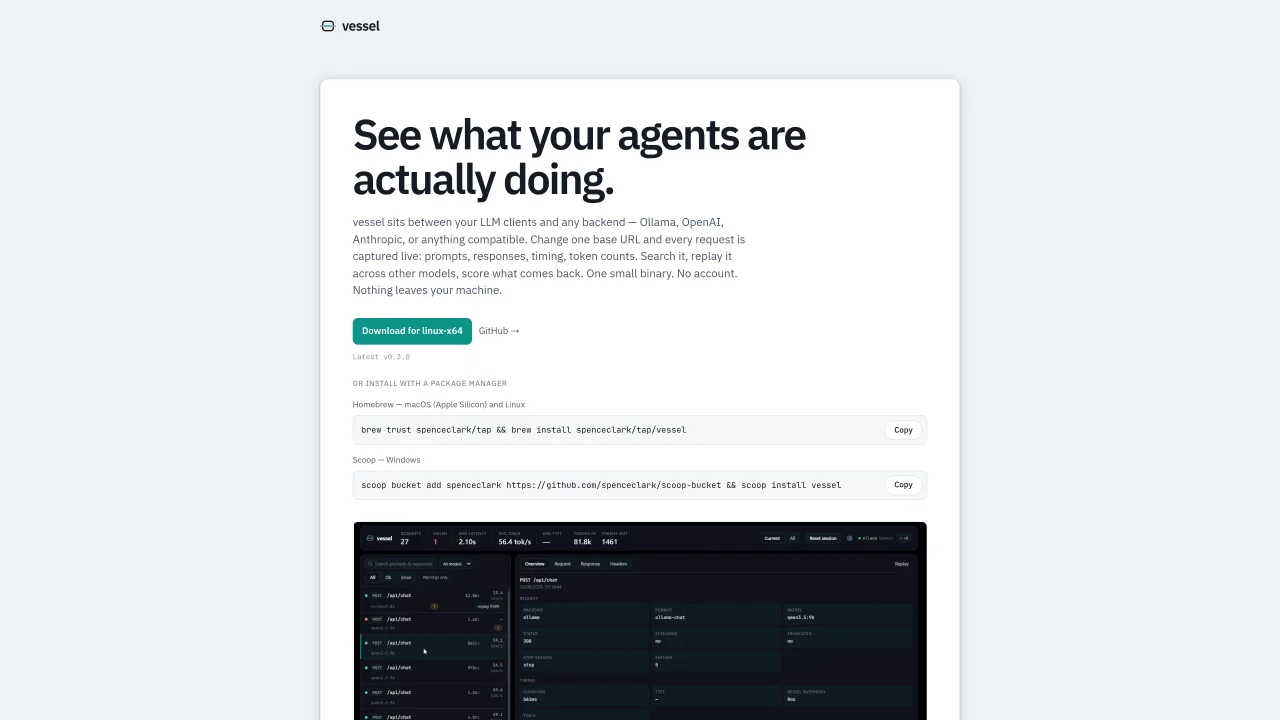
vessel is a local proxy that sits between LLM clients and backend services such as Ollama, OpenAI, or Anthropic. It captures live requests and responses, including prompts, responses, timing, and token counts, without modifying the traffic. The tool supports full-text search across captured data, filtering by model, backend, or agent tag, and tagging agents and runs for organization. Captured requests can be replayed to different backends or models, including multiple targets simultaneously, with side-by-side comparison of responses, timing, and token deltas. Users can rate responses and generate reports ranking models by score and win rate, with metrics such as tokens, tokens per second, duration, cache efficiency, and warnings. Data is stored locally in a SQLite file and never leaves the machine. A built-in read-only MCP server allows integration with MCP clients like Claude Code for direct querying of captured traffic.
No, vessel captures requests and responses byte-for-byte without changing the traffic. The only exceptions are the removal of X-Vessel-* headers and an opt-in flag for injectStreamUsage, which is clearly marked.
Captured data is stored locally in a SQLite file next to the configuration. Nothing leaves the machine, and authentication headers are redacted at rest while keys are never stored.
Vessel supports Ollama natively, any OpenAI-compatible server (such as LM Studio, llama.cpp, vLLM, OpenRouter, or the OpenAI API itself), and Anthropic Messages. Unknown formats are stored raw and passed through untouched.
Change the base URL of your LLM client to point to vessel (e.g., http://127.0.0.1:4550/b/openai/v1) and run vessel as a reverse proxy. No SDK or language binding is required; it works with any tool that accepts a base URL.
Yes, vessel allows replaying captured requests to different backends or models, including multiple targets simultaneously, with side-by-side comparison of responses, timing, and token deltas.
No, vessel is a single-binary, local-first tool that does not require an account or an internet connection. It operates entirely offline on your machine.
We use essential cookies to run aitoolnavio™, and optional cookies to analyze traffic and measure our marketing. You choose what we use — optional cookies stay off unless you turn them on. See our Privacy Policy.
One short email a week: fresh tools worth trying, honest takes and the updates that actually matter. No spam, unsubscribe any time.
Collaboration and version control platform for software development and AI model hosting.
A cloud platform for deploying, scaling, and managing web apps and AI workloads with Git-based CI/CD and edge functions.
Unified platform to access and switch between hundreds of AI models like ChatGPT, Claude, and Gemini via a single API.
xAI builds Grok frontier AI models for reasoning, coding, voice, images, video, enterprise workflows, and developer APIs.
Meta AI enhances machine learning, NLP, and computer vision capabilities.
AI-powered coding platform that uses agents to plan, write, and test software with real-time feedback and verifiable artifacts.
Open-source backend platform providing Postgres, authentication, APIs, and real-time features to build scalable apps quickly.
Chat, build, and explore with open AI models.
Standardize application packaging and execution with portable containers for consistent local and cloud workflows.
Cloud communications platform that lets developers embed SMS, voice, WhatsApp, email, video, verification, and conversational AI via APIs.
Revolutionize AI application development, monitoring, and deployment with LangChain.
Run open-source chatbots locally on your PC without internet, keeping conversations private and offline.
Matched on what this tool does — grouped by the job you would be replacing.
matches Captures prompts, responses, timing, and token counts · Replay requests to different backends or models · Side-by-side comparison of responses with metrics
Free open-source AI gateway that routes requests across 236+ LLM providers from a single endpoint with automatic fallback.
OpenAI-compatible API for server-side multi-agent orchestration, LLM routing, and centralized observability.
Unified API for routing requests to multiple LLM providers with price comparison
Observes and controls AI agent calls via inline proxy
matches Full-text search and filtering by model, backend, or agent tag · Built-in read-only MCP server for direct querying
Unified local dashboard for AI coding sessions across multiple tools
Desktop library to search and resume coding agent sessions locally