AI assistant for safe, reliable productivity with code, collaboration, and integrations.

Data Sanitizer
$8Starting price
0Popularity
About Data Sanitizer
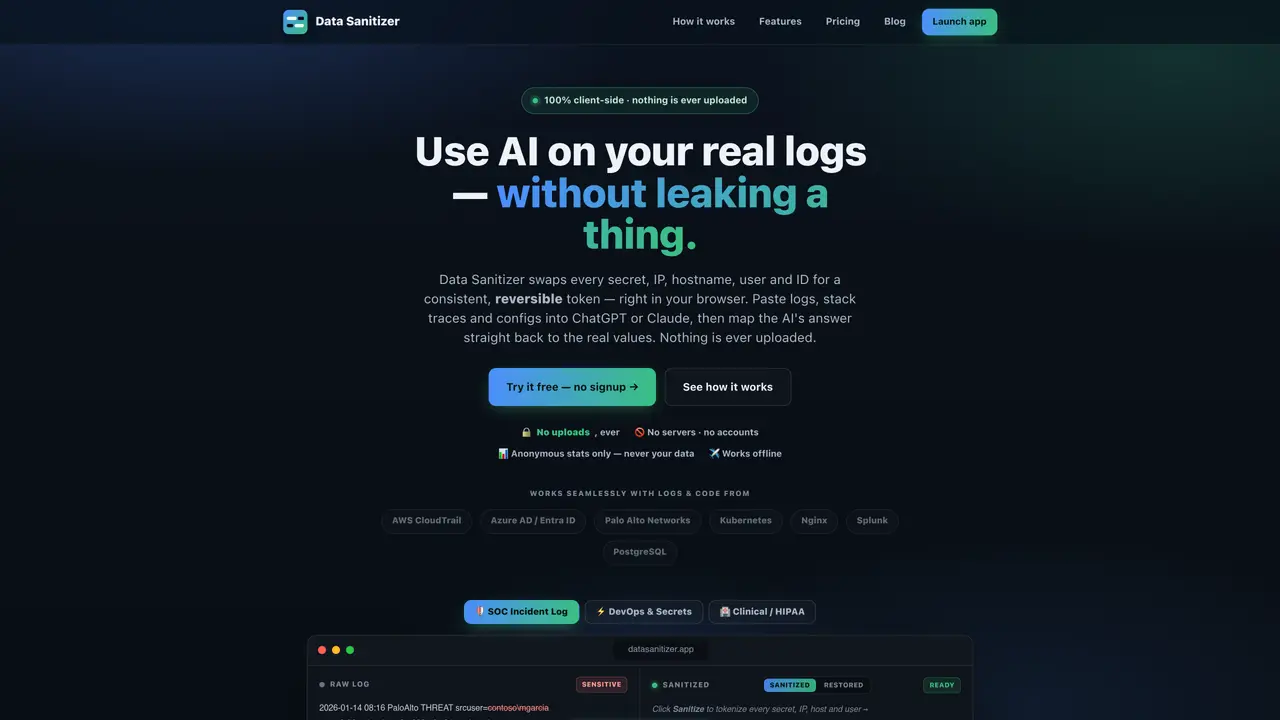
A browser-based tool that tokenizes sensitive data such as secrets, IP addresses, hostnames, user IDs, and PII in logs, stack traces, or configuration files before pasting them into AI assistants like ChatGPT or Claude. All processing occurs client-side, ensuring no data is uploaded or stored externally. The tool replaces real values with consistent, reversible tokens that maintain relationships for AI reasoning, then allows users to restore the original values after receiving AI responses. It supports common log formats from AWS CloudTrail, Azure AD, Palo Alto Networks, Kubernetes, Nginx, Splunk, and PostgreSQL, and includes presets for compliance needs like HIPAA or GDPR. The application works offline and integrates via a Chrome extension for streamlined workflows.
Key features
- 100% client-side processing
- Reversible tokenization of secrets, IPs, hostnames, and PII
- Presets for logs, cloud services, Windows/AD, and compliance
- Custom regex and watch lists for internal identifiers
- Highlight-what-changed view with hover-to-reveal
- Save and resume sessions with mapping and rules
- Mapping export in JSON or CSV format
- Chrome extension for side-panel workflow
Use cases
- Redacting sensitive logs before pasting into AI for analysis
- Sanitizing configuration files containing secrets or identifiers
- De-identifying clinical or HIPAA-regulated data before AI processing
Pros
- Client-side processing with no uploads or external storage
- Supports reversible tokenization for consistent data mapping
- Includes presets for logs, secrets, and compliance (HIPAA, GDPR)
- Works offline and integrates with major log sources
- Highlights changes and allows granular control over redaction rules
Cons
- Free tier limited to 5 sanitized logs per day
- No API or programmatic access
- Requires browser or Chrome extension
- Pro features needed for daily workflows
Frequently asked questions about Data Sanitizer
What does Data Sanitizer do?
Data Sanitizer tokenizes sensitive data such as secrets, IP addresses, hostnames, user IDs, and PII in logs, stack traces, or configuration files before pasting them into AI assistants like ChatGPT or Claude. It replaces real values with consistent, reversible tokens while maintaining relationships for AI reasoning.
Who is Data Sanitizer for?
The tool is designed for developers, DevOps & SRE teams, SOC/security professionals, IT & sysadmins, data analysts, and support engineers who handle sensitive logs or datasets and need to use AI tools without risking data leaks.
Does Data Sanitizer upload or store my data?
No, all processing occurs client-side in the browser, and nothing is ever uploaded or stored externally. The tool works fully offline and does not require accounts or servers.
How do I restore the original values after using AI?
After receiving an AI response, you can paste it back into Data Sanitizer and click 'Restore' to map the tokens back to their original values. The mapping remains on your device and is never shared.
What log formats does Data Sanitizer support?
It supports common log formats from AWS CloudTrail, Azure AD/Entra ID, Palo Alto Networks, Kubernetes, Nginx, Splunk, and PostgreSQL, among others. The tool also includes presets for compliance needs like HIPAA or GDPR.
Can I customize the redaction rules in Data Sanitizer?
Yes, the Pro version allows users to create custom regex patterns, define their own watch lists, and set up allowlists for values that should never be redacted. It also supports sharing team configurations.