AI assistant for safe, reliable productivity with code, collaboration, and integrations.

Gnocortex
0Popularity
About Gnocortex
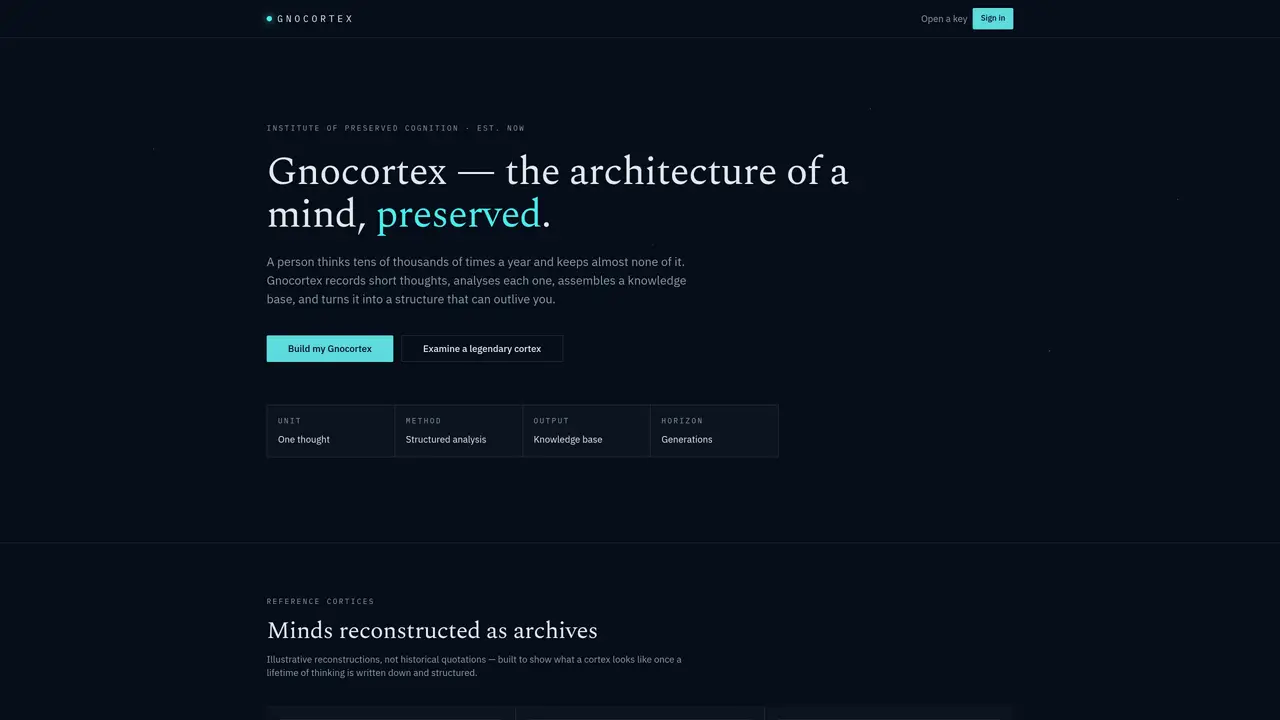
Gnocortex captures short thoughts, analyzes each entry by theme, domain, intensity and concepts, and synthesizes them into periodic reports that reveal dominant themes and contradictions. The system assembles these into a structured knowledge base that can be inherited by others, preserving the architecture of a mind beyond its lifetime. Users begin by writing a single sentence, after which the platform automatically organizes the input into a coherent structure over weeks. The resulting archive is presented as a readable cortex of interconnected ideas rather than a chronological record. Reference cortices demonstrate how the method reconstructs the thinking patterns of historical figures across disciplines such as theoretical physics, statecraft, medicine and invention. The process involves four repeating operations: capture, analyze, synthesize and inherit, enabling continuous accumulation and transfer of structured thought.
Key features
- Thought capture with automatic classification
- Thematic and conceptual analysis of entries
- Periodic synthesis reports
- Inheritable knowledge base
- Cross-disciplinary reference cortices
- Single-sentence initialization
- Automated structure generation
- Readable archive format
Use cases
- Preserving personal intellectual legacy for future generations
- Reconstructing historical thinkers' mental frameworks for research
- Structuring ongoing creative or scientific thought processes
Pros
- Preserves thoughts as structured data rather than anecdotal records
- Automatically organizes entries into thematic and conceptual relationships
- Enables inheritance of knowledge across generations
- Provides periodic synthesis reports to highlight dominant themes
- Supports cross-disciplinary reconstruction of historical minds
Cons
- No explicit mention of mobile or multi-device support
- Limited to text-based input without multimedia integration
- No stated support for collaborative editing or shared archives
Frequently asked questions about Gnocortex
What does Gnocortex do?
Gnocortex records short thoughts, analyzes each entry by theme, domain, intensity and concepts, and synthesizes them into periodic reports that reveal dominant themes and contradictions. The system assembles these into a structured knowledge base that can be inherited by others.
Who is Gnocortex suited for?
Gnocortex is designed for individuals who wish to preserve their thinking patterns and insights over time, as well as those interested in studying the structured thought processes of historical figures across disciplines.
How does the pricing model work for Gnocortex?
Gnocortex offers a model where users can begin by writing a single sentence and progressively build a structured archive of their thoughts, with the option to issue keys for others to inherit and read the archive.
What integrations does Gnocortex support?
The platform operates as a standalone system for capturing, analyzing, and synthesizing thoughts into a structured knowledge base, with no explicit mention of third-party integrations.
What are the limitations of Gnocortex?
Gnocortex requires users to actively record their thoughts, and the structured analysis and synthesis process depends on the quality and consistency of the input. The system does not claim to reconstruct historical records but rather illustrates the method of preserving thought structures.
How do I get started with Gnocortex?
Users can begin by writing a single sentence on the platform, after which the system automatically organizes the input into a coherent structure over time. The process involves four repeating operations: capture, analyze, synthesize, and inherit.