
Automate video editing, add text-to-speech voice-overs, and optimize videos for impactful results.

AI Video Frame Interpolator
FreeStarting price
0Popularity
About AI Video Frame Interpolator
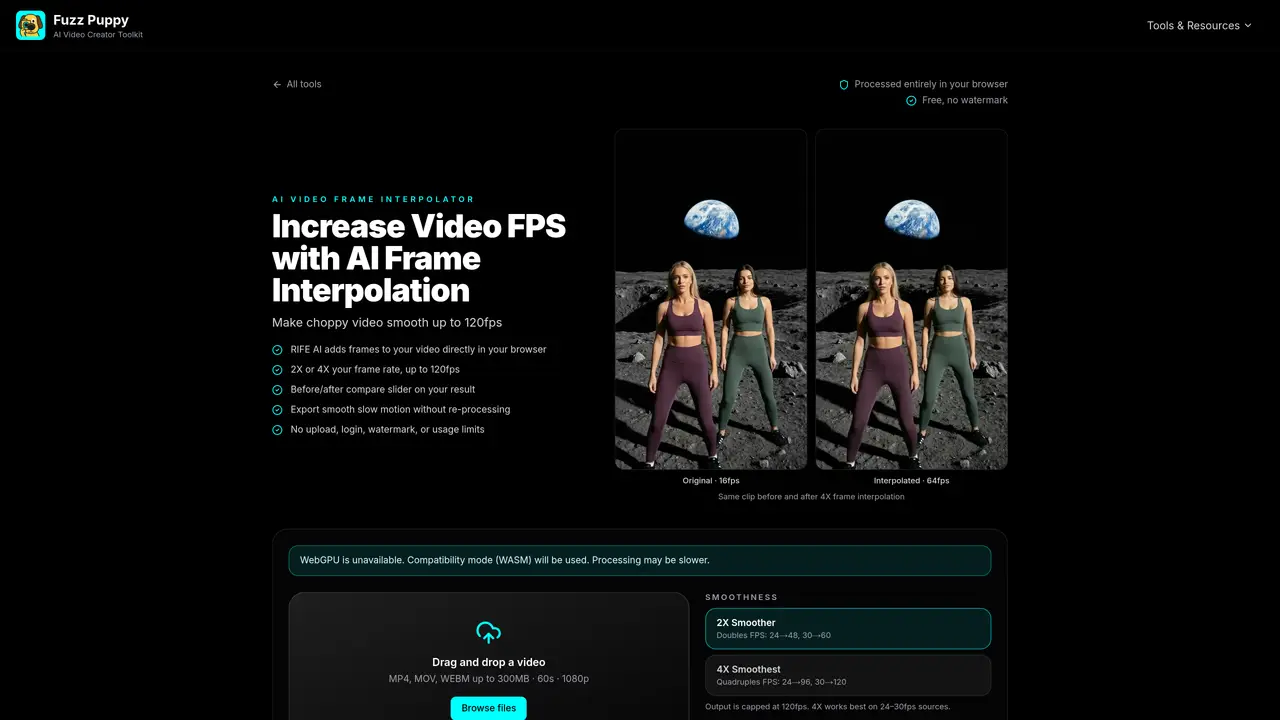
The AI Video Frame Interpolator uses the RIFE model to generate new in-between frames, increasing a video’s frame rate from sources such as 24fps to 48fps or 96fps and from 30fps to 60fps or 120fps. Processing occurs entirely within the user’s browser via WebGPU, eliminating uploads, logins, or watermarks. The tool supports MP4, MOV, and WEBM inputs up to 300MB and 1080p resolution, with a 60-second duration limit. Output retains the original audio track and can be exported at normal speed or in slow motion up to 0.25x. A before/after slider allows side-by-side comparison of the original and interpolated footage. The service is free and unlimited, with no usage caps or sign-up required. It is designed for smoothing choppy footage, enhancing AI-generated clips, and preparing videos for slow-motion playback.
Key features
- 2X and 4X frame rate doubling/quadrupling
- Before/after comparison slider
- Slow motion export at 0.5x and 0.25x
- Original audio preservation
- WebGPU acceleration for local processing
- MP4, MOV, WEBM input support
- No watermark or usage limits
- Real-time intermediate flow estimation via RIFE
Use cases
- Smoothing choppy AI-generated video clips
- Enhancing low-FPS footage for smoother playback
- Preparing videos for slow-motion export
Pros
- Processes video entirely in-browser without uploads or logins
- Supports 2X and 4X frame rate increases up to 120fps
- Preserves original audio in output with minimal re-encoding
- Includes before/after comparison slider for quality assessment
- Free and unlimited with no watermark or usage limits
Cons
- Input limited to 60 seconds and 1080p resolution
- Requires WebGPU-compatible browser for optimal performance
- Desktop applications may handle longer or 4K footage more efficiently
Frequently asked questions about AI Video Frame Interpolator
What is AI frame interpolation?
AI frame interpolation generates new in-between frames to increase a video’s frame rate, producing smoother motion instead of choppy playback. FuzzPuppy uses the RIFE model to estimate motion between existing frames and synthesize the missing frames.
Is the FuzzPuppy frame interpolator free?
Yes, the tool is free and unlimited, requires no signup, and does not watermark downloaded videos. Processing occurs entirely in the user’s browser using WebGPU, so there are no uploads or paid tiers.
What FPS can I convert my video to?
The 2X option doubles the frame rate (e.g., 24fps becomes 48fps) and the 4X option quadruples it (e.g., 24fps becomes 96fps). Output is capped at 120fps, so 4X works best for 24–30fps sources and 2X for 50–60fps sources.
What is the difference between frame interpolation and video upscaling?
Frame interpolation increases the frame rate (more frames per second), while upscaling increases resolution (more pixels per frame). They address different issues: use frame interpolation for choppy motion and upscaling for low-resolution footage.
Can this fix choppy AI-generated video?
Yes, AI video generators often output low-frame-rate clips with visible stutter. Interpolating these clips to 48–60fps or higher makes motion significantly smoother. The tool supports output from models like Sora, Runway, and Kling.
Does FuzzPuppy upload my video?
No, the tool processes videos entirely locally in the browser using WebGPU. The source video never leaves the user’s device, ensuring privacy and no upload queue.