Build teams of AI agents that collaborate, automate workflows, and complete complex tasks together.

Taskflow
$240 /workspace/moStarting price
0Popularity
About Taskflow
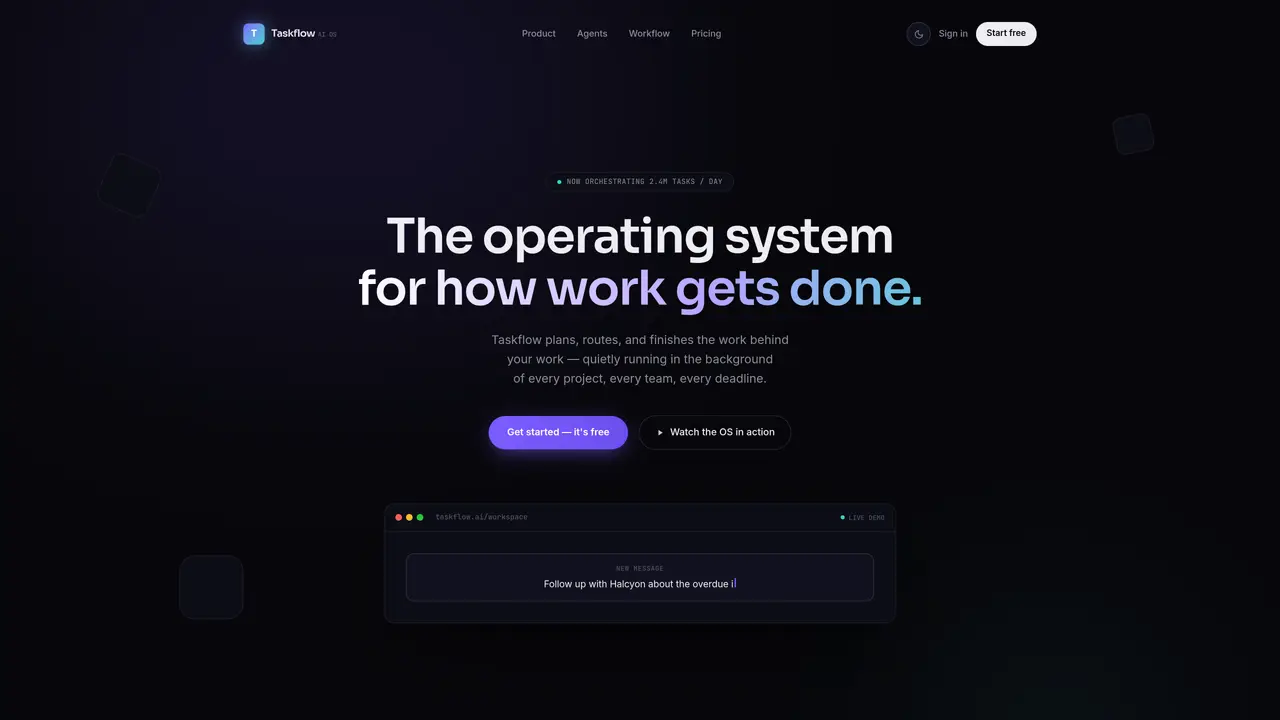
Taskflow functions as an AI layer beneath existing tools to automatically capture, understand, route and execute tasks. It ingests work from multiple sources such as emails, Slack threads and voice notes, converting them into structured tasks. The system reads intent and context from past projects, files and conversations to determine what completion looks like for each task. Tasks are then routed to the most suitable owner—human or AI agent—based on skill, capacity and history rather than static rules. A specialized agent workforce handles drafting, research, QA and billing under human supervision. Taskflow maintains a living priority map that re-ranks work in real time as deadlines and context shift, while context memory ensures no information is repeated. Native integrations allow it to operate within Slack, Notion and other tools without requiring migration or new interfaces.
Key features
- Autonomous task routing and assignment
- Drafting agent for replies, documents and follow-ups
- QA agent for reviewing work before delivery
- Billing agent for tracking invoices and renewal signals
- Living priority map that adapts to shifting deadlines
- Context memory across past projects and conversations
- Command console for plain-language task creation
- Native Slack integration with additional connectors in development
Use cases
- Agencies reclaiming billable hours through automated task execution
- Operations teams reducing manual inbox triage and routing errors
- Teams consolidating scattered work inputs into a single orchestrated system
Pros
- Autonomous task routing based on real-time capacity and skills
- Specialized AI agents for drafting, QA, billing and research
- Context memory that retains decisions and files across sessions
- Native integrations with Slack, Notion and email without migration
- Command console for plain-language task creation and assignment
Cons
- Limited to Slack integration at present with others listed as coming soon
- No explicit mention of mobile or cross-platform support beyond desktop
- Agent workforce requires human supervision and configuration
Frequently asked questions about Taskflow
What is Taskflow and what does it do?
Taskflow is an AI operating system that automates the capture, understanding, routing, and execution of tasks from multiple sources such as emails, Slack threads, and voice notes. It converts unstructured work into structured tasks, determines completion criteria, and routes them to the most suitable owner—human or AI agent—based on skill and capacity.
Who is Taskflow designed for?
Taskflow is designed for operations teams, agencies, and organizations looking to streamline workflows and reduce manual task management. It suits teams that rely on tools like Slack, Notion, and Linear and want to automate repetitive work without migrating to new platforms.
How does Taskflow integrate with existing tools?
Taskflow operates as a layer beneath existing tools, integrating natively with platforms like Slack, Notion, Linear, and email inboxes. It does not require migration or new interfaces, allowing teams to continue using familiar tools while Taskflow handles task orchestration in the background.
What types of AI agents does Taskflow offer?
Taskflow provides a specialized agent workforce including a Router agent for classifying and assigning tasks, a Drafting agent for creating replies and documents, a QA agent for reviewing work, and a Billing agent for tracking invoices and renewal signals. Each agent operates under human supervision and configurable guardrails.
How does Taskflow prioritize tasks?
Taskflow maintains a living priority map that re-ranks work in real time based on shifting deadlines, blockers, and context. This ensures that the most critical tasks are addressed first, adapting dynamically to changes in the team's workload and priorities.
What is Taskflow's pricing model?
Taskflow offers multiple pricing tiers, including plans for studios, agencies, and enterprises. Each plan includes the core AI orchestration features, with higher tiers unlocking additional autonomy, memory capacity, and access to the full agent workforce. Pricing is based on outcomes rather than headcount.