
OpenAI builds and deploys advanced AI models like GPT-4o for autonomous agents and workflows.

EvoX Genesis
0Popularity
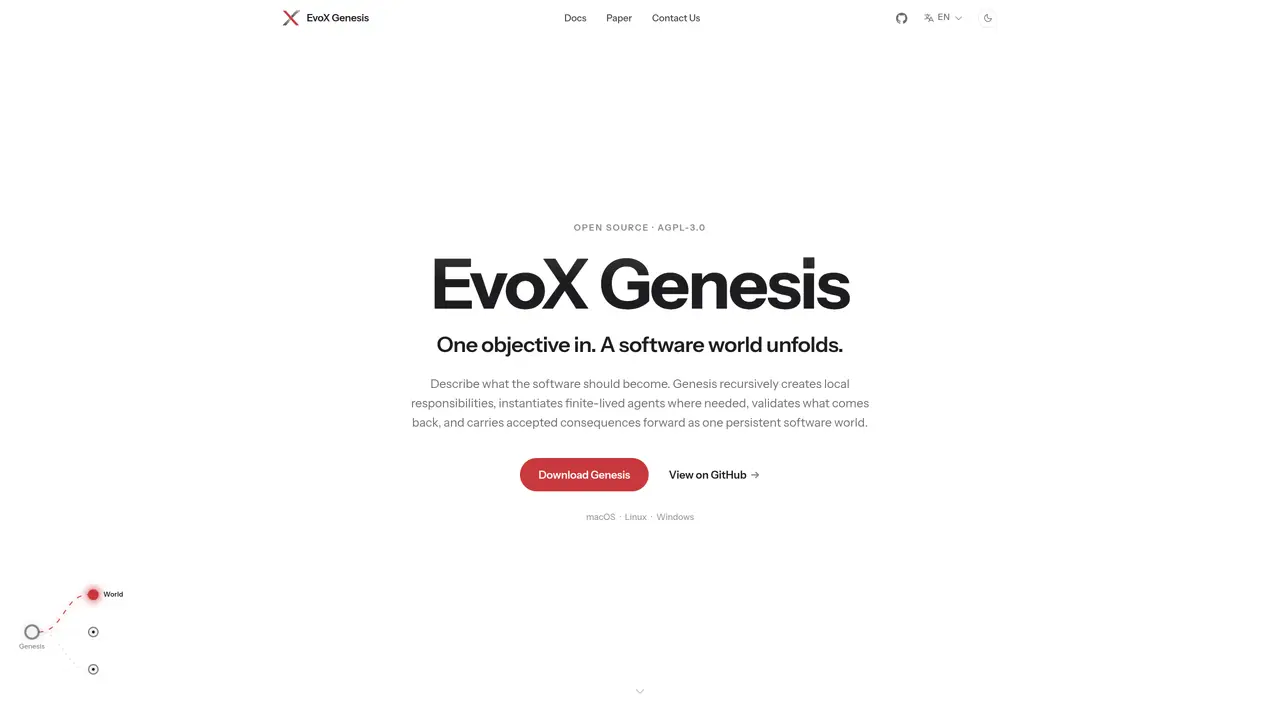
About EvoX Genesis
EvoX Genesis is a recursive agent-based development system designed to create persistent software worlds from a single objective. The tool separates the persistent software world from transient agents, where agents act within situated local contexts defined by repository paths and accepted software versions. Development proceeds through a hierarchy of managers and executors, with managers decomposing objectives and delegating tasks while judging returned contributions against evidence and constraints. Executors implement concrete changes in isolated Git worktrees, ensuring modifications are validated before acceptance into the version history. The system supports read-only investigators for reconnaissance and provides a native desktop dashboard for monitoring agent activity, reviewing diffs, and adjusting runtime settings. Remote development is possible via a headless daemon accessible through an encrypted SSH tunnel, allowing work to continue on powerful servers without disrupting workflows.
Key features
- Recursive decomposition of development objectives
- Agent-based task execution in isolated worktrees
- Platform-specific sandboxing (systemd-run, sandbox-exec, Windows)
- Real-time dashboard for monitoring agent activity
- Remote development via headless daemon and SSH tunnel
- Read-only investigator agents for reconnaissance
- Version history tracking with accepted consequences
- Contextual responsibility via repository-relative paths
Use cases
- Building a Rust-based C compiler from an empty repository
- Continuing development of an existing compiler with a new model
- Recursive decomposition of large software projects into manageable tasks
Pros
- Recursive agent hierarchy with managers and executors
- Persistent software world with transient agents
- Isolated Git worktree execution with platform-specific sandboxes
- Native desktop dashboard for real-time monitoring
- Remote development via encrypted SSH tunnel
Cons
- No explicit mention of free tier or open-source availability beyond AGPL-3.0
- Limited to desktop environments (no mobile or web version)
- Requires local installation and setup
Frequently asked questions about EvoX Genesis
What does EvoX Genesis do?
EvoX Genesis is a recursive agent-based development system that creates persistent software worlds from a single objective. It separates persistent software versions from transient agents, where agents act within situated local contexts defined by repository paths and accepted software versions.
Who is EvoX Genesis designed for?
The tool is designed for developers and teams seeking to automate complex, long-running software development tasks. It suits those who want to specify high-level objectives and let the system recursively decompose and execute the work while maintaining a persistent software world.
How does EvoX Genesis work?
Genesis works by recursively decomposing objectives into smaller tasks managed by a hierarchy of managers and executors. Managers judge contributions against evidence and constraints, while executors implement changes in isolated Git worktrees. The system validates modifications before accepting them into the version history.
What are the key features of EvoX Genesis?
Key features include persistent software worlds, situated local contexts for agents, recursive task decomposition, isolated Git worktree execution, read-only investigators for reconnaissance, a native desktop dashboard for monitoring, and remote development via an encrypted SSH tunnel.
Can EvoX Genesis be used for remote development?
Yes, Genesis supports remote development by running a headless daemon on a powerful server while connecting to a local desktop dashboard over an encrypted SSH tunnel. This allows work to continue without disrupting workflows and supports multiple targets from one place.
How do I get started with EvoX Genesis?
To get started, download Genesis from the official website or GitHub, install it on your system (macOS, Linux, or Windows), and use the native desktop dashboard to launch objectives, monitor agent activity, and review diffs. The system is designed to be set up in minutes.