
Unify customer data, automate workflows, and scale experiences with Einstein AI, Copilot, and Data Cloud in one CRM platform.

Pickle Browser
0Popularity
About Pickle Browser
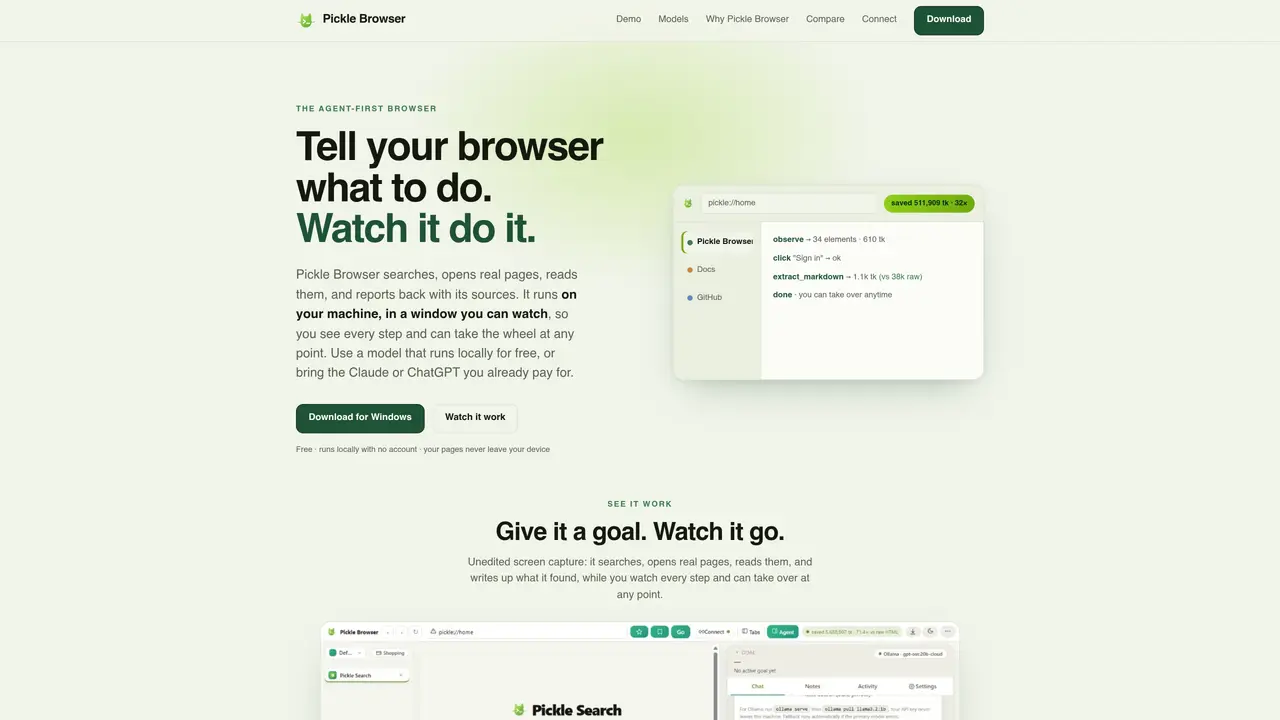
Pickle Browser is an agent-first browser that executes web-based tasks under user supervision. It can search, open real pages, read their content, and report back with sources, all within a visible window on the user’s machine. The tool supports multiple AI models: a local model via Ollama that runs offline, free hosted models through Ollama Cloud or NVIDIA Build, or existing subscriptions like Claude or ChatGPT. Users can switch between these options at any time. The browser provides structured summaries of page content to reduce token usage, with measured savings of up to 156 times fewer tokens compared to raw HTML. It integrates with the user’s existing browser logins and allows manual intervention at any step, including pausing or taking over control. The application is designed for research, data extraction, and multi-step tasks while maintaining privacy by keeping page content local.
Key features
- Local AI model via Ollama with offline capability
- Free hosted models through Ollama Cloud or NVIDIA Build
- Integration with existing Claude, ChatGPT, or Gemini subscriptions
- Structured page summaries for token efficiency
- Manual control and intervention during tasks
- Real-time observation of agent actions in a visible window
- MCP client support for connected agents
- Token usage tracking and per-step logging
Use cases
- Multi-step web research with real-time oversight
- Data extraction from structured web pages
- Automated browsing tasks with user approval for actions
Pros
- Runs locally or with user-chosen hosted models
- Allows real-time observation and manual control during tasks
- Reduces token usage by sending structured page summaries
- Supports offline operation with bundled local models
- Integrates with existing browser logins and accounts
Cons
- Local models may lose context on long multi-step tasks
- Hosted models require sending page text to external servers
- No free tier for all model options beyond basic local use
- Windows-only application
Frequently asked questions about Pickle Browser
What is Pickle Browser and what does it do?
Pickle Browser is an agent-first browser that performs web-based tasks under user supervision. It can search, open real web pages, read their content, and report back with sources, all within a visible window on the user’s machine. Users can provide goals, and the browser executes steps while allowing manual intervention at any point.
Who is Pickle Browser designed for?
Pickle Browser is designed for individuals or teams who need to automate web research, data extraction, or multi-step tasks while maintaining visibility and control. It suits users who prefer privacy, flexibility in model choice, or the ability to pause and take over tasks manually.
How does Pickle Browser handle AI models and pricing?
Pickle Browser supports multiple AI models, including a local model via Ollama that works offline, free hosted models through Ollama Cloud or NVIDIA Build, or existing subscriptions like Claude or ChatGPT. The local model incurs no per-use or subscription fees, while hosted models may require a free sign-up or API key.
Can Pickle Browser integrate with existing browser logins and tools?
Yes, Pickle Browser integrates with the user’s existing browser logins and can connect to any MCP-compatible agent or tool. It also allows users to switch between models or take manual control at any step, including before performing actions like purchases.
What are the privacy and security features of Pickle Browser?
Pickle Browser prioritizes privacy by running on the user’s local machine, ensuring page content never leaves the device when using the bundled local model. Even when using hosted models, user history, notes, and logins remain local, and the app warns if content must be sent to a server.
How does Pickle Browser reduce token usage when reading web pages?
Pickle Browser sends a structured summary of page content (headings, links, and interactive elements) instead of raw HTML, resulting in significantly fewer tokens. The app logs exact token savings per step, with measured reductions up to 156 times fewer tokens compared to raw HTML.