GitHub hosts HunyuanVideo, Tencent's open-source framework for large-scale video generation models, enabling AI-driven video creation.

dlogs
1.3KMonthly visits
2Popularity
About dlogs
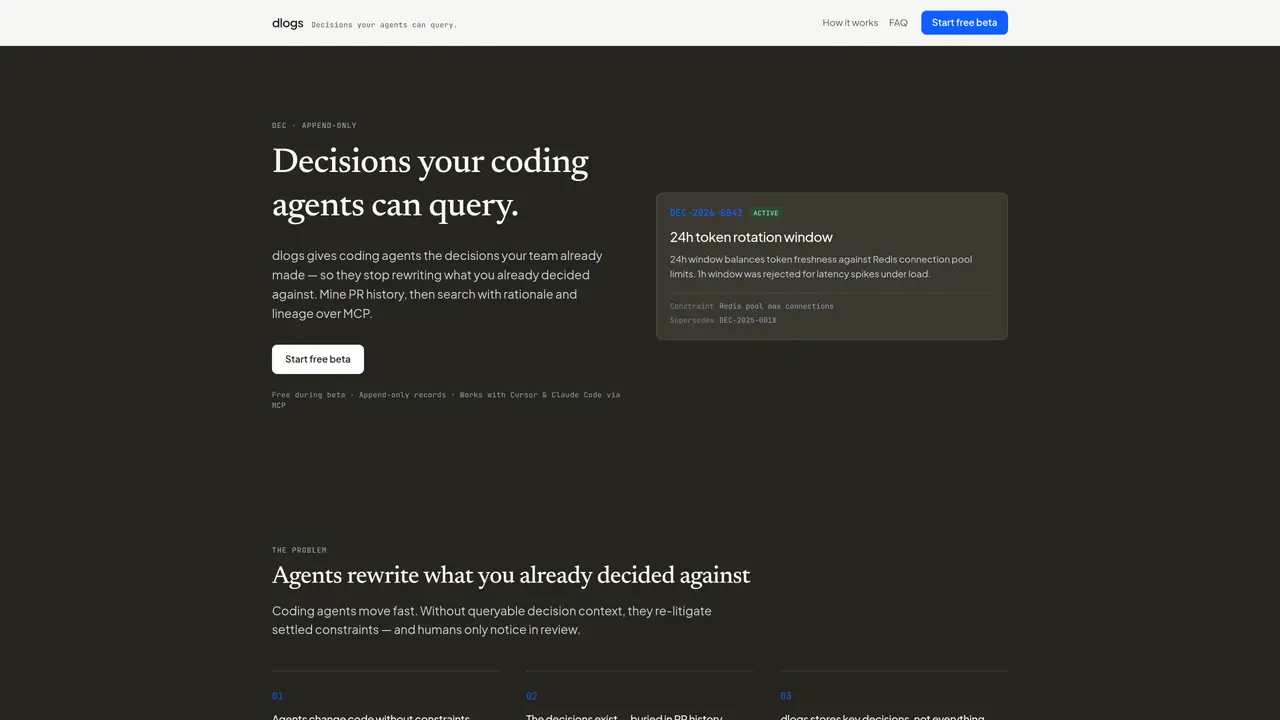
dlogs captures consequential decisions made by engineering teams and makes them queryable for both humans and coding agents. It mines merged pull requests to extract decision drafts, which a human reviewer confirms and activates as append-only records. Each decision includes rationale, constraints, and lineage, allowing agents to search for the governing rules before editing code. The tool integrates with Cursor and Claude Code via the Model Context Protocol, enabling agents to retrieve relevant decisions directly within their workflow. Advisory checks on pull requests cite the applicable decision without blocking merges, providing context during code review. Records are organized by DEC IDs with supersede relationships, preserving the evolution of decisions over time. The system balances token freshness with system constraints, such as Redis connection pool limits, and avoids silent rewrites of historical context.
Key features
- Append-only decision records with supersede lineage
- PR history mining to extract decision drafts
- MCP integration for agent queries
- Advisory comments on pull requests
- Semantic and keyword search for decisions
- Per-org tamper-evident DEC IDs
- Token rotation with 24-hour window
- Human confirmation for decision activation
Use cases
- Guiding coding agents to avoid rewriting settled constraints
- Providing context during pull request reviews
- Tracking the evolution of engineering decisions over time
Pros
- Append-only records prevent silent rewrites of decision history
- Integrates with Cursor and Claude Code via MCP for agent queries
- Mines existing PR history to populate decisions on day one
- Advisory checks on PRs provide non-blocking decision context
- Supports semantic and keyword search for decision retrieval
Cons
- Limited to GitHub repositories for PR history mining
- Requires human confirmation for decision activation
- Advisory checks do not block PR merges
- Constrained by Redis connection pool limits for token rotation
Frequently asked questions about dlogs
What does dlogs do?
dlogs captures consequential engineering decisions from merged pull requests and stores them as append-only records that coding agents can query via the Model Context Protocol (MCP). It turns existing PR history into searchable decision records with rationale, constraints, and lineage.
Who is dlogs for?
dlogs is designed for engineering teams that use coding agents like Cursor or Claude Code and want to prevent agents from rewriting decisions already made by the team. It helps onboard new engineers and ensures agents respect existing constraints.
How does dlogs integrate with coding agents?
dlogs integrates with Cursor and Claude Code via the Model Context Protocol (MCP), allowing agents to search for and retrieve relevant decisions directly within their workflow before editing code.
Can dlogs block pull requests?
No, dlogs provides advisory checks on pull requests that cite the applicable decision without blocking merges, ensuring context is available during code review without imposing merge gates.
How are decisions recorded and updated in dlogs?
Decisions are recorded as append-only records with unique DEC IDs and supersede relationships, preserving the evolution of decisions over time. Humans confirm and activate draft decisions, and agents can propose updates that humans approve.
How do I get started with dlogs?
Start by connecting your GitHub repositories to dlogs, which mines merged PRs into decision drafts for human review and activation. Once decisions are recorded, coding agents can query them via MCP during development.
dlogs Website Engagement
Last Update: 24 days ago
Total Monthly Visits
0
Bounce Rate
0%
Visit Duration (avg)
0.00s
Pages Per Visit
0
Country Rank
0
United States
Global Rank
0
Monthly Traffic
Traffic Share By Country
- United States97.1%
- Japan2.9%