
OpenAI builds and deploys advanced AI models like GPT-4o for autonomous agents and workflows.

Sculptor
0Popularity
About Sculptor
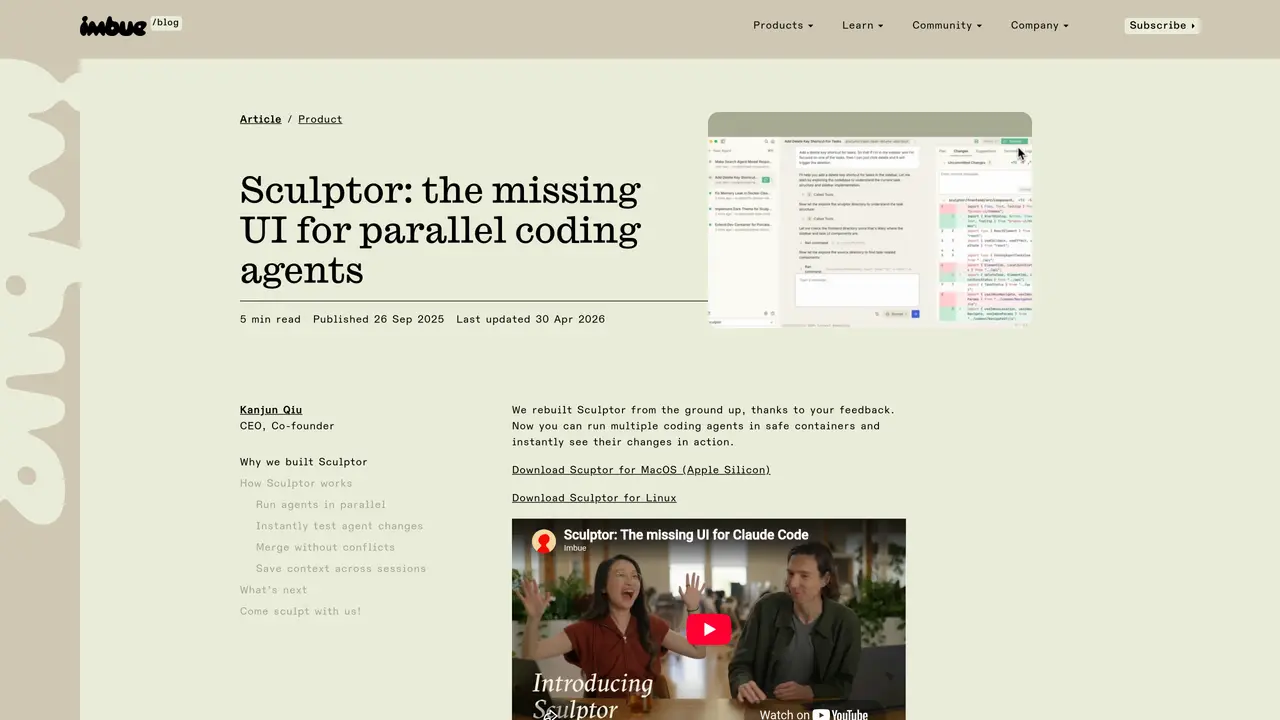
Sculptor is an advanced AI-powered coding assistant designed to help developers identify and resolve issues directly within their workflow. The tool employs multiple AI coding agents that operate simultaneously in isolated sandboxes, enabling automatic detection of problems such as missing tests, hardcoded variables, memory leaks, and race conditions. Each agent works independently in a contained environment, reducing risks to the main codebase. Developers can review suggested fixes, customize issue detection using LLM prompts or shell commands, and leverage seamless bidirectional synchronization with their local editor through Pairing Mode. Sculptor supports integration with Claude and plans to add GPT-5 support, positioning itself as an AI-native development environment where artificial intelligence augments routine debugging and code improvement tasks. This allows engineers to focus more on creative problem-solving while automated agents handle repetitive tasks.
Key features
- Identifies issues like missing tests, hardcoded variables, memory leaks, and race conditions
- Uses multiple isolated AI agents working in parallel within sandboxes
- Suggests and implements fixes for detected problems
- Customizable issue detection via LLM prompts or shell commands
- Seamless bidirectional synchronization with local editors through Pairing Mode
- Supports integration with Claude (GPT-5 support coming soon)
- Operates in contained environments to minimize risk to the main codebase
- Enables developers to review and approve proposed changes
Use cases
- Automated debugging and issue resolution in software development workflows
- Improving code quality by detecting and fixing common programming errors
- Enhancing productivity by offloading routine debugging tasks to AI agents
Pros
- Runs multiple coding agents in parallel within isolated, safe containers to prevent environment conflicts
- Enables instant testing of agent changes via Pairing Mode with bidirectional synchronization to the local IDE
- Preserves full session context—plans, chats, tool calls, and code changes—across restarts for seamless workflow continuity
- Supports merging agent changes with conflict detection and agent-assisted resolution for cleaner integration
- Planned integrations with multiple AI models including Claude, GPT-5, and Codex for flexible model choice
Cons
- Currently limited to macOS (Apple Silicon), Linux, and upcoming Windows support, excluding some platforms
- Features like Suggestions and instruction audits are still in beta, indicating potential instability or incomplete functionality
- Requires containerized environments, which may introduce setup complexity for users unfamiliar with Docker or similar tools
Sculptor videos
Frequently asked questions about Sculptor
What is Sculptor and what does it do?
Sculptor is an AI-powered development environment that runs multiple coding agents in parallel within isolated containers, allowing developers to safely explore different approaches, test changes instantly, and merge results back into their codebase.
Who is Sculptor designed for?
Sculptor is designed for developers and engineering teams who want to leverage AI agents for parallel coding tasks, debugging, refactoring, and feature development while maintaining control over the process and environment safety.
How does Sculptor integrate with my existing workflow?
Sculptor synchronizes bidirectionally with your local IDE through Pairing Mode, allowing you to review, edit, and commit agent changes directly in your development environment without disrupting your workflow.
What AI models does Sculptor support?
Sculptor currently supports Claude Code and Codex, with planned support for GPT-5. Users can switch models by providing the appropriate API key or credentials.
Can I customize the behavior of the AI agents?
Yes, you can customize agent behavior using LLM prompts or shell commands, and future updates will allow adding custom MCP servers and writing plain-English rules for instruction audits.
How do I get started with Sculptor?
Download Sculptor for your platform (macOS Apple Silicon, Linux, or upcoming Windows), install it, and start spinning up agents directly from your IDE or terminal to begin parallel coding sessions.