Tesla’s AI stack powers Full Self-Driving, Optimus humanoid robots, and real-world autonomy with neural networks, custom hardware, and Dojo-scale training.
31M visits/mo+5.5%#8 Coding & Development

Autonomous offensive security testing across web, API, cloud, mobile, and desktop
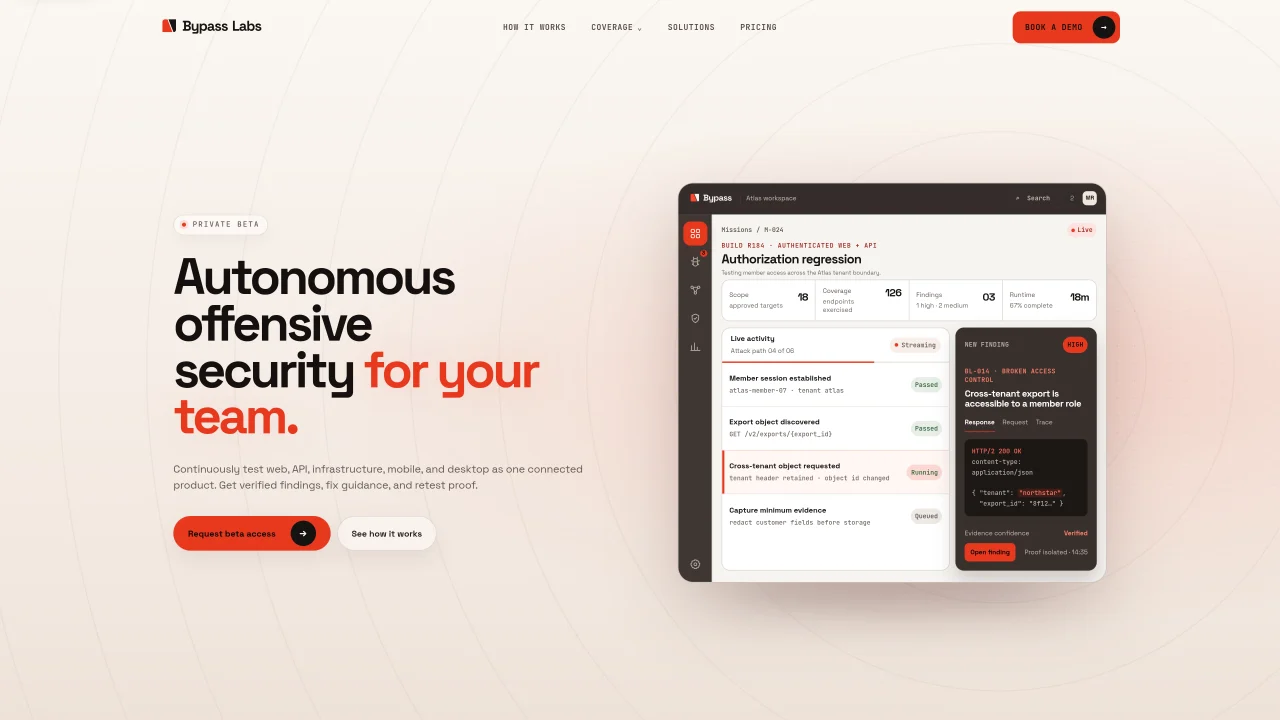
Bypass Labs provides autonomous offensive security testing for software teams. It continuously tests web, API, infrastructure, mobile, and desktop applications as a single connected product. The platform maps changes in each release, tests affected attack paths, and delivers verified findings with fix guidance and retest proof. Findings include detailed evidence such as request/response traces and remediation history, enabling engineers to address issues efficiently. Two engagement modes are offered: Self-Service for automated testing of every release and White-Glove for researcher-led assessments of sensitive systems or high-stakes decisions. The platform covers identity, business logic, access control, cloud paths, local data, and endpoint boundaries across multiple operating systems and frameworks. It supports iOS, Android, Windows, macOS, Electron, and local trust environments, with policy checks governing every action during testing.
Bypass Labs provides autonomous offensive security testing for software teams, continuously testing web, API, infrastructure, mobile, and desktop applications as a single connected product. It maps changes in each release, tests affected attack paths, and delivers verified findings with fix guidance and retest proof.
The platform is designed for software teams that need continuous security testing, including engineering leadership, auditors, and security researchers. It suits organizations shipping frequently or requiring high-assurance testing for sensitive systems.
Bypass Labs offers two engagement modes: Self-Service for automated testing of every release and White-Glove for researcher-led assessments of sensitive systems or high-stakes decisions. Self-Service automates repeatable work, while White-Glove provides expert-led testing with named researcher ownership.
The platform supports testing across web, API, infrastructure, mobile (iOS, Android), and desktop (Windows, macOS, Electron) applications. It also covers local trust environments and various operating systems and frameworks.
Each finding includes detailed evidence such as request/response traces, remediation history, and proof of failure. Findings are verified and delivered with fix instructions, enabling engineers to address issues efficiently and auditors to review consistent records.
Prospective users can request beta access through the Bypass Labs website to explore the platform. The process involves approving the testing boundary, mapping changes in the release, and running automated or researcher-led assessments based on the chosen engagement mode.
We use essential cookies to run aitoolnavio™, and optional cookies to analyze traffic and measure our marketing. You choose what we use — optional cookies stay off unless you turn them on. See our Privacy Policy.
One short email a week: fresh tools worth trying, honest takes and the updates that actually matter. No spam, unsubscribe any time.
Tesla’s AI stack powers Full Self-Driving, Optimus humanoid robots, and real-world autonomy with neural networks, custom hardware, and Dojo-scale training.
Customize, deploy, and control AI models securely.
Standardize application packaging and execution with portable containers for consistent local and cloud workflows.
AI-first electronic design automation for ICs, advanced packaging, and systems with hardware-assisted acceleration and elastic cloud delivery.
Unified AI-powered platform for real-time monitoring, analytics, and security across cloud infrastructure, applications, and services.
Prevention-first, AI-powered cybersecurity platform protecting networks, clouds, and endpoints with unified controls and autonomous response.
Automate tasks, analyze data, and ensure data security with advanced measures.
Cloud communications platform that lets developers embed SMS, voice, WhatsApp, email, video, verification, and conversational AI via APIs.
AI-powered endpoint security with XDR, cloud or on-prem control, and low system impact for ransomware, email threats, and account takeover prevention.
Automate error tracking, monitor application performance, and gain insights with advanced analytics.
Identify stolen identities, uncover copyright infringements, and find unauthorized use of images with precision.
Instant threat detection and response, AI-powered prevention, unified dashboard for full visibility and control.
Matched on what this tool does — grouped by the job you would be replacing.
matches Autonomous offensive security testing across web, API, cloud, mobile, and desktop · Release-aware mapping and regression testing · Full-stack coverage across multiple platforms
Autonomous AI-driven penetration testing with auditor-ready reports starting at $99
Continuous autonomous penetration testing for code, APIs, apps, infrastructure and cloud
Continuous autonomous AI pentesting for applications, APIs and infrastructure
AI-powered penetration testing tool that simulates cyberattacks to uncover and fix security flaws in applications.
matches AI-powered application security platform for scanning code, dependencies, and cloud config to detect and fix vulnerabilities across the SDLC · Unified vulnerability dashboard aggregating SAST, DAST, SCA, and Cybe Analysis results · AI-assisted triage with sorting by exploitability, relevance, and risk signals
Unified cloud security platform that maps risks across cloud, code, runtime, identities, and AI workloads with graph-based prioritization and code-to-cloud remediation.
AI-powered application security platform for scanning code, dependencies, and cloud config to detect and fix vulnerabilities across the SDLC.
AI security scanning platform that detects exploitable vulnerabilities in code, logic, and infrastructure and delivers fixes via PRs and CI/CD pipelines.
AI-assisted static analysis and application security posture management with evidence tracking