
Tesla’s AI stack powers Full Self-Driving, Optimus humanoid robots, and real-world autonomy with neural networks, custom hardware, and Dojo-scale training.
31M visits/mo+5.5%#8 Coding & Development

LLM defense platform that blocks prompt injection and data leakage in real time
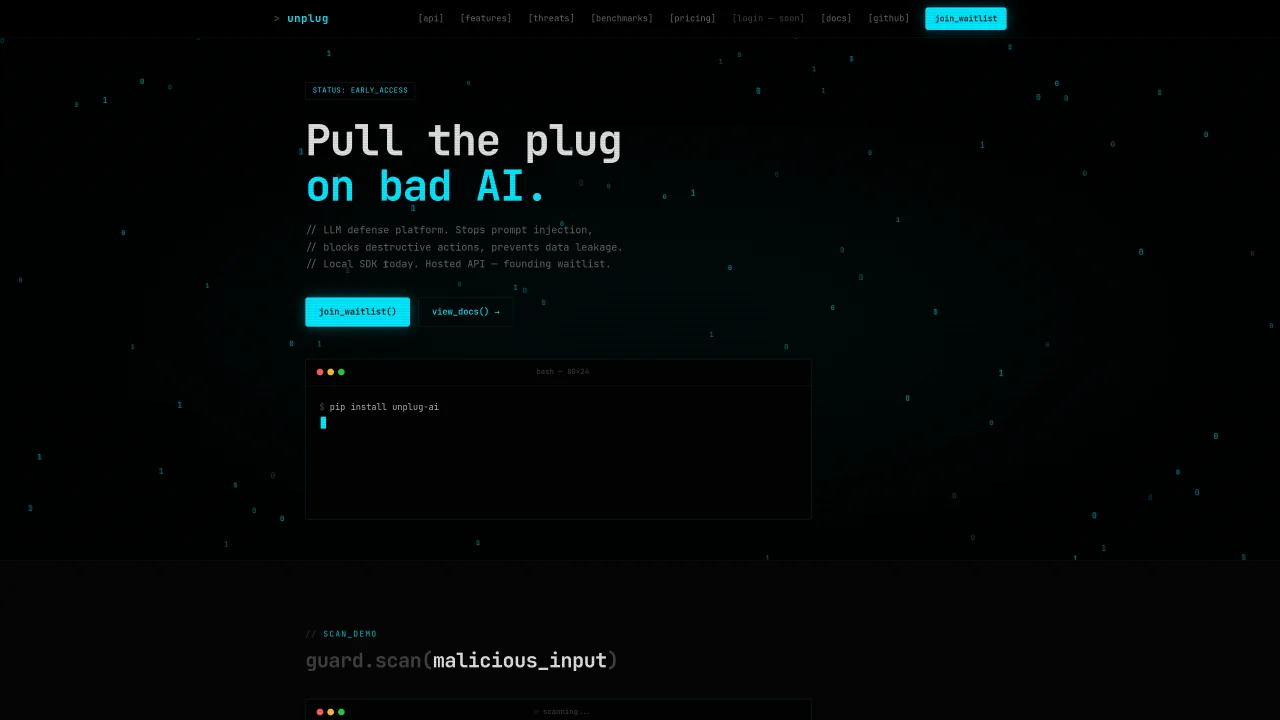
unplug is a defense platform designed to protect large language model (LLM) applications from adversarial attacks such as prompt injection, destructive actions, and data exfiltration. It operates as a three-stage pipeline—normalize, scan, and decide—processing inputs in under 20 milliseconds to identify and block malicious content before it reaches the agent. The system supports both local SDK deployment for offline, CPU-only scanning and a planned hosted API for server-side integration. It provides span-level redaction, evidence-based findings with risk scores, and source-aware scanning across user inputs, retrieved content, tool outputs, and system prompts. The platform categorizes threats into six scanner types, including injection, destructive actions, data leakage, harmful outputs, financial risks, and secret exposure. Benchmarks show high recall and precision rates, particularly for indirect injection attacks hidden in retrieved context, with false positive rates below 1%.
unplug is an LLM defense platform that scans untrusted text for prompt injection, destructive actions, and data leakage. It provides evidence-based findings and span-level redaction rather than binary blocking.
unplug is designed for developers and organizations deploying large language model applications that require protection from adversarial attacks such as prompt injection and data exfiltration.
unplug can be integrated via a free Python SDK available on PyPI, with installation options including basic and ML-enhanced versions. A hosted API is planned for server-side integration.
Yes, unplug offers an MCP server for agent-based systems, available via uvx unplug-mcp. This requires the unplug-ai SDK version 0.5.2 or higher.
unplug detects prompt injection, destructive actions (such as SQL or shell commands), data leakage (including API keys and PII), harmful outputs, financial risks, and secret exposure.
Yes, unplug supports local SDK deployment for offline, CPU-only scanning, making it suitable for environments with limited connectivity or strict data privacy requirements.
We use essential cookies to run aitoolnavio™, and optional cookies to analyze traffic and measure our marketing. You choose what we use — optional cookies stay off unless you turn them on. See our Privacy Policy.
One short email a week: fresh tools worth trying, honest takes and the updates that actually matter. No spam, unsubscribe any time.
Tesla’s AI stack powers Full Self-Driving, Optimus humanoid robots, and real-world autonomy with neural networks, custom hardware, and Dojo-scale training.
Customize, deploy, and control AI models securely.
Standardize application packaging and execution with portable containers for consistent local and cloud workflows.
AI-first electronic design automation for ICs, advanced packaging, and systems with hardware-assisted acceleration and elastic cloud delivery.
Unified AI-powered platform for real-time monitoring, analytics, and security across cloud infrastructure, applications, and services.
Prevention-first, AI-powered cybersecurity platform protecting networks, clouds, and endpoints with unified controls and autonomous response.
Automate tasks, analyze data, and ensure data security with advanced measures.
Cloud communications platform that lets developers embed SMS, voice, WhatsApp, email, video, verification, and conversational AI via APIs.
AI-powered endpoint security with XDR, cloud or on-prem control, and low system impact for ransomware, email threats, and account takeover prevention.
Automate error tracking, monitor application performance, and gain insights with advanced analytics.
Identify stolen identities, uncover copyright infringements, and find unauthorized use of images with precision.
Instant threat detection and response, AI-powered prevention, unified dashboard for full visibility and control.
Matched on what this tool does — grouped by the job you would be replacing.
matches Span-level redaction of malicious content · Evidence-based findings with risk scores · Source-aware scanning for multiple input types
Open-source input firewall that scans AI agent prompts and files for security threats before model ingestion
Local-first AI data loss prevention tool that scans prompts for secrets and PII before they reach AI services
AI gateway that secures LLM requests with a firewall, budget controls, and automatic failover.
Static and dynamic security gates for AI models and agents
matches Runtime enforcement layer for governing AI agents and generating compliance proofs · Real-time agent traces with token-level precision · Cryptographically signed audit logs
Runtime enforcement layer for governing AI agents and generating compliance proofs
Runtime security service that inspects AI support workflows for untrusted content and actions