
Summarizes, extracts, and rewrites content from files.

Linkly AI
$29/yearStarting price
27KMonthly visits
24Popularity
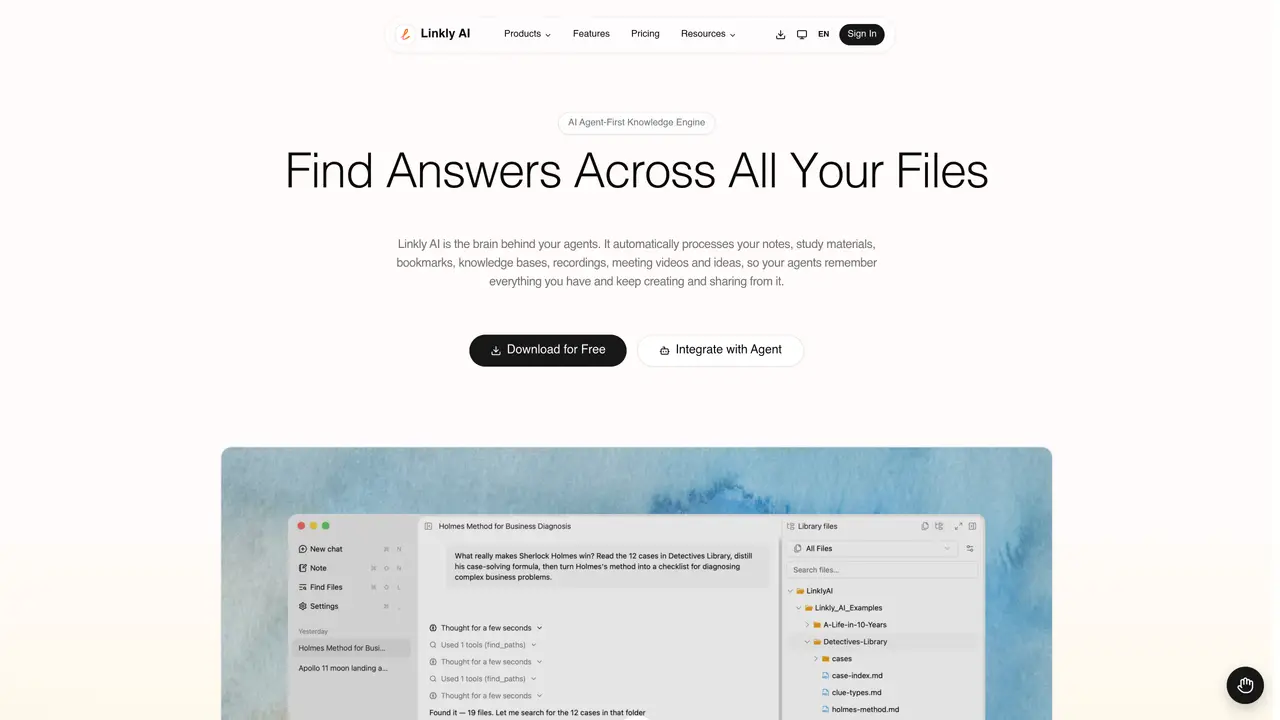
About Linkly AI
Linkly AI functions as a local document search engine designed to integrate with AI agents. It automatically processes and indexes files stored on a user’s computer, including documents, images, e-books, audio, and video. The tool maintains a private knowledge layer that agents can query to retrieve relevant information without manual curation. Users can organize files into shareable libraries accessible via a single link, enabling collaboration while retaining control over visibility settings. Integration is supported through CLI, MCP, and official Skills, allowing seamless connection with various AI applications. The system emphasizes speed, with indexing completed in minutes and query responses under half a second. It operates locally by default but offers cloud-enhanced features in its Pro plan for remote access and advanced capabilities.
Key features
- Local document parsing and indexing
- Full-text and semantic search
- Outline indexing for large documents
- Cross-language search capability
- CLI and MCP integration methods
- Shareable knowledge libraries
- Browser extension for webpage clipping
- Lightweight background operation
Use cases
- Students indexing lecture videos, slides, and handouts for quick retrieval
- Researchers comparing and searching through scattered academic papers
- Legal teams analyzing contracts and case files across multiple documents
Pros
- Automatic parsing and indexing of local files without manual curation
- Supports multiple file formats including PDF, EPUB, MP4, and DOCX
- Integrates with mainstream AI agents via CLI, MCP, and Skills
- Local-first operation with optional cloud-enhanced features
- Cross-language semantic search across hundreds of languages
Cons
- Pro plan required for cloud features and advanced AI models
- Limited cloud library usage quota on Free plan
- No explicit support for mobile or web-based access
Frequently asked questions about Linkly AI
What is Linkly AI and what does it do?
Linkly AI is a local document search engine designed for AI agents. It automatically processes and indexes files stored on a user’s computer, including documents, images, e-books, audio, and video, to create a private knowledge layer that agents can query for relevant information without manual curation.
Who should use Linkly AI?
Linkly AI is suited for knowledge workers, students, researchers, lawyers, content creators, and product teams who need to organize, search, and share large volumes of files efficiently. It helps users move from hoarding information to actively using it through AI-driven retrieval.
How does Linkly AI integrate with other AI tools?
Linkly AI offers integration through CLI, MCP, and official Skills, allowing seamless connection with various AI applications such as OpenAI Codex, Claude, ChatGPT, GitHub Copilot, Cursor, and others. This enables AI agents to search, compare, read, and cite files directly.
Can I share my indexed files with others?
Yes, Linkly AI allows users to organize files into shareable libraries accessible via a single link. These libraries can be shared with friends, teammates, or followers, and their AI agents can use the shared knowledge directly while visibility settings remain under the user’s control.
Does Linkly AI work with non-English files?
Yes, Linkly AI supports cross-language search powered by a local multilingual model, enabling semantic-based search across hundreds of languages. This allows users to retrieve relevant information regardless of the language of their files.
How do I get started with Linkly AI?
To get started, download and install Linkly AI, then add a local folder containing your files. The tool will automatically index the contents, creating a private knowledge layer that your AI agents can query. Integration with AI tools is supported through CLI, MCP, or official Skills.
Linkly AI Website Engagement
Last Update: 9 days ago
Total Monthly Visits
0
Bounce Rate
0%
Visit Duration (avg)
0.00s
Pages Per Visit
0
Country Rank
0
China
Global Rank
0
Monthly Traffic
Traffic Sources
Traffic Share By Country
- China77.6%
- United States10%
- Vietnam4.8%
- Singapore3.8%
- India2.6%