AI assistant for safe, reliable productivity with code, collaboration, and integrations.

Dim0
€6.99Starting price
0Popularity
About Dim0
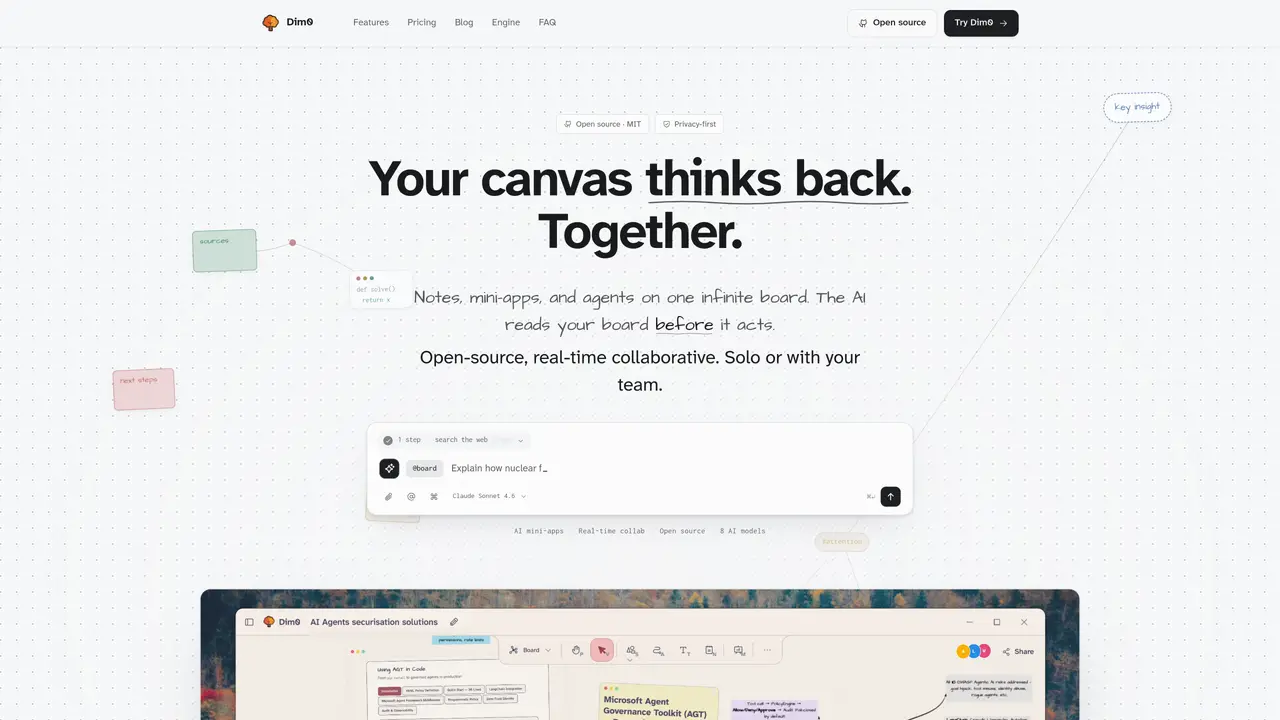
Dim0 is an open-source, privacy-first infinite thinking canvas designed to consolidate notes, sketches, code, and live widgets onto a single board. A board-aware AI agent reads the workspace, searches and synthesizes information, executes code, and places editable results—such as mind maps, summaries, charts, or nodes—directly onto the canvas. The tool supports multiple AI models and offers optional self-hosting, giving users full control over their data. Researchers, designers, engineers, and creators can use Dim0 to maintain spatial structure in their thinking while leveraging contextual AI that acts on their actual work. By unifying tools and workflows, it reduces fragmentation and keeps projects organized in a single, interactive environment. The platform emphasizes privacy and flexibility, making it suitable for both individual and collaborative use cases where data sovereignty is a priority.
Key features
- Open-source and privacy-first design
- Infinite canvas for notes, sketches, and code
- Board-aware AI agent for contextual search and synthesis
- Supports live widgets and editable results (mind maps, summaries, charts)
- Multi-model AI support
- Optional self-hosting for data control
- Unified workspace for notes, code, and AI workflows
- Spatial organization of ideas and projects
Use cases
- Researchers organizing notes, code snippets, and AI-generated insights on a single canvas
- Designers and engineers collaborating on projects with integrated code execution and visual documentation
- Creators consolidating workflows by combining sketches, summaries, and AI-driven analysis in one space
Pros
- Open-source and self-hostable under MIT license, ensuring full data control and privacy
- Board-aware AI agent reads the entire canvas before acting, enabling contextual and accurate outputs
- Supports real-time collaboration with live cursors, shared agents, and conflict-free editing
- Unifies notes, sketches, code, mini-apps, and AI agents on a single infinite canvas
- Offers multiple AI model options and themes for customization
Cons
- May require technical setup for self-hosting, which could be challenging for non-technical users
- Real-time collaboration features may introduce complexity for users accustomed to simpler note-taking tools
Frequently asked questions about Dim0
What is Dim0 and who is it designed for?
Dim0 is an open-source, privacy-first infinite thinking canvas that consolidates notes, sketches, code, and live widgets onto a single board. It is designed for researchers, designers, engineers, and creators who need a unified workspace to maintain spatial structure in their thinking while leveraging contextual AI.
How does the board-aware AI agent work in Dim0?
The AI agent reads the entire canvas before taking action, enabling it to search, synthesize information, execute code, and place editable results directly onto the board as nodes. This ensures contextual accuracy and reduces the need for manual copy-pasting.
Can Dim0 be used for collaboration, and how does it handle real-time editing?
Yes, Dim0 supports real-time collaboration with features like live cursors, shared agents, and conflict-free editing using operational transforms. Multiple users can work on the same board simultaneously without merge conflicts.
Does Dim0 offer self-hosting options, and what are the privacy implications?
Dim0 is self-hostable and operates under a privacy-first model. The cloud version encrypts data in transit and at rest, and the tool never trains on user content or sells data. Self-hosting allows users to retain full control over their infrastructure and data.
What types of AI models does Dim0 support?
Dim0 supports multiple AI models, including options from Anthropic, OpenAI, Google, Mistral, DeepSeek, Alibaba, Moonshot, and Z.ai. Users can switch between models based on their preferences and workflow needs.
How can I get started with Dim0?
Users can start with Dim0 Cloud for free without requiring setup, or self-host the tool using the open-source codebase. The platform emphasizes ease of use with no proprietary formats, allowing users to export their work at any time.