Generate content, correct spelling, suggest synonyms to enhance writing.
173M visits/mo+0.1%#1 Productivity & Office
Open-source Kubernetes interface with UI and MCP server for troubleshooting and visibility
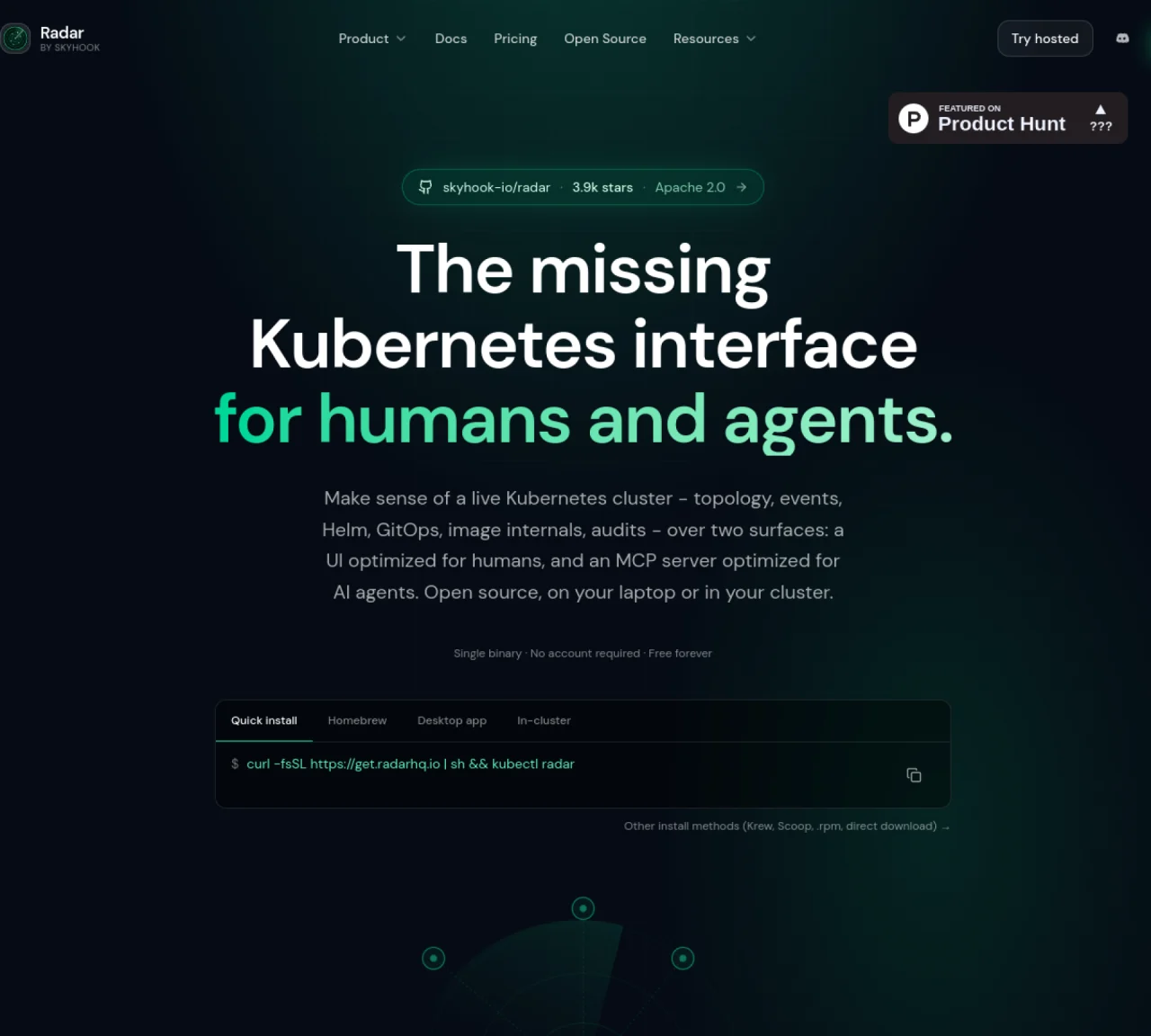
Radar provides a unified interface for observing and managing Kubernetes clusters through two components: a web UI optimized for human operators and an MCP server designed for AI agents. The open-source version runs locally or in-cluster and offers live topology views, event timelines, Helm chart visibility, GitOps integration with Argo CD and Flux, and cluster audits with 44 best-practice checks. It supports cross-cluster search, resource health tracking, and detailed inspection of workloads, environments, and image contents. Radar Cloud extends these capabilities with hosted alerts, AI-driven root cause analysis, shared team views, and long-term event history up to 30 days. The tool is distributed as a single binary with multiple installation options including Homebrew, direct download, and Helm charts. It is released under the Apache 2.0 license and emphasizes data privacy by keeping cluster information within the user’s infrastructure.
Radar is an open-source Kubernetes interface designed for both human operators and AI agents. It provides a unified view of Kubernetes clusters through a web UI and an MCP server, offering live topology visualization, event timelines, Helm chart visibility, GitOps integration, and cluster audits with best-practice checks.
Radar is built for Kubernetes operators, platform teams, and DevOps engineers who need to troubleshoot, monitor, and manage multiple clusters efficiently. It is also useful for AI agent developers who require cluster context for debugging or automation tasks.
Unlike traditional tools, Radar combines a modern UI optimized for humans with an MCP server for AI agents, offering features like cross-cluster search, AI-driven root cause analysis, and long-term event history. It also emphasizes data privacy by keeping cluster information within the user’s infrastructure.
Radar Cloud is the hosted version of Radar, adding features like alerts, AI investigations, shared team views, and long-term event history. The open-source version (Radar OSS) remains free and fully functional, while Radar Cloud extends its capabilities for teams needing additional features.
Radar can be installed as a single binary using methods like Homebrew, direct download, or Helm charts. No account is required for the open-source version, and it can be run locally or in-cluster. Documentation and community resources are available for setup and usage.
Yes, Radar integrates with GitOps tools like Argo CD and Flux, providing visibility into sync states and drift. It also supports Kubernetes RBAC for team collaboration and can be used with MCP-compatible AI agents for enhanced debugging and automation.
radarhq.io · third-party estimates from Similarweb
Last 3 months · grows by one month every month
Share of visits by channel
Share of visits · estimated visits
Other countries: 9.4%
Productivity & Office · Sep 2026
Traffic figures are third-party estimates, good for scale and trends; they can differ from a company's own numbers. Updated monthly.
We use essential cookies to run aitoolnavio™, and optional cookies to analyze traffic and measure our marketing. You choose what we use — optional cookies stay off unless you turn them on. See our Privacy Policy.
One short email a week: fresh tools worth trying, honest takes and the updates that actually matter. No spam, unsubscribe any time.
Generate content, correct spelling, suggest synonyms to enhance writing.
Turn messy team ideas into actionable plans with Miro's visual workspace.
Leverage analytics, automate tasks, share documents, and coordinate projects.
Integrates AI into Airtable to analyze data, summarize insights, draft content, and automate workflows without prior AI experience.
Cloud accounting software that automates bookkeeping, invoicing, and financial reporting for small and growing businesses.
Streamline teamwork, manage projects, automate tasks efficiently.
Automate code, research, and documents using agents.
AI assistant for safe, reliable productivity with code, collaboration, and integrations.
Create customizable tables, databases, and spreadsheets, share data securely with team members.
Easy-to-use CRM platform that automates lead capturing, prioritizes tasks, and provides sales pipeline analytics for businesses of all sizes.
Transforms thoughts into actions, enhancing productivity and efficiency.
Write & run code in 50+ languages, auto-complete with AI, and code faster with an intuitive interface.
Matched on what this tool does — grouped by the job you would be replacing.
Paid placement · similar tools from listings that support aitoolnavio™
Instant lead response for home-service pros: your phone rings on every new lead, plus 14 days of follow-up
matches Live resource graph with SSE updates · Event timeline beyond default 1-hour TTL · Helm chart versioning and rollback
matches Local resource graph visualization · Snapshot creation and comparison · Package manager and runtime detection
Open cloud security platform for posture management and compliance across multiple providers
Enterprise GitOps platform with AI agents, policy-driven promotions, and managed Argo CD/Kargo for safe, observable deployments across Kubernetes.
Local-first tool that turns AI coding sessions into inspectable, reusable workflows
Local tool that scans and visualizes installed software, dependencies and AI agents on a developer machine