AI assistant for safe, reliable productivity with code, collaboration, and integrations.

ThinkDeepWide
$7.99/mStarting price
0Popularity
About ThinkDeepWide
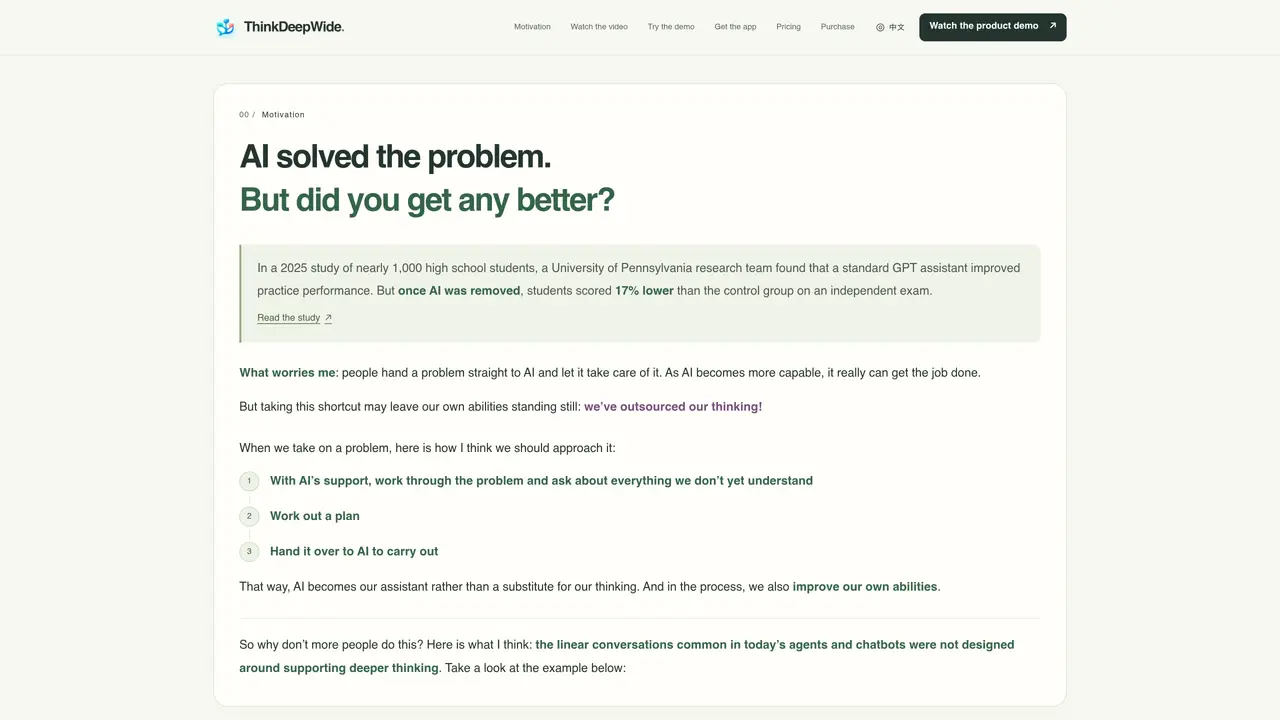
ThinkDeepWide is an AI agent designed to support structured, multi-threaded problem-solving rather than linear chatbot interactions. It organizes conversations as a tree where each node represents a question or topic, allowing users to revisit and expand on earlier exchanges without losing context. The tool enables parallel branching, so users can ask follow-up questions while AI is still processing a response, and optimizes context reuse to reduce redundant processing and token costs. It supports local file interaction, code execution, web searches, and remote server connections via SSH, integrating with existing workflows through Skills and MCP. Users can manage projects, delegate tasks, and inspect changes made by the agent, with decisions requiring user confirmation when necessary. The interface emphasizes returning to prior discussions to refine understanding before moving forward.
Key features
- Tree-structured conversation interface
- Parallel branching for simultaneous questions
- Context-cache optimization to reduce token costs
- Local file reading and editing
- Code execution and experiment running
- Web search and source analysis
- Remote server connection via SSH
- Project-based task organization
Use cases
- Developing and refining complex problem-solving approaches through iterative questioning
- Collaborative research or study sessions where multiple threads of inquiry are explored simultaneously
- Technical work involving code execution, file analysis, and remote server tasks with oversight
Pros
- Tree-structured conversations to revisit and expand on earlier exchanges
- Parallel branching allows asking follow-up questions while AI processes responses
- Optimized context-cache reuse reduces redundant processing and token costs
- Supports local file interaction, code execution, and remote server connections
- Integrates with existing workflows via Skills and MCP
Cons
- Currently macOS-only with Windows and Linux support limited or pending
- Requires manual confirmation for decisions, which may slow automated workflows
- No explicit mention of a free tier or pricing model on the homepage
ThinkDeepWide videos
Frequently asked questions about ThinkDeepWide
What is ThinkDeepWide and how is it different from a regular chatbot?
ThinkDeepWide is an AI agent designed for structured, multi-threaded problem-solving rather than linear chatbot interactions. It organizes conversations as a tree, allowing users to revisit and expand on earlier exchanges without losing context, and supports parallel branching for simultaneous exploration of multiple questions.
Who would benefit from using ThinkDeepWide?
The tool is designed for individuals or teams who need to work through complex problems methodically, such as researchers, students, developers, or professionals requiring deep understanding and iterative refinement of ideas with AI assistance.
How does ThinkDeepWide handle parallel questions and reduce costs?
Users can ask follow-up questions while AI is still processing a response, with different branches replying simultaneously. The tool optimizes context-cache reuse across branches to minimize redundant processing and token costs.
What integrations or workflows does ThinkDeepWide support?
It supports local file interaction, code execution, web searches, and remote server connections via SSH. Users can integrate existing workflows through Skills and MCP, and connect their own model accounts for personalized use.
Can ThinkDeepWide execute code or edit files?
Yes, it can read local files, edit code, run experiments, and save discussions as documents within projects. Users can inspect changes made by the agent and decide which modifications to keep.
How do I get started with ThinkDeepWide?
Users can download the application for macOS, connect their existing model accounts (e.g., Codex or Grok), and start a project locally or via SSH on a remote Linux host. Windows and Linux local support are noted as upcoming or SSH-only, respectively.