AI assistant for safe, reliable productivity with code, collaboration, and integrations.

Tomok
0Popularity
About Tomok
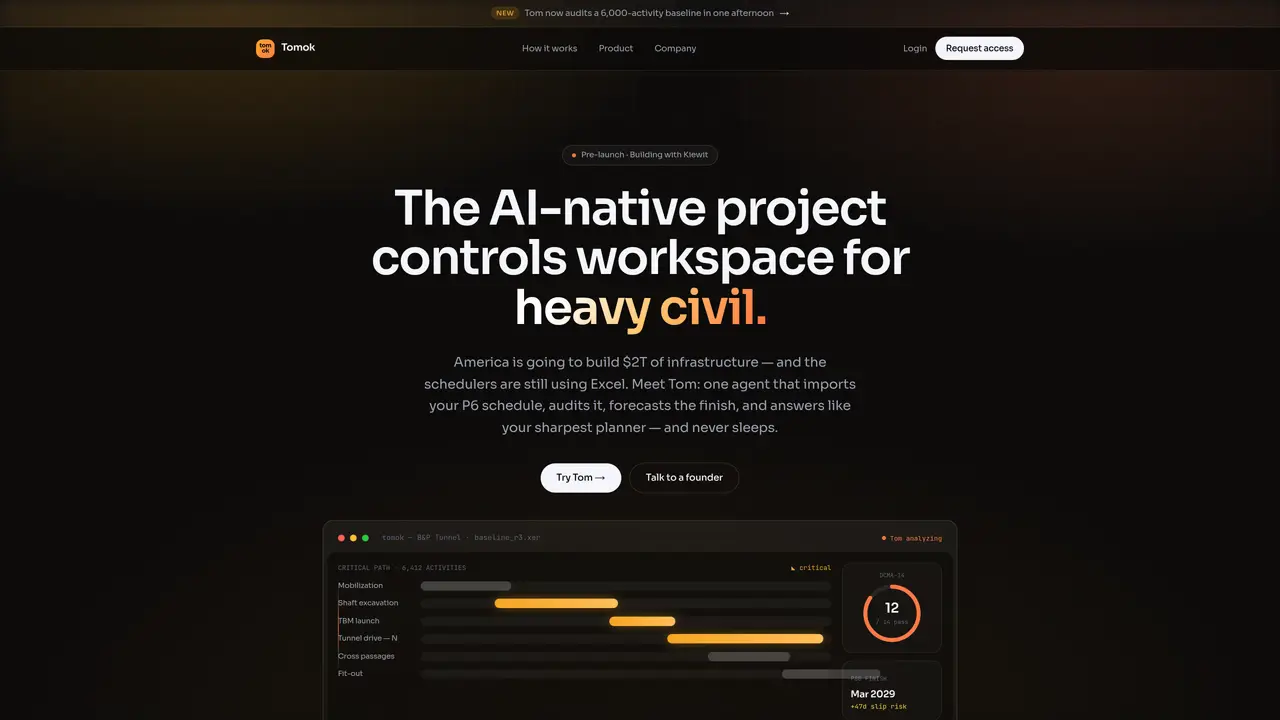
Tomok is an AI-native project controls workspace designed for heavy civil construction projects. It imports schedules from Primavera P6, Microsoft Project, or Asta Powerproject and audits them against DCMA-14 standards in seconds. The tool performs constraint-aware critical path method (CPM) analysis, simulating thousands of sequences to identify risks that manual planners might overlook. Users can query the system in plain English to receive defensible finish dates, slip probabilities, and delay narratives with traceable data links. Tomok also supports probabilistic forecasting using P50 and P80 confidence intervals, incorporating historical data for accuracy. Site verification features convert 360-degree site captures into observed progress metrics, aligning schedules with actual field conditions. The platform is built for schedulers managing large-scale infrastructure projects such as highways, bridges, tunnels, and rail systems.
Key features
- Schedule import from Primavera P6, Microsoft Project, Asta Powerproject
- Live DCMA-14 compliance auditing
- Constraint-aware critical path method (CPM) analysis
- Monte Carlo risk simulation with P50/P80 forecasting
- 360-degree site verification for progress tracking
- Plain-English query interface for schedule insights
- Defensible delay narratives with traceable data links
- Probabilistic finish date calculations from historicals
Use cases
- Auditing large infrastructure schedules for compliance and risk
- Generating probabilistic forecasts for megaproject timelines
- Converting site capture data into schedule progress updates
Pros
- Imports and parses schedules from P6, MSP, and Asta without remapping
- Runs full DCMA-14 audits in under 30 seconds
- Generates constraint-aware CPM sequences and probabilistic forecasts
- Converts site capture data into observed progress metrics
- Supports plain-English queries with traceable, defensible outputs
Cons
- Requires schedule files in specific formats (XER, XML, Asta)
- Currently in pre-launch phase with limited public access
- Focused exclusively on heavy civil project types
Frequently asked questions about Tomok
What is Tomok and what does it do?
Tomok is an AI-native project controls workspace designed for heavy civil construction projects. It imports schedules from tools like Primavera P6, Microsoft Project, or Asta Powerproject, audits them against DCMA-14 standards, and performs constraint-aware critical path method (CPM) analysis to identify risks and provide defensible forecasts.
Who is Tomok designed for?
Tomok is built for schedulers and project controls professionals managing large-scale infrastructure projects such as highways, bridges, tunnels, rail systems, and transmission lines. It is particularly suited for heads of schedule overseeing complex, high-stakes projects.
How does Tomok integrate with existing project management tools?
Tomok directly imports schedules from Primavera P6 (XER files), Microsoft Project (XML files), and Asta Powerproject without requiring remapping or cleanup. It also supports DCMA-14 audits, IIJA reporting, and SCC codes as part of its workflow.
What kind of analysis does Tomok perform on schedules?
Tomok runs DCMA-14 schedule quality audits, performs constraint-aware CPM analysis by simulating thousands of sequences, and provides probabilistic forecasting using P50 and P80 confidence intervals. It also converts 360-degree site captures into observed progress metrics for alignment with field conditions.
Can Tomok help with delay claims and risk assessment?
Yes, Tomok generates defensible delay narratives with traceable data links, slip probabilities, and the dollar cost of delays. It identifies risks that manual planners might overlook and provides actionable insights for risk management.
How do I get started with Tomok?
To get started, users can request access or contact Tomok directly to onboard as an early design partner. The process involves importing a real schedule to surface risks that traditional methods might miss, serving as a demonstration of the tool's capabilities.