AI assistant for safe, reliable productivity with code, collaboration, and integrations.

VoipMemory
$9/moStarting price
0Popularity
About VoipMemory
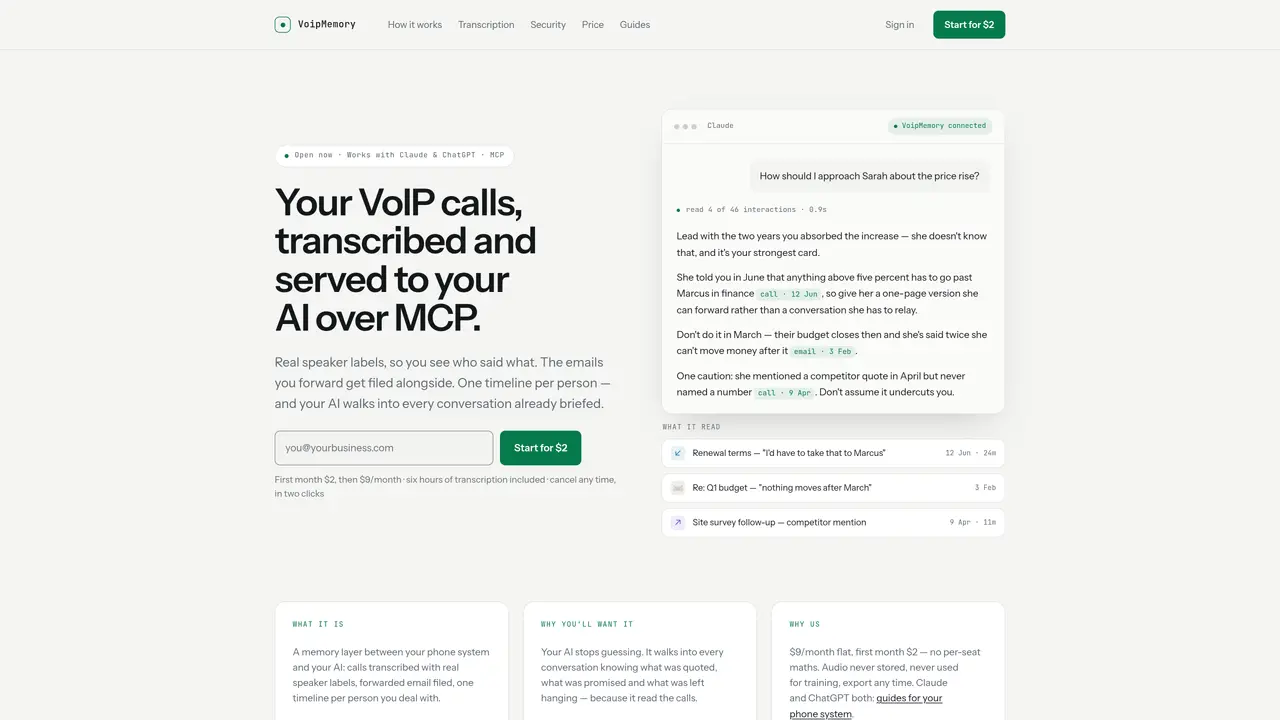
VoipMemory acts as a memory layer between a VoIP phone system and an AI assistant. It transcribes calls with real speaker labels and automatically files forwarded emails, creating a single timeline per contact. The service integrates with Claude and ChatGPT through an MCP endpoint, allowing the AI to access call transcripts, emails, and notes without requiring new habits from the user. Transcription can be handled via built-in credits, a user-provided API key, or an on-device Mac app that processes audio locally. The platform emphasizes security by never storing audio, prohibiting training use, and restricting support access to metadata only. Transcripts are exportable and deletable on demand, with encryption at rest and per-account isolation. The service charges a flat monthly fee per user with no per-seat pricing, including six hours of transcription credits initially.
Key features
- Call transcription with real speaker labels
- Automatic email filing via dedicated address
- MCP endpoint for AI integration
- Six hours of included transcription credits
- Support for user-provided transcription API keys
- On-device Mac transcription without cloud processing
- Playbooks for call preparation and audits
- Flat $9/month pricing per user
Use cases
- Preparing for client conversations with full historical context
- Auditing past commitments and promises across calls and emails
- Tracking relationship health by monitoring call frequency patterns
Pros
- Flat monthly pricing with no per-seat calculations
- Real-time speaker labels in call transcripts
- MCP integration for direct AI access to call data
- No audio storage or use for model training
- Export and deletion of all data available on demand
Cons
- Limited to RingCentral initially, with other systems in development
- On-device Mac app lacks speaker labels
- Requires paid transcription API key after initial credits
- No free tier beyond initial trial
Frequently asked questions about VoipMemory
What phone systems does VoipMemory support?
VoipMemory currently integrates with RingCentral and supports Vonage, GoTo, Zoom Phone, 8x8, Dialpad, and Nextiva through audited builds. Additional systems are added based on user demand.
How does VoipMemory handle transcription pricing?
VoipMemory includes three hours of transcription credits in the monthly fee. After that, users can bring their own transcription API key (e.g., Deepgram, AssemblyAI, or OpenAI) and pay the vendor directly.
Can VoipMemory be used with on-device transcription?
Yes, VoipMemory offers an on-device Mac app that transcribes audio locally without sending it to servers, though it does not provide speaker labels and requires the Mac to be awake.
Is VoipMemory secure for sensitive business calls?
VoipMemory emphasizes security by never storing audio, prohibiting training use, and restricting support access to metadata only. Transcripts are encrypted at rest and can be exported or deleted on demand.
How do I get started with VoipMemory?
Sign up with an email and password, then connect your phone system (e.g., RingCentral) via a two-click grant screen. You’ll receive an email address to forward or BCC relevant emails, and your AI can access the timeline via an MCP endpoint.
Does VoipMemory require new habits or apps to use?
No, VoipMemory works with existing call recording and email forwarding habits. It automatically files emails and transcribes calls without requiring users to adopt new tools or workflows.