

Open-source control plane for orchestrating multiple coding agents
703K visits/mo+93.9%#52 Automation & Agents
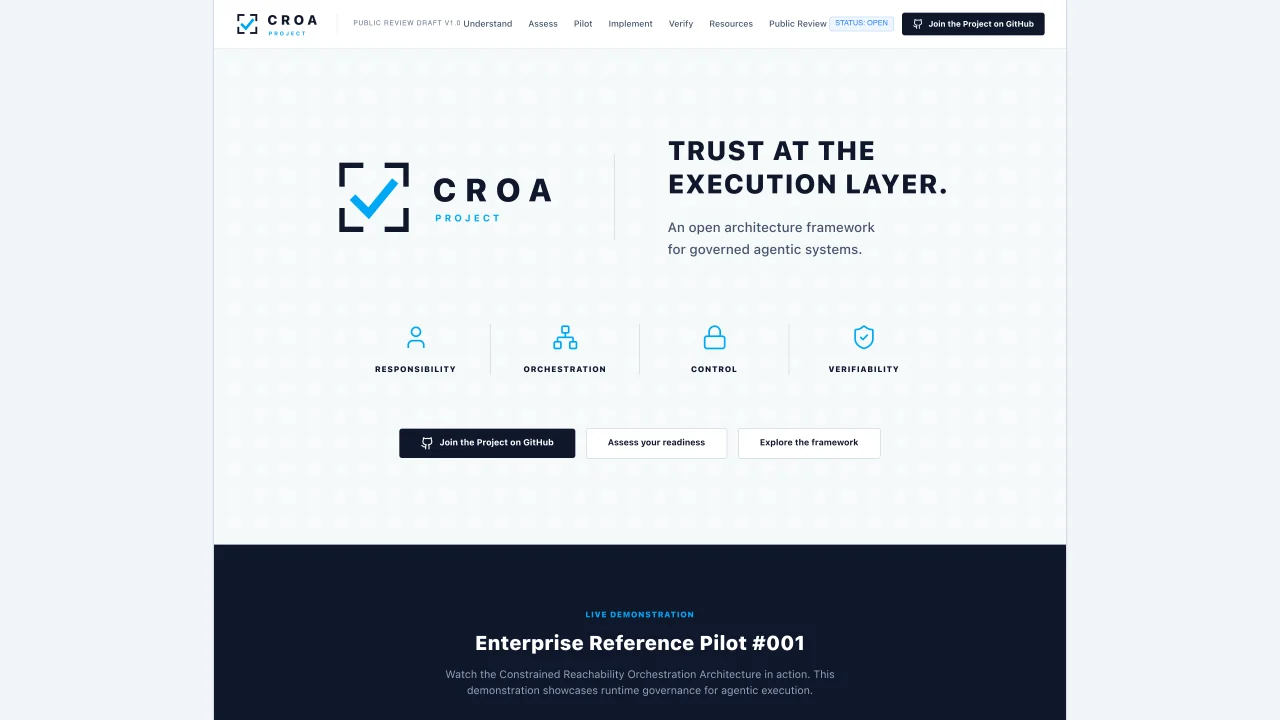
CROA is an open architecture framework designed to govern agentic AI systems at the execution layer. It shifts governance from model-level alignment to structural enforcement, making governed execution deterministic, enforceable, and auditable. The framework introduces a seven-component architecture that mediates all agentic execution, including components for policy authority, execution governor, invariant monitor, audit store, path resolver, contract compiler, and execution firewall. CROA defines six formal properties that must be validated independently, such as complete execution mediation, authority non-expansion, and trajectory constraint preservation. The architecture aims to address risks like execution ambiguity and technical sycophancy by ensuring unauthorized actions are structurally unreachable regardless of agent intent. It supports a conformance ladder from unconstrained execution to provable invariance, with only L4+ systems considered CROA-conformant. The framework is open for testing and invites validation by security researchers and architects.
CROA Project provides an open architecture framework for governing agentic AI systems at the execution layer, shifting governance from model-level alignment to structural enforcement.
CROA Project is designed for security researchers, architects, and developers working with agentic AI systems who require deterministic, enforceable, and auditable execution governance.
CROA Project introduces a seven-component architecture that mediates all agentic execution, including policy authority, execution governor, invariant monitor, and audit store, among others.
The framework includes components such as policy authority, execution governor, invariant monitor, audit store, path resolver, contract compiler, and execution firewall.
CROA Project defines six formal properties, including complete execution mediation, authority non-expansion, and trajectory constraint preservation, which must be validated independently.
The framework is open for testing and invites validation by security researchers and architects; users can explore its components and conformance ladder to assess applicability.
We use essential cookies to run aitoolnavio™, and optional cookies to analyze traffic and measure our marketing. You choose what we use — optional cookies stay off unless you turn them on. See our Privacy Policy.
One short email a week: fresh tools worth trying, honest takes and the updates that actually matter. No spam, unsubscribe any time.
Open-source control plane for orchestrating multiple coding agents
Open-source agent orchestration platform for managing teams of AI agents with org charts, goals, and governance in a self-hosted deployment.
Build teams of AI agents that collaborate, automate workflows, and complete complex tasks together.
Design, automate, and orchestrate complex workflows across systems with Camunda's AI-enabled process orchestration platform.
Orkes is a modern workflow orchestration platform designed to enhance how developers create, connect, and deploy applications across various environments.
Buda AI, a cloud-native workspace where AI agents collaborate to execute tasks and run companies 24/7.
A protocol for tokenized AI agents that autonomously generate services, products, and trade onchain with humans or other agents.
Open-source tool to orchestrate multi-agent workflows that decompose complex tasks into parallel sub-agents with sandboxed execution and persistent memory.
Open meta-harness for composing, sandboxing, and collaborating on AI agent sessions across multiple platforms.
A reasoning-focused AI agent that plans, executes, and self-improves complex multi-step workflows with auditability and verification.
A Tool OS for AI agents that discovers, routes, and executes third-party services via a single OpenAI-SDK-compatible API.
Declarative runtime for running agentic tasks at scale with sandboxing and state management
Matched on what this tool does — grouped by the job you would be replacing.
matches Execution mediation for all agentic actions · Deterministic policy evaluation using Rego or Cedar · Cryptographic execution contracts with temporal bounds
Enterprise governance layer for AI agents with runtime enforcement and audit trails
Pre-execution governance layer that verifies AI-agent actions before payment rails are triggered
Governance layer that checks identity, authority and policy before autonomous systems execute consequential
Runtime authority and audit layer for AI agents that spend money
matches Execution mediation for all agentic actions · Audit store for reconstructing authorization decisions · Invariant monitoring for policy adherence
AI governance and compliance platform for controlling and auditing AI agent actions
Runtime enforcement layer for governing AI agents and generating compliance proofs
Audit-grade evidence layer for AI that enforces policy, meters costs, and signs tamper-evident receipts in
A security layer that enforces policies and audits actions for AI agents accessing real-world tools.