
Unify customer data, automate workflows, and scale experiences with Einstein AI, Copilot, and Data Cloud in one CRM platform.

SelfCmd
0Popularity
About SelfCmd
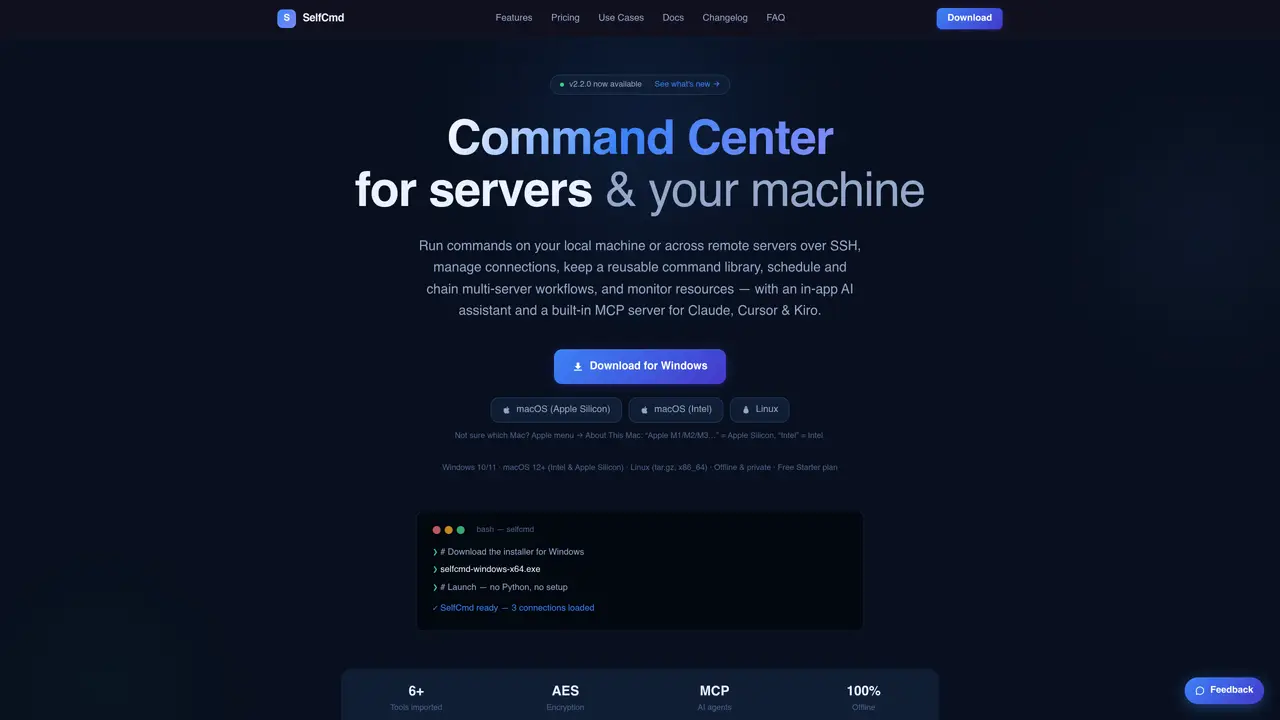
SelfCmd provides a unified interface for managing servers and local machines through SSH. It allows users to organize connections with groups and tags, import sessions from other SSH clients, and connect through bastion hosts. The tool includes an interactive terminal and built-in SFTP explorer for file transfers. Commands can be saved in a reusable library with syntax highlighting and variable support, and workflows can be created to chain multi-server tasks with retry logic and live progress tracking. Scheduled tasks can run commands periodically or one-time with result checks and output logging. A resource monitor tracks CPU, memory, disk, network, and SSD health against user-defined thresholds with alerting options. An in-app AI assistant translates plain-language intent into commands with one-click failure diagnosis, and a built-in MCP server integrates with external AI agents like Claude and Cursor. All data remains on the user’s machine with AES-encrypted credentials and optional offline licensing.
Key features
- SSH connection manager with groups, tags, and import from other clients
- Interactive terminal and SFTP explorer for file transfers
- Command library with variables and syntax highlighting
- Workflow engine for multi-server task chaining
- Scheduled tasks with periodic and one-time execution
- Resource monitoring for CPU, memory, disk, network, and SSD health
- In-app AI assistant for command generation and failure diagnosis
- Built-in MCP server for integration with AI agents like Claude and Cursor
Use cases
- Managing multiple remote servers from a single interface
- Automating multi-step deployment or maintenance workflows
- Monitoring server resource usage and setting up alerts
Pros
- Supports SSH management with jump-host (bastion) connections
- Includes built-in SFTP explorer and file transfer tools
- Command library with variables, syntax highlighting, and usage-based ranking
- Workflow engine for chaining commands and SFTP transfers with retry logic
- Resource monitoring with threshold-based alerts and trend visualization
Cons
- No web-based interface; desktop application only
- Limited to offline operation with no cloud sync
- Multi-language UI restricted to English and Simplified Chinese
Frequently asked questions about SelfCmd
What is SelfCmd and what does it do?
SelfCmd is a unified command center for managing local machines and remote servers over SSH. It provides tools for organizing connections, running commands, transferring files, scheduling tasks, monitoring resources, and using an in-app AI assistant to translate plain-language intent into commands.
Who is SelfCmd designed for?
SelfCmd is designed for system administrators, DevOps engineers, developers, and IT professionals who need to manage multiple servers, automate workflows, and monitor system resources efficiently from a single interface.
Does SelfCmd support integrations with other AI tools?
Yes, SelfCmd includes a built-in Model Context Protocol (MCP) server that allows external AI agents like Claude and Cursor to interact with its commands, tasks, and workflows, enabling automated assistance while maintaining offline privacy.
Can I import existing SSH connections into SelfCmd?
Yes, SelfCmd allows importing SSH sessions from tools like Xshell, MobaXterm, FinalShell, SecureCRT, PuTTY, and from the ~/.ssh/config file, making it easy to migrate existing setups.
How does the resource monitoring feature work in SelfCmd?
The resource monitor tracks metrics such as CPU, memory, disk usage, network bandwidth, and SSD health against user-defined thresholds. It provides alerts, trend views, and exportable logs without requiring external services.
Is SelfCmd secure and private?
Yes, all data including credentials and logs remain on the user’s machine. Passwords are AES-encrypted at rest, and the app operates fully offline with no telemetry or external data transmission.